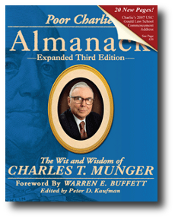
Poor Charlie’s Almanack is not a normal how-to-invest book. It is more like a notebook full of Charlie Munger’s best thinking. Munger, the longtime vice-chairman of Berkshire Hathaway, used short talks, stories, and jokes to show how clear thinking can help people make better choices with money and with life. The book was first published in 2005 and later expanded and republished in a new edition by Stripe Press. [1][2][3]
At its heart, this book says something very simple: the goal is not to sound smart. The goal is to think clearly, stay calm, and avoid big mistakes. That is why investors, business owners, and curious readers keep coming back to it.
Book facts
| Author / editor | Charles T. Munger, edited by Peter D. Kaufman |
|---|---|
| First published | 2005 |
| Topic | Investing, decision-making, business thinking, and practical wisdom |
| Format | A collection of talks and essays, not a straight-line textbook [2][3] |
| Core idea | Build a latticework of mental models so you can see problems from more than one angle. [2][3] |
What the book is about
Munger believed that good judgment comes from using many different subjects together. He drew ideas from business, psychology, physics, history, biology, and ethics. He did not think one school subject was enough. He wanted a web of ideas, because real life does not come in neat little boxes.
The book collects some of his best talks, so you hear his voice directly. He is blunt, funny, and practical. He keeps returning to one message: if you want better results, train your mind to notice patterns, contradictions, and traps before they catch you.
Main ideas explained simply
Mental models
A mental model is a simple thinking tool. It is like a pair of glasses that helps you understand a problem. Munger says the more good models you have, the better your thinking can become.
Latticework
A latticework is a connected web. Munger used this word to describe how ideas from many subjects can fit together. One idea helps explain another.
Circle of competence
This means the small area you really understand. If you stay inside that circle, you are less likely to fool yourself. If you leave it, you should be extra careful.
Inversion
Inversion means asking the question backward: instead of “How do I win?”, ask “What would make me fail?” That can reveal hidden risks much faster.
Steps to apply the book
- Start with the problem. Before you buy an investment or start a project, ask what could go wrong.
- Stay inside your circle of competence. If you do not understand the business, the product, or the risk, slow down.
- Use more than one model. Think about numbers, human behavior, incentives, and long-term effects together.
- Wait for better odds. Do not force action just because you feel bored or left behind.
- Avoid dumb mistakes. Munger often taught that not losing money badly is a big advantage in itself.
What the book gets right
- Judgment matters. Good results often come from avoiding bad decisions, not from chasing big wins.
- Thinking across subjects is powerful. Problems in money are often also problems in psychology, incentives, and patience.
- Humility helps. If you think you know everything, you stop learning.
- Patience is a real skill. The ability to wait can be worth more than clever talk.
What to be careful about
This book is full of wisdom, but it is not a simple checklist for beginners. Some lessons are scattered across talks, so readers have to connect the dots themselves. Also, Munger’s style can be so memorable that people copy the phrases without learning the deeper idea. That is a mistake.
The best way to read the book is slowly. Do not treat it like a list of magic quotes. Treat it like a conversation with a very sharp thinker who wants you to slow down, notice more, and think before you act.
Bottom line
Poor Charlie’s Almanack is a book about how to think, not just how to invest. It teaches that the best investors are usually the ones who keep learning, stay humble, and avoid the silly errors that ruin good returns. If you want a book that can sharpen your judgment, this one is a strong choice. [1][2][3][4]