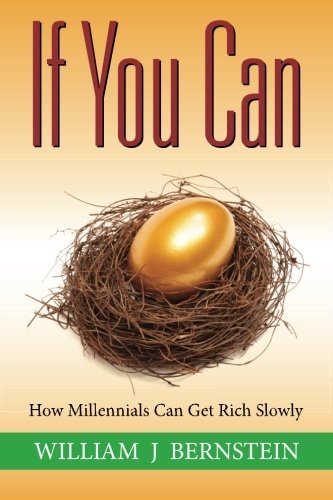
If You Can: How Millennials Can Get Rich Slowly is a tiny booklet, but it has a big message: if you save early, keep costs low, and ignore noise, your money can grow over time. William J. Bernstein wrote it for young adults who are starting out and want a clear path to retirement saving. [1][2][3]
The whole book can be summed up like this: save first, keep learning, and do not let the money industry trick you.
Book facts
| Author | William J. Bernstein |
|---|---|
| First published | 2014 |
| Length | About 48 pages in the paperback edition [4] |
| Publisher | Efficient Frontier Publications |
| Main topic | How a young worker can build a simple retirement plan with saving, index funds, and patience. [1][3][4] |
What the book is about
Bernstein says many people get money advice that sounds fancy but does not help. He keeps the message plain. A young person does not need to predict the market or find secret winners. The real job is to save a good chunk of income, invest it in a sensible mix of low-cost funds, and let time do the heavy lifting.
The booklet also warns that investing is simple, but not easy. That means the steps are easy to describe, yet hard to stick with when life gets busy, the market gets scary, or friends start chasing hot ideas.
Main ideas, explained simply
Save about 15%
Bernstein says a young worker should try to save a meaningful slice of income, not just the leftover crumbs. The point is to make saving a habit early.
Use index funds
An index fund is a basket that copies a whole market, like the whole U.S. stock market. Instead of betting on one company, you own a little piece of many companies at once.
Split money across stocks and bonds
Stocks are ownership pieces of companies. Bonds are loans you make to governments or companies. Stocks can grow more, but they bounce around more. Bonds usually move more slowly and can steady the ride.
Rebalance once in a while
Rebalancing means putting your mix back where you want it. If stocks grow too much, you sell some and buy more of the parts that fell behind. It is like trimming a plant so it keeps its shape.
Learn enough finance to stay safe
Bernstein thinks financial knowledge matters because bad products are often sold with big smiles and fancy words. Knowing the basics helps you avoid paying too much.
Ignore the noise
The market is full of drama, predictions, and confident voices. The booklet says most of that noise is not useful for a normal saver.
Five big traps the book warns about
- Not saving enough — if money never gets set aside, there is nothing to invest.
- Not understanding finance — basic terms like fees, risk, and diversification matter.
- Forgetting history — markets have booms and crashes, and people keep repeating the same mistakes.
- Letting feelings take over — fear and greed can push people to buy high and sell low.
- Trusting the industry too much — some money products are built to help the seller more than the buyer.
What it gets right
The booklet is strong because it does not confuse readers with too much detail. It gives a simple roadmap that many people can actually follow. It also reminds us that a good money plan is not about being brilliant. It is about being steady.
Another strength is its honesty. Bernstein does not promise a quick win. He says the path is boring, repetitive, and worth it. That is probably why the booklet still helps new investors.
What to be careful about
The advice is aimed mostly at young people with a long time before retirement. If you are older, self-employed, in debt, or living with high costs, your starting point may be different. The booklet also keeps things very simple, so readers may still need more help with taxes, account choices, and real-life budgets.
So the safest way to read it is to treat it as a first map, not the whole trip.
Kid-simple version: do the easy good thing early, and do it again for a long time.
Bottom line
If You Can is short, clear, and useful. It tells young savers to start now, keep costs low, and stay patient. If you want one tiny book that explains the basics of building wealth without fuss, this is a good one.