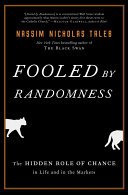
Fooled by Randomness is a book about a simple but powerful idea: good results do not always mean good judgment. Nassim Nicholas Taleb shows how luck, risk, and hidden patterns can trick people into praising the wrong winner and copying the wrong strategy. The book is especially useful for investors because markets are full of stories that look smart after the fact, even when chance did most of the work. [1][2][3]
In plain words, the book says: do not confuse a lucky streak with real skill.
Book facts
| Author | Nassim Nicholas Taleb |
|---|---|
| First published | 2001 |
| Updated edition | 2005 and later printings |
| Publisher | Random House / Penguin Random House |
| Length | About 368 pages in later editions |
| Main topics | Luck, probability, risk, investing, survivorship bias, and decision-making. [1][2][4] |
What the book is about
Taleb writes from the point of view of a trader who has seen how often people mistake noise for meaning. He argues that the world is messy and that outcomes are often shaped by chance in ways we do not notice. A person can make a bad decision and still win by luck. Another person can make a careful decision and still lose because the market or life turned against them.
The book is not a step-by-step investing manual. It is more like a warning sign. It tells readers to slow down, question tidy stories, and remember that the future is not a copy of the past.
Main ideas
- Luck and skill are mixed together. When you see a winner, you cannot instantly tell how much was talent and how much was luck.
- Survivorship bias can fool you. We notice the people who made it and forget the many who tried the same thing and failed.
- Randomness can look like a pattern. Humans naturally search for meaning, even when the result may be mostly noise.
- Big gains can hide big risks. A strategy that wins many small times can still blow up once in a while.
- Past success is not a promise. Just because something worked before does not mean it will work again.
Simple explanations of key terms
Randomness
Randomness means results are partly controlled by chance. Think of rolling dice. You can make a good guess, but you cannot control every outcome.
Probability
Probability is the chance that something will happen. If a coin is fair, heads has about a 50% chance. In real life, many things are much harder to measure than a coin toss.
Survivorship bias
This is when we only look at the people who survived or succeeded. It is like studying only the trees that are still standing after a storm and forgetting the ones that fell.
Skewed payoff
A skewed payoff means the wins and losses are uneven. You may win small amounts many times, then lose a huge amount once. That can make a strategy look safe when it is not.
What it gets right
- It teaches healthy doubt. That is useful in markets, where story-telling is often louder than facts.
- It explains why people should judge decisions, not just results.
- It gives investors a stronger fear of hidden risk, which can prevent careless bets.
- It pushes readers to think in probabilities instead of certainty.
What to be careful about
- The style can feel sharp, funny, and a little combative. Some readers will love that, and others will not.
- The book is more philosophical than practical. If you want a clean investing plan, you may need another book too.
- Taleb sometimes pushes his point hard. The lesson is strong, but readers should still compare it with other investing ideas.
- Not every outcome is random. Skill matters too. The real trick is learning how much weight to give each one.
Bottom line
Fooled by Randomness is a sharp reminder that money success is not always a sign of genius. It helps readers see how luck, noise, and hidden risk can shape investing results. If you want to make better money decisions, the book’s main lesson is simple: stay humble, question easy stories, and keep room for the fact that the world can surprise you. [1][2][3][4]
Sources
- [1] Penguin Random House — Fooled by Randomness product page: https://www.penguinrandomhouse.com/books/176225/fooled-by-randomness-by-nassim-nicholas-taleb/
- [2] Google Books — Fooled by Randomness: https://books.google.com/books/about/Fooled_by_Randomness.html?id=DCqFYOrGyegC
- [3] Goodreads — Fooled by Randomness: https://www.goodreads.com/book/show/38315.Fooled_by_Randomness
- [4] Wikipedia — Fooled by Randomness: https://en.wikipedia.org/wiki/Fooled_by_Randomness