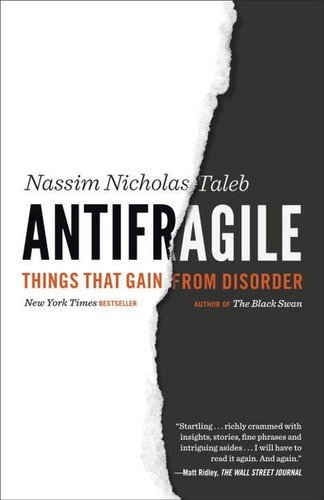
Antifragile is a book about what happens when life gets messy. Nassim Nicholas Taleb says some things do not just survive stress — they get better because of it. That idea sounds strange at first, but the book uses many examples to show why some people, businesses, and systems grow stronger when they face disorder, while others break under pressure. [1][2][3]
In plain words: fragile things break when shaken, resilient things stay the same, and antifragile things improve.
Book facts
| Author | Nassim Nicholas Taleb |
|---|---|
| First published | 2012 |
| Publisher | Random House / Penguin |
| Pages | About 519 to 544 pages depending on the edition [1][2][3] |
| Main idea | Build people and systems that can benefit from stress, uncertainty, and change instead of being ruined by them. [1][2] |
What the book is about
Taleb argues that the world is full of surprises. Markets jump around. Life plans break. Governments make mistakes. Medical advice changes. Because of that, we should not only ask, “How do I survive?” We should also ask, “How can I become better when things go wrong?”
The book builds on ideas from The Black Swan. If The Black Swan says rare shocks matter a lot, Antifragile says the best answer is not to pretend shocks will disappear. The better answer is to build in a way that can handle shocks and sometimes use them.
Main ideas, explained simply
Resilient vs. antifragile
Resilient means something can take a hit and keep going. Antifragile means it can use the hit to get stronger. A muscle that grows after exercise is Taleb’s favorite kind of example.
Volatility
Volatility means ups and downs. In money, it often means prices move a lot. Taleb says those swings are not always bad. Sometimes they are the very thing that helps the best systems learn and adapt.
Small bets and upside
The book likes strategies where the downside is limited but the upside can be big. A small bet is safer than a huge one because one mistake cannot wipe out everything.
Skin in the game
This means the person giving advice should also feel the pain if the advice is bad. If someone can make money while other people take the loss, that setup can become unfair and fragile.
Via negativa
This is a fancy way to say “improve by removing bad things.” Instead of always adding more stuff, sometimes it helps more to cut the junk, debt, noise, or overcomplicated plans.
Optionality
Optionality means keeping choices open. If you do not trap yourself in one path, you can adapt when the world changes. That can be very powerful in business and investing.
What it gets right
- Life is uncertain. The book is right that you cannot plan for every surprise.
- Small mistakes matter less than one giant mistake. Avoiding ruin is a huge advantage.
- Simple setups can beat fancy ones. Fewer moving parts often means fewer things can go wrong.
- Debt can make you fragile. Big fixed payments can turn a bad month into a disaster.
- Learning from feedback helps. Trial and error often works better than pretending you already know the answer.
What to be careful about
Taleb writes with a strong voice, and that can make the book exciting. It can also make some claims feel bigger than the evidence. Not every system can really become antifragile, and not every shock is helpful. Sometimes stress is just damage.
The book is best used as a lens, not a magic rule. It can help you ask better questions about debt, risk, health, and investing. But it should not be used to excuse reckless behavior or to pretend all hardship is good.
Simple money lesson from the book
If you are thinking about money, the safest takeaway is this: do not build a life that falls apart when one thing goes wrong. Keep debts low, keep some cash or flexibility, spread your risks, and leave yourself room to adapt. In other words, try to make your money life harder to break.
Bottom line
Antifragile is a sharp, original book about risk and uncertainty. Its big idea is that the goal is not only to survive chaos, but to use it to improve. Even if you do not agree with every claim, the book can change how you think about debt, work, investing, and the way you build your life.