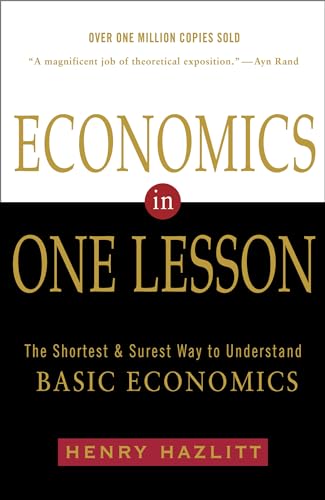
Economics in One Lesson by Henry Hazlitt is a short, clear introduction to the way economic choices work. Hazlitt’s main message is simple: do not judge a policy only by what you can see today. Look at what it does later, what it prevents, and how it affects everyone—not only the group that receives the first benefit.
What the book is about
Hazlitt wrote the book in 1946, and the current Crown Currency edition describes it as a guide to the basic ideas of economics. He explains common mistakes through everyday examples: a broken shop window, a new machine in a factory, tariffs on imported goods, rent controls, inflation, and government spending.
The book is not a neutral tour of every school of economic thought. Hazlitt strongly favors markets and is skeptical of many government interventions. That viewpoint is important to understand. Still, his central reasoning tool is useful far beyond one political side: trace the full chain of effects.
The one lesson
Hazlitt’s “one lesson” can be put in ordinary words: look beyond the first result. Ask three questions:
- What happens right away?
- What happens after people adjust?
- Who gains, who pays, and what opportunities disappear?
A policy may help one visible group while quietly raising costs for many other people. The first group is easy to notice because its benefit is concentrated. The cost may be spread across millions of shoppers or taxpayers, so it is harder to see.
Main ideas
Seen and unseen effects
Suppose a baker’s window is broken. A glazier earns money replacing it, which is the visible effect. But the baker now cannot spend that money on something else, such as a coat. The glazier gains work, but the tailor loses work. Society has a new window, but it has not gained a new window plus a coat. The broken window moved spending; it did not create extra wealth.
Short-term help can have a long-term cost
Hazlitt repeatedly warns against judging a policy by its first month or first year. A subsidy, tax, price rule, or spending program may bring quick relief. Later, it may change prices, reduce supply, discourage investment, or create a bill that someone else must pay.
Production matters
Money is not the same as wealth. Wealth means useful goods and services that improve people’s lives. Printing more money can make the numbers in bank accounts larger, but it does not automatically create more food, homes, medicine, or skilled work. If money grows faster than the things people want to buy, prices may rise.
Prices carry messages
A price is more than a number on a shelf. It tells buyers how scarce something is and tells sellers whether producing more might be worthwhile. When a rule holds a price below the level that balances buyers and sellers, demand can rise while supply falls. The result may be shortages, queues, lower quality, or unofficial markets.
Simple explanations of key terms
- Opportunity cost: what you give up when you choose one option. If a city spends money on a stadium, it cannot spend that same money on a school or road.
- Incentive: a reason that pushes someone to act. A higher price can encourage producers to make more of a scarce product.
- Inflation: a broad rise in prices that reduces what each unit of money can buy.
- Tariff: a tax placed on imported goods. It may protect some domestic producers, but it can also make inputs and finished products more expensive.
- Subsidy: financial help from government to a person, company, or industry. The money must come from taxes, borrowing, or reduced spending elsewhere.
- Unseen effect: a result that is real but hidden because it happens later, elsewhere, or to people who are not part of the favored group.
Step by step: how to use the book’s method
- Name the proposed benefit. Write down exactly who is expected to gain and how.
- Find the payer. Ask who pays directly through taxes, prices, debt, or lost income.
- Follow the incentives. Predict how buyers, workers, landlords, businesses, and investors might change their behavior.
- Look for substitutes. If one choice becomes more expensive or difficult, what will people choose instead?
- Check the time horizon. Compare the immediate result with the likely result after several years.
- Count the opportunity cost. Identify what the same money, labor, land, or materials cannot now be used to do.
- Separate facts from opinions. Decide whether the disagreement is about what will happen or about which trade-off is worth accepting.
What it gets right
The book teaches a habit that is valuable in personal finance and investing too: do not stop at the headline. A high salary is not the same as high savings. A stock that rises today is not automatically a good business. A cheap loan is not cheap if it encourages a purchase you cannot afford. In every case, the full cost and the later effects matter.
Hazlitt is also good at showing why economic myths survive. A benefit that is easy to see and concentrated in one place can be politically powerful, while a small cost spread across many people may attract little attention.
What to be careful about
Hazlitt’s examples and conclusions reflect his strong free-market perspective. Modern economics also studies situations where markets fail, such as pollution, public goods, market power, or severe recessions. In those cases, simply saying “leave it to the market” may not answer every question.
Some historical claims and policy arguments in the book should be checked against newer data. The best way to read it is as a reasoning exercise, not as a complete modern economics course. Its central question remains useful even when reasonable people disagree about the answer.
Bottom line
Economics in One Lesson teaches readers to widen the frame. Before celebrating a policy, purchase, or investment, ask what happens next, who bears the cost, and what else could have been done. That simple habit helps people think more clearly about money, markets, and public choices.