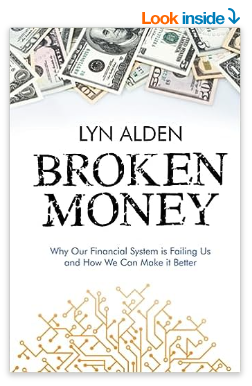
Broken Money by Lyn Alden is a wide-ranging book about how money has changed, why today’s financial system can feel weak, and what new technologies might change next. Published by Timestamp Press in 2023, it follows money from shells and metal coins to banks, electronic payments, and Bitcoin. [1][2][3]
What the book is about
Alden studies money through the lens of technology. Her question is simple: if technology keeps improving how we communicate and move information, why is money still slow, costly, and divided into many national systems?
The book looks at history and the human side of money. It asks who can use a payment system, who controls it, how quickly money can move, and what happens when savings lose buying power.
Key terms in plain language
Inflation
Prices rise and the same amount of money buys less.
Fiat money
Money accepted because a government declares it legal money, not because each note can be exchanged for gold.
Hard money
Money that is difficult to create in large amounts. Gold is one example.
Settlement
The final step when a payment is truly complete.
Main ideas
- Money is a technology. It measures value, enables trade, and helps people save.
- Systems have different strengths. Cash can work without electricity; digital payments can travel quickly. No system is perfect.
- Access matters. A network that works only for wealthy or well-connected people leaves others behind.
- Inflation is human. It changes wages, savings, rent, food prices, and planning.
- Bitcoin is an experiment in monetary technology. The book discusses its scarcity, reach, and limits, but readers should separate description from investment advice.
What the book gets right
Money is not invisible magic. It is a set of rules, records, networks, and institutions. Seeing those parts makes confusing events—bank failures, currency drops, payment delays, or rising prices—easier to understand.
The book also makes a human point: people born in countries with unstable currencies can face a much harder saving problem than people in countries with stable money.
What to be careful about
This is an ambitious book, and its arguments are not neutral. Alden is more favorable toward scarce monetary assets and Bitcoin than many economists or central bankers are. Compare her claims with other views and remember that a useful technology can still be risky as an investment.
Bitcoin prices can fall sharply, custody can be difficult, and no asset guarantees safety. Inflation also has many causes; blaming every price increase on one institution or policy can hide important details.
Kid-simple version: a new kind of money may solve one problem and create another. Look at both sides.
Bottom line
Broken Money is a tour of money’s plumbing: the pipes, rules, and machines underneath everyday payments. Its biggest lesson is that money is shaped by technology and power. Understanding that can help you think more clearly about inflation, banking, digital payments, and crypto—without treating any single answer as magic.