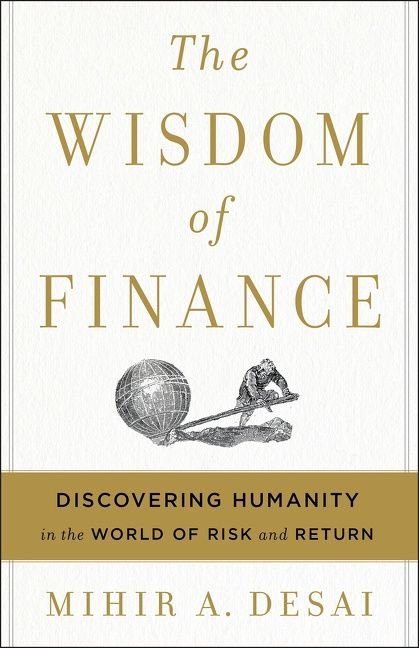
The Wisdom of Finance by Mihir Desai asks a human question about a technical subject: what can finance teach us about living well? Desai, a Harvard Business School professor, uses ideas from finance alongside stories from literature, film, history, and philosophy. The result is not a stock-picking manual. It is a guide to understanding risk, value, failure, debt, and the ways money connects people.
What the book is about
Finance can sound cold because it uses words such as risk, return, pricing, and capital. Desai shows that these ideas describe ordinary life too. We make choices with uncertain results, decide what is valuable, borrow from our future, and depend on other people’s promises. Looking at finance this way can make the subject easier to understand—and can also remind finance professionals that numbers affect real human beings.
The book moves through subjects including the good life, fortune, risk, value, production, finance and romance, dreams, failure, and why people often dislike the financial industry. Its core argument is that finance is not only about making money. Used responsibly, it helps people share risk, fund useful work, and plan for uncertain futures.
Main ideas
- Risk is part of life. We cannot remove all uncertainty. Insurance, diversification, and preparation help us live with risks we cannot predict perfectly.
- Value is more than a price. A price is the amount paid today. Value is a reasoned estimate of the benefit something may provide over time. The two can differ.
- Finance connects today with tomorrow. Saving, investing, and borrowing move resources through time. A loan lets someone use money now in exchange for promises about the future.
- People make finance work. Contracts and markets depend on trust, judgment, incentives, and institutions—not just equations.
- Failure can teach us. A bad result does not always prove that every decision was foolish, but it should make us examine our assumptions and process.
- Finance has a moral side. A transaction can be legal and still raise questions about fairness, responsibility, and who carries the risk.
Simple explanations of key terms
Risk
Risk is the possibility that the future result will be different from what we expect. Losing money is one kind of risk, but missing an opportunity or being unable to pay a bill can also be risky.
Return
Return is what you gain or lose from an investment. It can come from income, such as interest or dividends, and from a change in price.
Insurance
Insurance is a way for many people to share the cost of a bad event. Each person pays a premium, or fee. The insurer uses the pooled money to help the people who suffer a covered loss.
Asset pricing
Asset pricing means estimating what an investment should cost. The estimate depends on expected future cash, timing, uncertainty, and what other opportunities are available.
Capital
Capital means resources used to create more value. It can be money, equipment, buildings, skills, or ownership in a business.
Incentive
An incentive is something that encourages a person to act. A bonus can encourage sales, while a penalty can discourage late payment. Good incentives help people make sound choices; bad ones can reward harmful behavior.
What it gets right
The book’s strongest point is that finance is a human activity. A spreadsheet cannot decide what is fair, what risks are acceptable, or what a good life means. Those questions belong to people. Desai also makes difficult ideas less frightening by connecting them to familiar stories and choices.
For investors, the lesson is useful: do not confuse a precise calculation with certainty. Every valuation rests on assumptions about the future. A careful investor can use numbers while staying humble about what the numbers cannot know.
What to be careful about
The Wisdom of Finance is philosophical and explanatory, not a step-by-step personal-finance plan. It will not tell every reader how much to save, which fund to buy, or how to choose insurance. Those decisions depend on income, goals, taxes, time horizon, and personal risk.
Stories and analogies can illuminate an idea, but they are not proof. Before making a financial decision, check the actual fees, terms, risks, and evidence. A beautiful explanation should improve your questions, not replace careful research.
Bottom line
The Wisdom of Finance argues that money concepts become more useful when we connect them to human life. Risk is uncertainty we must prepare for. Value is a judgment, not just a number. Capital can support useful work, but financial power also creates responsibilities. The book’s lasting lesson is simple: understand the tools of finance, then remember the people who live with their results.