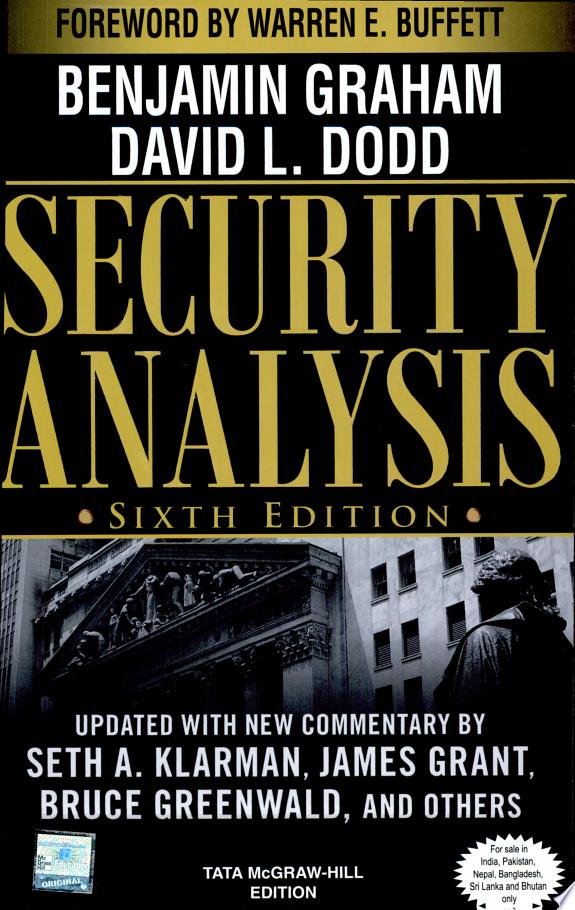
Security Analysis is one of the most important investing books ever written. It teaches a simple idea that still matters today: do not buy a stock just because the price is moving. First, try to understand what the business is really worth.
What the book is about
Benjamin Graham and David Dodd wrote this book to show readers how to study a company before putting money into it. The book is not about quick tips or hot stock picks. It is about slow, careful thinking. The main goal is to help investors separate price from value.
Price is what the market asks you to pay today. Value is what a business may truly be worth based on its assets, profits, debts, and future earning power. Those two things are often different. When the gap is large, an investor may find a real bargain.
Main ideas in simple words
- Buy with a margin of safety. That means leaving yourself a cushion. If your guess is wrong, the cushion helps protect you.
- Study the business, not just the stock chart. A stock chart shows price changes. A business analysis asks how the company makes money, what it owns, and how much debt it has.
- Do not confuse investing with guessing. Investing is careful and patient. Guessing is hoping the price goes up because you feel lucky.
- Look at facts, not hype. A loud story can be exciting, but numbers matter more.
- Think long term. Good investing is often boring. That is not a bug. It is a feature.
Simple explanations of key terms
Intrinsic value means the real worth of a business. Think of it like the actual value of a toy, not the price one excited kid shouts in the playground.
Margin of safety means buying only when the price is clearly below your estimate of value. It is like wearing a seat belt. You hope you never need it, but you are glad it is there if something goes wrong.
Speculation means taking a chance because you think the price will rise. That can work sometimes, but it is closer to a bet than to careful investing.
Asset value is the value of what a company owns. Earnings are the profits it makes. Debt is money it owes. Graham and Dodd push readers to study all three.
What the book gets right
The biggest strength of Security Analysis is its discipline. It tells investors not to be led around by excitement. That advice is still useful because markets still get emotional. People still chase stories. People still overpay.
The book also treats stocks like pieces of real businesses, not just lines on a screen. That is a powerful idea. If you would not buy a whole business without reading the books, why buy a small slice of one without doing the same work?
Another strong point is risk control. The book does not promise magic. It says the first job of an investor is to avoid big mistakes. That is a wise goal. You do not need every win. You need fewer disasters.
The book also helped shape value investing. Columbia Business School notes that Graham and Dodd developed this approach in the 1920s and wrote the classic text in 1934. That history matters because the book is not just old; it is foundational.
What to be careful about
This book is famous, but it is not easy. It is dense, and some parts feel like a textbook. Readers who want fast answers may find it slow.
It is also an old book. Markets today are faster, more global, and more technical than they were in 1934. Some tools and examples in the book come from a different era. That does not make the ideas useless. It just means you should apply the lessons with modern facts in mind.
Also, the book leans hard toward deep analysis. That can be great, but not every investor needs to pick individual stocks. Many people are better off using simple index funds and focusing on saving more money. The book is a guide for thinking, not a rule that every person must trade the same way.
Who should read it
This book is best for people who want to understand how serious investors think. It is especially useful for value investors, finance students, and anyone who wants to learn how to judge whether a stock is cheap for a good reason or cheap because the market is wrong.
If you are brand new to money, this is not the easiest first book. But if you already know the basics and want to go deeper, it is one of the most important books you can read.
Bottom line
Security Analysis teaches one big lesson: do not pay any price just because everyone else is excited. Learn what a business is worth, demand a cushion, and be patient. That simple habit can save investors from many painful mistakes.
The book is old, long, and sometimes hard, but the core ideas are still strong. If you want to learn the roots of value investing, this is a classic for a reason.
Sources
- Columbia Business School: Value Investing History
- Google Books: Security Analysis 6E
- McGraw Hill: Security Analysis, Seventh Edition
- Wikipedia: Security Analysis (book)
- Open Library: Security analysis
Related reading: For a fuller beginner roadmap, see Investing Basics.