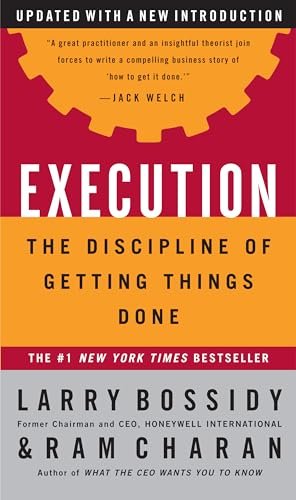
Execution: The Discipline of Getting Things Done by Larry Bossidy and Ram Charan is a compact book about a problem that becomes more important as responsibility grows: being busy is not the same as being effective. A full calendar, a clever idea, or a long list of completed tasks can still produce very little value if attention is pointed at the wrong work.
Bossidy and Charan’s central message is encouraging because it is practical. Effectiveness is not a personality trait reserved for naturally organized people. It is a set of habits that can be learned, practiced, and improved. For entrepreneurs, managers, and anyone building wealth, this matters: money tends to follow useful results, and useful results require deliberate choices about time, contribution, strengths, priorities, and decisions.
The book’s core idea: effectiveness is a practice
Bossidy and Charan writes for executives, but his definition reaches far beyond a corporate title. An executive is anyone whose knowledge and judgment are expected to make a meaningful contribution. That includes a founder deciding where to invest scarce cash, a freelancer choosing which clients to serve, and an employee whose recommendations influence a team.
Effectiveness means choosing work that matters and converting knowledge into results. Efficiency—doing a task with little waste—is useful, but it cannot rescue a task that should not have been done. A fast answer to the wrong question is still a poor answer. The effective person therefore asks what outcome is needed before asking how quickly a task can be completed.
Why this is a wealth lesson
Wealth building is often described in terms of income, saving, and investing. Those are important, but they depend on an earlier resource: focused human effort. If your best hours disappear into low-value meetings, reactive messages, or projects that do not advance a meaningful goal, you lose opportunities to earn, learn, create, and compound.
Bossidy and Charan’s framework helps turn productivity into an economic question. What work creates value? Which capabilities can produce an outsized result? Which commitments should be stopped? What decision would make the next six months better rather than merely making today feel active? These questions are useful whether your goal is a stronger business, a higher-value career, or more control over your time.
Practical lessons from Execution
1. Know where your time really goes
Memory is a poor time-tracking system. We remember important conversations and frustrating interruptions, but we often miss the small leaks that consume an entire week. Bossidy and Charan recommends recording time as it happens, then reviewing the record honestly.
Try this: For seven days, note what you do in blocks of 15 or 30 minutes. At the end of each day, label each block as value-creating, necessary maintenance, or avoidable. Do not use the exercise to criticize yourself. Use it to find patterns. Then remove, shorten, delegate, or batch one recurring low-value activity.
For wealth, this can reveal a hidden trade-off. An hour spent on a low-impact task may be an hour not spent improving a product, developing a skill, following up with a valuable customer, or studying an investment. Time cannot be stored, so it must be allocated before it disappears.
2. Start with contribution, not activity
Many roles come with a description of duties, but duties alone do not explain why the work matters. Bossidy and Charan urges people to ask, “What can I contribute?” The question shifts attention from pleasing a supervisor or clearing a queue to producing an outcome that others can use.
Try this: Write one sentence answering: “At the end of the next quarter, what result should be visibly better because of my work?” Make it measurable where possible. For a business owner, it might be a profitable offer, a reliable sales process, or a better customer-retention rate. For an employee, it might be a decision-ready analysis rather than another report.
Clear contribution improves communication. It tells collaborators what they can expect from you and helps you decline work that has no owner, audience, or useful outcome.
3. Build on strengths
Bossidy and Charan’s approach is not a license to ignore weaknesses. It is a reminder that exceptional results usually come from making strengths productive. People, including yourself, should be placed where their abilities can matter. Trying to turn every weakness into competence can consume energy without creating distinction.
Try this: List three activities where you consistently create better-than-average results and three where you struggle despite effort. Look for ways to spend more time in the first group, partner with people whose strengths complement yours, and improve only the weaknesses that materially limit performance.
This is also an investing principle. A person may build wealth more reliably by concentrating on an understandable edge—technical expertise, sales ability, operations, or patient capital allocation—than by chasing every fashionable opportunity.
4. Make the important thing first
Priorities are not a long list; they are an order of commitment. If everything is urgent, the most important work is usually postponed by whatever is loudest. Bossidy and Charan emphasizes doing one major priority at a time and making a clean decision about what will receive attention now.
Try this: Choose one outcome that would make the next 30 to 90 days meaningfully better. Put it on the calendar before routine work fills the space. Define what you will stop or postpone to protect it. At the end of each week, ask whether your schedule proves that the priority was real.
In personal finance, this might mean funding an emergency reserve before increasing lifestyle spending, or paying down expensive debt before taking on speculative risk. The right order can matter as much as the individual actions.
5. Turn decisions into action
A decision is not complete when people agree in a meeting. It is complete when someone owns the next action, understands the expected result, and has a way to review progress. Bossidy and Charan treats decision-making as a disciplined process: define the issue, identify the boundary conditions, consider alternatives, and convert the choice into responsibility.
Try this: For every consequential decision, write four lines: the problem being solved, the constraints that cannot be violated, the chosen action, and the person responsible by a specific date. Add a review date. This reduces the common failure where a group leaves with enthusiasm but no execution.
Good decisions also require disagreement before commitment. Invite a thoughtful challenge while alternatives are still open. After the decision, support implementation rather than reopening the question whenever anxiety appears.
6. Treat meetings as tools, not destinations
Meetings can coordinate knowledge, but they can also become a substitute for progress. An effective meeting has a stated purpose, the right participants, and a defined contribution. A meeting called to decide should not drift into an unfocused information exchange.
Try this: Put the purpose in the invitation, identify the decision or output required, and end by naming owners and deadlines. If no decision, learning goal, or coordination need exists, use an update or written note instead. Protecting attention is not antisocial; it is respect for everyone’s limited time.
A simple weekly operating system
Use Bossidy and Charan’s ideas in a 30-minute review each week:
- Review your time record and identify one avoidable drain.
- Write the single contribution that matters most next week.
- Choose the strength you will deliberately use and the task you will delegate or decline.
- Set one priority block on your calendar before filling in routine work.
- List decisions that need an owner, a deadline, and a review date.
Repeat the process for four weeks, then compare outcomes rather than judging the system by how organized it feels. Are valuable projects moving? Are customers better served? Is income-producing or wealth-building work receiving your best attention? The purpose of a productivity system is not a prettier schedule. It is better results.
Important cautions
Effectiveness should not become an excuse for relentless work or an obsession with measurable output. Rest, relationships, health, and ethical responsibilities are part of a sustainable life. Nor should “focus on strengths” be used to avoid learning essential skills or supporting teammates.
Bossidy and Charan’s framework is best used as a set of questions. It cannot determine your values for you, guarantee a profitable business, or eliminate uncertainty from investing. It can help you direct limited attention toward work that is worth doing and make responsibility visible.
Bottom line
Execution teaches that wealth and achievement are built less by frantic motion than by repeated, intelligent choices. Track your time, define your contribution, use strengths, protect the highest priority, and turn decisions into owned action. These habits create leverage: the same hours can produce more value when they are aimed at the right work. Effectiveness is not a finish line. It is a practice that makes meaningful progress more likely.
Sources and credit
- Amazon.com product page for Execution — title, author, and revised paperback edition information
- Google Books bibliographic record — Larry Bossidy and Ram Charan, HarperCollins, 2006, ISBN 9780609610570
- The Bossidy and Charan Institute — background on Peter Bossidy and Charan and his management legacy
- Amazon-hosted cover image for ISBN 0609610570