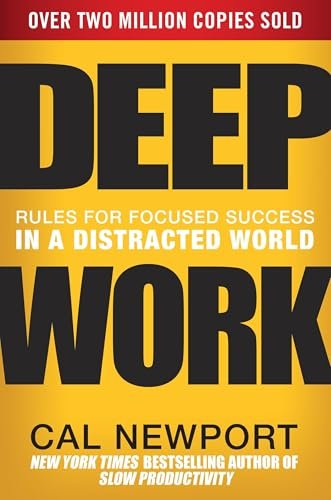
Deep Work: Rules for Focused Success in a Distracted World by Cal Newport makes a simple argument with powerful financial implications: the ability to concentrate intensely on demanding work is becoming rarer, while its value is increasing. In a world of notifications, open tabs, meetings, and constant digital availability, uninterrupted attention can become a genuine advantage.
Newport is not promising a shortcut to wealth. Instead, he shows how to build a capability that supports wealth over time: learning difficult skills faster, producing valuable work, and protecting the attention required to make good decisions. For an entrepreneur, investor, student, or professional, focus is not merely a productivity preference. It is an asset that can compound.
What Newport means by deep work
Newport defines deep work as professional activity performed in a state of distraction-free concentration that pushes your cognitive abilities to their limit. It creates new value, improves your skill, and is difficult for other people to replicate. Writing a thoughtful business plan, learning a technical discipline, analyzing a company, designing a product, or solving a difficult customer problem can all qualify.
Its opposite is shallow work: logistical, often fragmented activity that can be performed without intense concentration. Email, routine administration, status meetings, and quick responses may be necessary, but they can expand until they consume the hours needed for more valuable work. The issue is not that shallow work is always bad. The issue is allowing it to crowd out the work that creates the greatest future value.
Why focus matters for building wealth
Financial progress usually depends on a chain of capabilities. You may need to acquire expertise before earning more, produce excellent results before winning better opportunities, and think clearly before allocating savings or business capital. Each link benefits from sustained attention.
Distraction also carries a hidden switching cost. When attention moves from a proposal to a message and back again, part of the mind remains attached to the unfinished task. The day can feel full while the most important project barely moves. Deep work creates protected space for activities whose payoff is delayed but substantial—the very kind of activities that often lead to better income, stronger businesses, and wiser long-term decisions.
Practical lessons from Deep Work
1. Schedule concentration instead of hoping for it
Deep work rarely appears by accident. If you wait until every message is answered and every small task is finished, there will always be another interruption. Newport’s first rule, “Work Deeply,” means making concentration a deliberate part of the calendar.
Try this: Choose one important outcome for the next seven days. Reserve two or three blocks of 60 to 90 minutes for it. Put the blocks on your calendar, close unnecessary applications, silence notifications, and decide in advance what “done” means. Start with a manageable schedule rather than an unrealistic promise of eight perfect hours.
A useful ritual reduces the number of decisions required. Work in the same place, at a consistent time, with a clear target. If you have a team, explain when you are unavailable and when you will respond. Boundaries make focus visible rather than mysterious.
2. Measure results, not just hours
Time spent concentrating is an input, not the final achievement. A two-hour block that produces a finished analysis is more valuable than a full day of vague effort. Newport connects high-quality work to both time spent and intensity of focus.
Try this: At the end of each deep-work block, record the result: pages drafted, problems solved, lessons completed, customers contacted, or decisions prepared. Review the record weekly. If your output is weak, ask whether the goal was unclear, the task too large, or the environment too distracting.
This distinction is especially helpful for wealth-building projects. “Work on my business” is difficult to evaluate. “Complete the pricing page and test it with five potential customers” gives attention a concrete destination.
3. Train yourself to tolerate boredom
Newport’s second rule, “Embrace Boredom,” addresses the habit of reaching for stimulation whenever the mind becomes uncomfortable. If every pause is filled with a feed, video, or notification, sustained concentration becomes harder to access. Focus is a skill, and skills weaken when they are never practiced.
Try this: When waiting in line, walking, or taking a short break, leave your phone alone. During a work session, write down distracting thoughts instead of immediately acting on them. Give your mind a chance to return to the task. You do not need to eliminate technology; you need to stop teaching your attention that discomfort must be instantly escaped.
The same patience has a financial parallel. Learning, saving, and investing often deliver uneven rewards. The ability to remain engaged during a quiet period can help you continue a sensible plan instead of constantly switching to whatever seems exciting.
4. Use a higher standard for digital tools
“Quit Social Media” does not have to mean abandoning every online platform. Newport challenges the any-benefit mindset—the assumption that a tool deserves a place in your life because it offers even one possible advantage. The better question is whether its benefits justify its costs in attention, time, and mental noise.
Try this: List the digital tools you use most. For each one, write the important goal it supports and the cost it creates. Remove or restrict tools that produce little meaningful progress. Use scheduled windows for social media and messages rather than checking them whenever an urge appears.
For business owners, this can prevent a common trap: confusing visibility with progress. A platform may generate activity without generating qualified leads, useful relationships, or revenue. Keep it if the evidence supports its role; change the way you use it if the cost is higher than the return.
5. Drain the shallows
Newport’s fourth rule, “Drain the Shallows,” is about reducing low-value work and containing the rest. The goal is not to pretend administration does not exist. The goal is to stop it from taking over every available minute.
Try this: Batch email at two or three planned times. Set a time limit for routine tasks. Use templates for recurring communication. Decline meetings without a clear purpose, and request an agenda or written update when that will work better. At the end of the day, shut down work deliberately so unfinished shallow tasks do not occupy your evening.
Draining the shallows creates room for higher-value activities. It also improves recovery. A person who finishes important work efficiently has a better chance of protecting sleep, relationships, and health—resources that support earning power over the long term.
A practical focus system for the next month
Use this four-week experiment:
- Week one: Track distractions and identify the two activities that most often break your concentration.
- Week two: Schedule three protected deep-work blocks and define a visible output for each.
- Week three: Remove one low-value digital habit and batch routine communication.
- Week four: Review your results. Keep the practices that improved meaningful output, and adjust the schedule to fit your real responsibilities.
At the end of each week, ask three questions: What valuable result did my focused work produce? Which interruption was preventable? What deserves my best attention next week? These questions turn focus from an inspiring idea into an operating practice.
Balanced perspective
Deep work is not a demand to be unavailable all day, nor is it a guarantee that every concentrated effort will succeed. Some jobs require responsiveness, collaboration, caregiving, or customer service. The right schedule depends on your obligations. Focus should serve your values, not become another source of guilt.
It is also important to distinguish focused work from busyness performed in isolation. A protected block needs a worthwhile objective and feedback. Concentrating intensely on the wrong project only makes the wrong project move faster. Pair Newport’s methods with clear priorities, useful measurement, and regular conversations with the people affected by your work.
Bottom line
Deep Work offers a compelling lesson for anyone who wants to build a more prosperous life: attention is limited, and its allocation has consequences. Schedule the work that creates value, practice remaining present when boredom appears, evaluate digital tools by their real contribution, and contain shallow tasks before they consume the day. These habits will not replace sound money management or patient investing. They can, however, help you develop the skills, judgment, and output on which those financial practices depend.