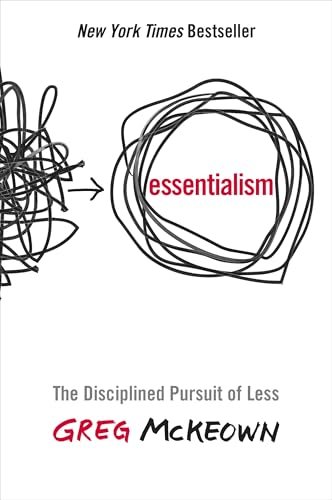
Modern ambition often feels like a crowded desk: every opportunity looks urgent, every message requests attention, and every promising idea competes for the same limited hours. In Essentialism: The Disciplined Pursuit of Less, Greg McKeown offers a sharper alternative. Essentialism is not laziness, minimalism for its own sake, or an excuse to avoid responsibility. It is a method for identifying what matters most, removing what does not, and putting enough energy behind the vital few to make a meaningful contribution.
That argument has a direct connection to wealth. Money and career progress compound when attention is invested consistently in valuable skills, useful relationships, strong decisions, and work that creates results. Scattering effort across too many goals makes progress expensive. The lessons below translate McKeown’s central ideas into a practical operating system for building a richer life—one with more financial capacity, autonomy, and time for what you value.
Essentialism is especially useful for anyone who has mistaken busyness for progress. Its central question is simple: what is essential now? The answer will differ from person to person, but the discipline of asking the question can change how you earn, spend, invest, and lead.
Lesson 1: Define the highest contribution
Before adding another target to your list, decide what “enough” and “important” mean in this season of life. A wealth goal might be eliminating high-interest debt, increasing your earning power, launching a business, or building an investment habit. Those are all legitimate aims, but trying to pursue them with equal intensity at the same time creates friction.
Step by step:
- Write your most important twelve-month outcome in one sentence.
- Describe why it matters and how you will measure progress.
- Choose one weekly activity that most directly moves that outcome forward.
- Place that activity on your calendar before lower-value commitments.
This is not a declaration that other areas do not matter. It is a recognition that priority means priority. A clear primary aim makes it easier to judge opportunities by their contribution rather than their novelty.
Lesson 2: Create space to choose
McKeown emphasizes the value of “space”—time to think, examine options, and notice what is truly important. Without space, the loudest request becomes the default decision. In financial life, that can look like reacting to market headlines, accepting every purchase suggestion, or making career choices while exhausted.
Try this weekly reset:
- Reserve 30 minutes with no notifications or input.
- Review your calendar, spending, and open commitments.
- Ask which activities produced real progress and which merely created motion.
- Make one deliberate subtraction before making a new addition.
That pause is an asset. It protects judgment, and good judgment is often more valuable than another productivity trick.
Lesson 3: Use selective criteria
Essentialism does not require saying yes to nothing; it requires saying yes to the right things. McKeown recommends a high bar for commitments. You can adapt that idea into a simple decision filter for money and work.
When an opportunity appears, score it against three questions: Does it support my primary goal? Is the likely value substantial enough to justify the time and risk? If I were not already considering it, would I actively choose it today? If the answer is not a clear yes, pause. A neutral answer is useful information.
For a business owner, this may mean declining a custom project that distracts from a scalable offer. For an employee, it may mean pursuing one skill with strong market demand instead of collecting disconnected certificates. For an investor, it may mean refusing a complicated idea that cannot be explained clearly. Selectivity is a form of capital allocation.
Lesson 4: Learn the graceful no
Many people protect their money more carefully than their time, even though time is the resource that produces income, learning, and relationships. Saying no is uncomfortable because it can feel like rejecting a person. In practice, a respectful boundary can protect both the relationship and the quality of your contribution.
Use a short script: “Thank you for thinking of me. I cannot give this the attention it deserves, so I am going to decline.” You do not need a courtroom defense. If a request is important but not urgent, offer a later date or a smaller form of help. If it does not fit your priorities, let the answer stand.
Every yes has an opportunity cost. When you accept a low-value commitment, you may be spending the hours that could have built a portfolio, improved a sales process, or restored the energy needed for excellent work.
Lesson 5: Remove the nonessential
Subtraction is often more powerful than adding another system. Conduct an “essential audit” in four areas:
- Calendar: cancel, shorten, or delegate recurring meetings that have no clear outcome.
- Spending: identify subscriptions and habitual purchases that do not improve your life enough to justify their cost.
- Business: remove products, channels, or administrative steps that consume effort without serving customers or cash flow.
- Digital attention: mute nonessential notifications and create defined windows for email and social media.
Do not aim for a dramatic purge that you cannot maintain. Remove one recurring drain, observe the benefit, and continue. The point is to make the essential easier to execute.
Lesson 6: Make execution easy
Once you identify a priority, design the next action so it is obvious and physically easy to begin. A vague intention such as “improve finances” competes poorly with daily interruptions. A concrete action such as “automate a fixed transfer on payday and review it on the first Sunday of each month” has a clear trigger and finish line.
Break a wealth priority into a small sequence:
- Choose the financial outcome.
- Identify the single behavior that drives it.
- Automate or schedule that behavior.
- Track a visible measure.
- Review monthly and adjust without abandoning the objective.
Essentialism is disciplined, not rigid. If circumstances change, update the plan. What matters is returning to the essential outcome rather than allowing every interruption to rewrite it.
Lesson 7: Protect the asset of energy
McKeown treats sleep, recovery, and play as necessary support for high-quality decisions, not indulgences that must be earned after exhaustion. This matters financially because tired people tend to make expensive choices: impulsive purchases, avoidable errors, short-term career decisions, and poorly considered risks.
Protect a dependable sleep window, place demanding work during your best hours, and leave margins between major commitments. A sustainable pace lets you repeat valuable actions for years. That consistency is where compounding—of skills, trust, savings, and business improvements—does its work.
A 30-day Essentialist experiment
For the next month, pick one wealth-supporting priority. In week one, define the outcome and audit your commitments. In week two, remove one recurring distraction and practice one graceful no. In week three, automate or schedule the key behavior. In week four, review the evidence: what improved, what remained difficult, and what should be eliminated next?
Keep the experiment small enough to survive a busy week. The goal is not to become a different person overnight. It is to prove that fewer, better-directed commitments can produce stronger results than constant expansion.
Final takeaway
Essentialism reframes wealth as a question of deliberate allocation. You cannot maximize every opportunity, answer every request, or pursue every attractive goal. You can choose the contribution, habit, relationship, and financial decision that deserve your best energy. Then you can remove enough noise to give them that energy consistently.
Doing less is not automatically wise. Doing less of what is nonessential—so you can do more of what compounds—is. That is the discipline McKeown invites readers to practice.
Sources and Credit
Book discussed: Essentialism: The Disciplined Pursuit of Less by Greg McKeown, Crown, 2014, ISBN 9780804137386. Bibliographic and book-description verification: Google Books. Cover and product reference: Amazon.com edition. This article is an original practical commentary and is not a substitute for reading the book or for personalized financial advice.