Building wealth is often described as a contest of income, investment returns, or financial tactics. Viktor E. Frankl’s Man’s Search for Meaning asks a deeper question first: what makes a life worth directing? That question matters to money because a financial plan without a meaningful destination can become an empty chase. More income, more possessions, and more status do not automatically create a better life.
Frankl’s 1946 classic combines an account of his experiences as a prisoner in Nazi concentration camps with an introduction to logotherapy, his approach to psychology centered on the search for meaning. The book is not a personal-finance manual, and its subject deserves seriousness rather than a simplistic productivity makeover. Still, its ideas offer powerful guidance for anyone trying to build a purposeful career, business, or financial future.

The book’s central idea
Frankl argues that the primary human drive is not simply pleasure or power, but meaning. Meaning is personal: it may be found through work that needs doing, love and responsibility toward another person, or the attitude one chooses when facing unavoidable suffering. Circumstances can remove many freedoms, he observes, but they do not completely erase the ability to choose one’s response.
That is a demanding idea, not a promise that positive thinking can fix everything. Frankl writes from extreme historical suffering, and readers should not use his experiences to minimize anyone else’s pain. The practical lesson is more modest: even when we cannot control every condition, we can often decide what we will serve, what we will protect, and what next action is worthy of our effort.
Why meaning belongs in a wealth conversation
Money is useful because it can provide options, stability, and the ability to care for people. But it is a tool, not a complete definition of success. A person can increase income while losing health, relationships, integrity, or time. Conversely, a modest financial plan can feel rich when it supports a clear purpose.
Frankl’s framework helps separate means from ends. A higher salary is a means. Owning a business is a means. Investing is a means. The end might be freedom to raise children, create useful work, support family, serve a community, or live according to deeply held values. When the end is clear, financial decisions become easier to evaluate: does this choice expand the life I am trying to build, or merely increase the number on a scoreboard?
Step-by-step lessons from the book
1. Name the purpose behind the goal
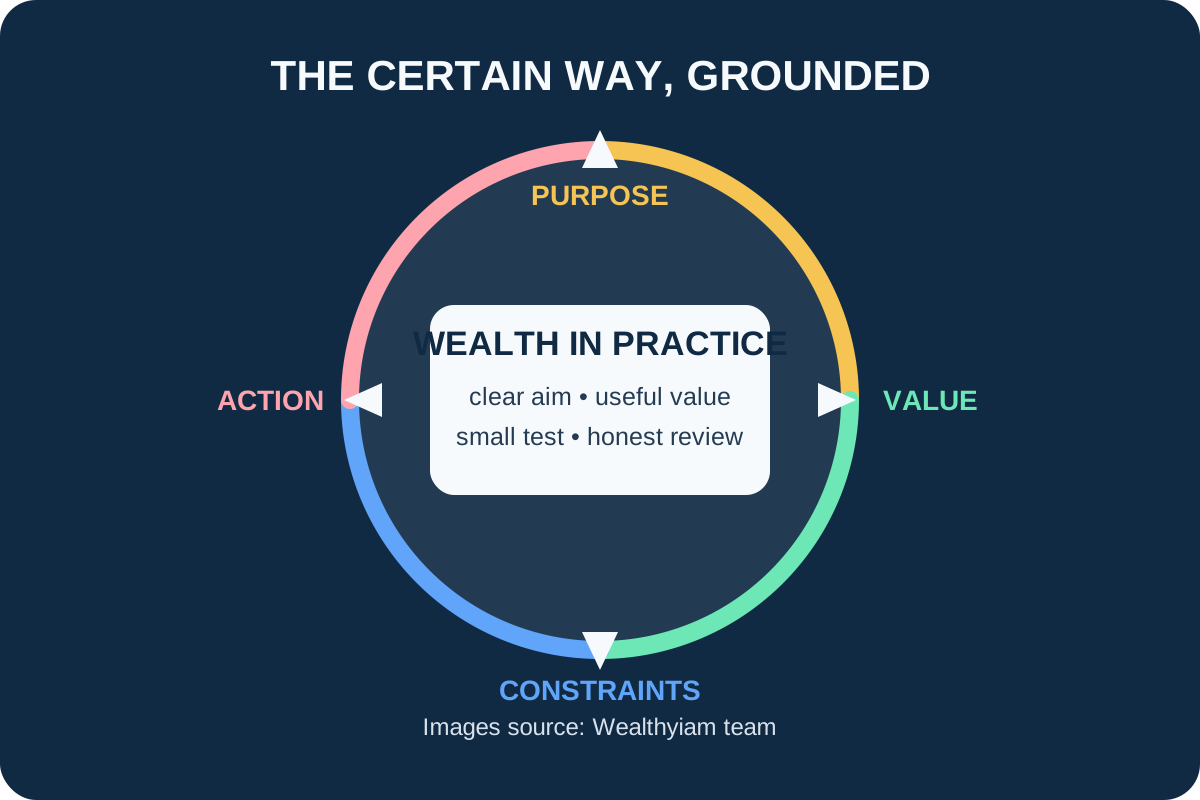
Start with a financial goal such as “I want to earn more” or “I want to retire early.” Then ask what that goal is meant to make possible. Write one sentence beginning, “I want financial security so that I can…” Keep asking until you reach something human and concrete, such as being present for family, doing meaningful work, or having room to recover from illness.
This exercise does not make the goal less ambitious. It gives ambition a direction. It also provides a test for opportunities that look profitable but pull you away from the life you value.
2. Choose responsibilities, not just rewards
Frankl presents meaning as something discovered through responsibility. Applied to work, that means asking where your abilities can solve a real problem for real people. Instead of choosing a career only for prestige, identify the customers, colleagues, students, patients, or family members you are prepared to serve well.
For an entrepreneur, turn this into a practical statement: “We help [specific people] solve [specific problem] by [specific method].” A business built around useful service has a stronger compass than one built only around the founder’s desire for status.
3. Separate controllable actions from uncontrollable outcomes
You cannot command the market, another person’s decision, or the timing of every opportunity. You can control whether you learn the skill, send the proposal, review the budget, reduce avoidable debt, or invest according to a sensible plan. Make two columns in a notebook: within my control and not within my control.
Put your next week’s actions in the first column. This reduces wasted emotional energy and turns uncertainty into a short list of commitments. It is not an excuse to ignore risks; it is a way to respond to risk with judgment rather than panic.
4. Treat adversity as a call to clarify values
Frankl does not claim that suffering is good or that people should be grateful for hardship. His lesson is that hardship can reveal what matters and how we want to live. When a setback hits your finances, ask three questions: What has changed? What remains? What response would I respect six months from now?
The answers may lead to a smaller budget, a job search, a conversation with a lender, or a decision to protect health before chasing extra income. Resilience is not pretending the setback is painless. It is continuing to make value-aligned choices while acknowledging the pain.
5. Build a “meaning budget” alongside a money budget
A money budget tracks dollars. A meaning budget tracks attention. For one week, record where your time and energy go. Mark each activity as purposeful, necessary, or draining. Then reduce one low-value commitment and redirect that time toward a meaningful responsibility.
This can improve wealth indirectly. Focused time may produce better work, stronger relationships, new skills, or a healthier business. It can also prevent lifestyle inflation from consuming every raise: when you know what matters, you are less dependent on buying something new for a sense of progress.
6. Review decisions by the life they create
Once a month, review a major financial decision and ask: What did this purchase, job, investment, or project make easier? What did it make harder? Did it strengthen my purpose or distract me from it? This is a better question than “Did it look successful?” because it measures the direction of your life, not just its appearance.
What readers should keep in perspective
Man’s Search for Meaning is powerful, but it should not be turned into a formula for guaranteed success. Meaning does not eliminate grief, poverty, injustice, or uncertainty. Financial planning still requires concrete skills: understanding cash flow, managing risk, saving, investing carefully, and seeking qualified advice when necessary. Purpose supports those skills; it does not replace them.
The book also invites careful reflection on the difference between accepting reality and accepting everything passively. Choosing a response can include asking for help, leaving an abusive situation, changing jobs, organizing with others, or challenging an unfair system. Agency is not the same as solitary self-reliance.
Final takeaway
Frankl’s lasting contribution is a reminder that a better financial life should serve a better-defined life. Before asking how to earn more, invest faster, or retire sooner, ask what kind of person and community those actions are meant to support. Then convert the answer into responsibilities, controllable actions, and a regular review of how money and attention are being used.
Wealth is most valuable when it gives purpose room to breathe. In that sense, Man’s Search for Meaning is not a book about getting rich. It is a book about finding a reason to use your limited time, energy, and resources well.
Sources and credit
- Amazon.com: Man’s Search for Meaning by Viktor E. Frankl, Beacon Press edition, ISBN 9780807014271 — verified title, author, edition, and cover reference.
- Google Books: Man’s Search for Meaning — bibliographic and publisher reference.
- Cover image credit: Amazon product image for the matching Beacon Press edition (ASIN 0807014273).