Many people are taught to think of wealth as a distant reward: work for decades, save what remains, invest patiently, and hope freedom arrives in old age. The Millionaire Fastlane: Crack the Code to Wealth and Live Rich for a Lifetime by MJ DeMarco challenges that timetable. Its argument is deliberately provocative, but its most useful question is practical: can you build value in a way that is not limited to your own hours?
DeMarco contrasts three financial paths. The Sidewalk is unmanaged consumption and dependence. The Slowlane is the conventional job-and-retirement plan. The Fastlane is an entrepreneurial path based on ownership, control, leverage, and solving problems for many people. The book does not promise a risk-free shortcut; it asks readers to become deliberate builders rather than passive passengers.

The central idea: wealth is a system, not merely a paycheck
A paycheck can be useful, but wages are usually tied closely to time, a role, and an employer. DeMarco argues that substantial wealth is more likely when a person owns an asset or business that can create value repeatedly and reach more customers than the owner could serve one at a time. A book, software tool, marketplace, product line, or well-designed service system can continue producing results after the original work is finished.
This is not an argument to quit a job impulsively or ignore diversified investing. It is a framework for examining the source of income. If every increase in income requires another increase in hours, the model has a ceiling. If a useful solution can be delivered through systems and scale, the ceiling may be higher.
Lesson 1: Choose ownership where it fits
Ownership means having a claim on the value created by an asset or business. It can include a company, intellectual property, a product, or a process that produces revenue. Employees can also build ownership through equity, expertise, or side ventures, but the key is to stop viewing income as something only other people control.
Step by step: list your current income sources. For each, ask whether it depends on your hours, someone else’s permission, or a single customer. Then identify one small asset you could build over the next 90 days: a paid digital resource, a repeatable consulting package, a niche service, or a product improvement. Start with a controlled experiment rather than a dramatic leap.
Lesson 2: Solve a real need
The book’s CENTS framework includes “Need”: businesses prosper when they solve problems people genuinely care about. Passion can help with persistence, but passion alone does not create demand. A market rewards a solution that saves time, reduces cost, improves status, removes risk, or makes an important task easier.
Try this: interview ten potential customers before investing heavily. Ask what they do now, what frustrates them, what they have already paid for, and what a better result would be worth. Look for behavior rather than compliments. A person who has already spent money or built a workaround is offering stronger evidence than someone who simply says an idea sounds interesting.
Lesson 3: Use the five-part CENTS lens
DeMarco evaluates business opportunities through five ideas: Control, Entry, Need, Time, and Scale. Together they offer a useful checklist for judging whether an idea could become a durable wealth vehicle.
- Control: Can you influence the product, customer experience, pricing, and direction?
- Entry: What skills, insight, relationships, or execution make the opportunity more than a copycat project?
- Need: Does the offer solve a meaningful problem?
- Time: Can delivery become less dependent on your personal hours?
- Scale: Can the solution reach more people without costs rising at the same rate?
Score a proposed idea from one to five on each dimension. The total is not a prediction, but it exposes weak assumptions. A business with strong demand but no control may be fragile; one with scale but no real need may be worthless.
Lesson 4: Build for scale, but earn the right to scale
Scale is the ability to serve additional customers efficiently. Digital distribution, licensing, software, media, franchising, and repeatable operations can all create scale. But scale magnifies the underlying model: it can amplify value, or amplify a bad product and unhappy customers.
Step by step: begin with a narrow customer group and a simple offer. Deliver it manually enough to learn what customers value. Document the repeated steps, remove unnecessary friction, and measure the cost of serving each customer. Only then automate, hire, or advertise. Growth should follow evidence, not substitute for it.
Lesson 5: Protect control and reduce dependence
A business can look successful while depending on one platform, one supplier, one client, or one advertising channel. DeMarco’s emphasis on control is a reminder to examine these dependencies. You do not control a business fully if a third party can change the rules overnight.
Create a simple dependency map. List your largest traffic source, customer, supplier, technology provider, and expense. For each, develop one backup: an email list, a second supplier, direct customer relationships, documented processes, or cash reserves. Reducing concentration may not make the business exciting, but it makes the wealth vehicle more resilient.
Lesson 6: Separate revenue from wealth
High revenue is not the same as wealth. A business that requires huge spending to acquire customers, creates constant refunds, or leaves the owner exhausted may be a demanding job rather than a valuable asset. Wealth requires a surplus that can be retained, reinvested, or converted into durable ownership.
Use a monthly scorecard: revenue, gross margin, operating costs, cash generated, customer retention, and owner hours. Track the trend, not one exciting month. If revenue rises while cash and customer satisfaction fall, pause expansion and repair the model. The goal is not to look large; it is to create value that survives.
Lesson 7: Treat time as a nonrenewable asset
The book’s strongest emotional appeal is its focus on time. Money can sometimes be recovered; a year cannot. That does not mean every reader should chase rapid riches. It means financial goals should be connected to the life they are supposed to improve.
Define what “rich” means in practical terms: a monthly spending level, a location, family time, creative freedom, or the ability to refuse harmful work. Then calculate which business or career decisions move you toward that life. A bigger number that consumes all of your time may not be progress.
Lesson 8: Take risk intelligently
Entrepreneurship involves uncertainty, and the Fastlane idea can be misunderstood as permission to gamble. Intelligent risk is different. It limits the downside, increases learning, and preserves the ability to try again.
Before launching, set a cash budget and a time limit for the experiment. Keep essential personal expenses covered, avoid high-interest debt used to fund unproven ideas, and define the evidence that would make you continue, change direction, or stop. Use a job or existing income as runway when that is the responsible choice. Speed without survival is not freedom.
What to balance in the book’s message
DeMarco is right that ownership and value creation can accelerate financial independence. However, patient saving, diversified investing, emergency reserves, and sensible risk management remain important. A business can fail, and markets can be useful tools for preserving and compounding capital once it exists.
The Fastlane is best understood as one possible route, not a moral judgment on everyone who chooses a stable career. The right route depends on temperament, obligations, skills, capital, and desired lifestyle. The transferable lesson is to make those choices consciously.
A 30-day action plan
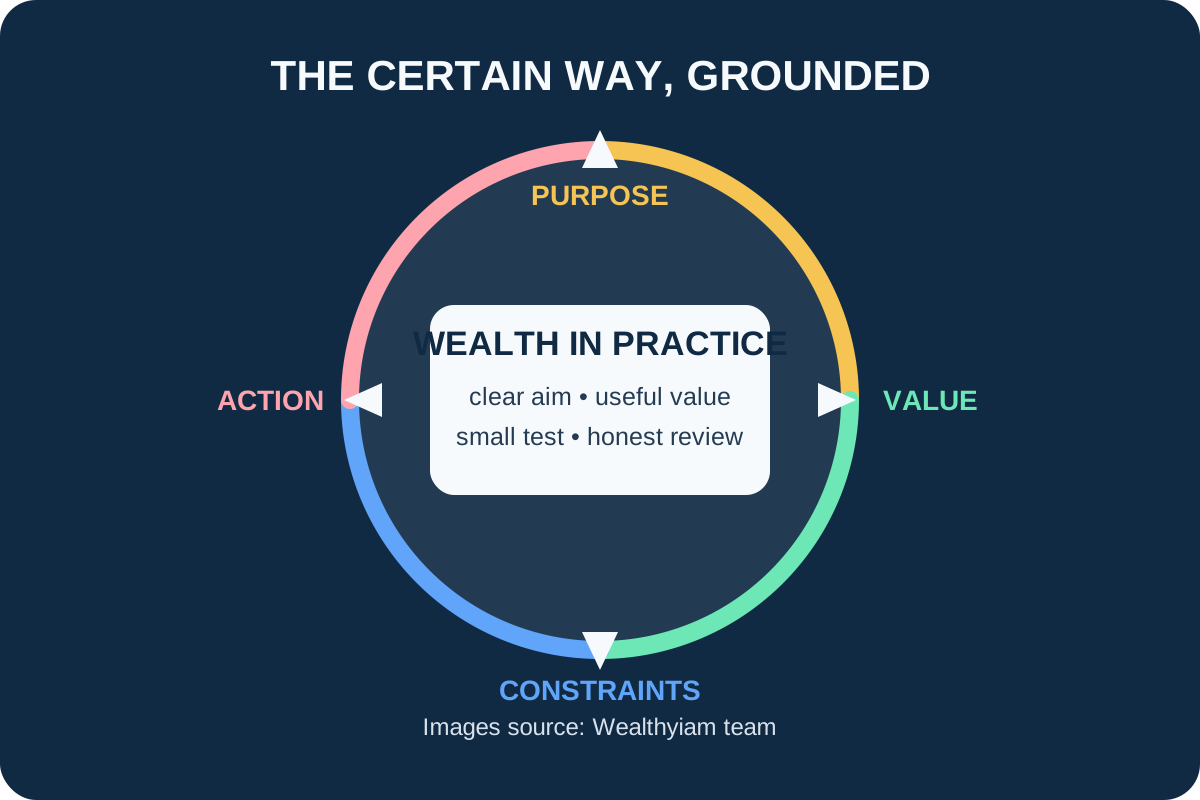
- Write down the life your money should support and your current financial constraints.
- List three problems you understand because you have experienced them or served people who have.
- Interview ten potential customers and record evidence of existing demand.
- Design the smallest paid test that can prove whether your solution helps.
- Score the idea for Control, Entry, Need, Time, and Scale.
- Review the numbers weekly and decide whether to improve, pivot, or stop.
Bottom line
The Millionaire Fastlane is a call to think like an owner. Its practical sequence is clear: find a meaningful need, create a solution, protect control, build repeatable systems, measure cash rather than vanity, and use scale responsibly. The book’s tone is bold, but the durable lesson is grounded: wealth grows when useful value can reach more people without requiring every unit of growth to consume another unit of your time.
Sources and credits
- DeMarco, MJ. The Millionaire Fastlane: Crack the Code to Wealth and Live Rich for a Lifetime. Viperion Publishing Corporation, ISBN 9780984358106.
- Amazon.com product page — verified title, author, edition, ISBN, and product listing.
- Google Books edition record — bibliographic details and subject information.
- The Fastlane Forum author/book page — author-linked book information.
- Cover credit: Amazon-hosted cover image for ISBN 9780984358106, displayed above.