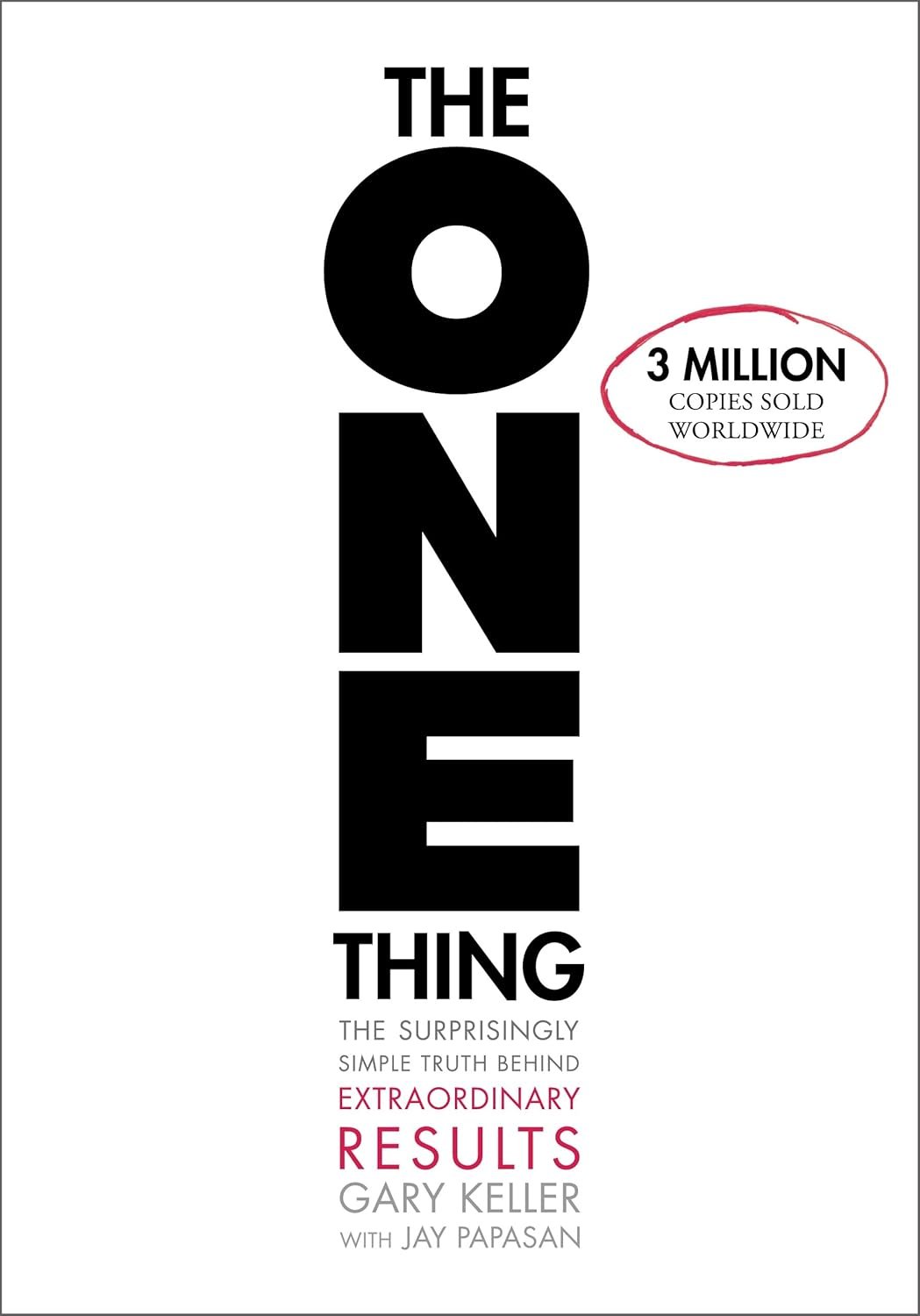
Modern work rewards people who can create value, yet most days are crowded with messages, meetings, errands, and competing ambitions. The result is constant motion with too little progress. The ONE Thing: The Surprisingly Simple Truth Behind Extraordinary Results by Gary Keller with Jay Papasan offers a direct response. Instead of asking how to fit more tasks into the day, the authors ask which single priority would make the rest easier, less important, or unnecessary.
That idea has an important wealth-building application. Money grows from repeated choices: learning a valuable skill, serving customers well, protecting cash, investing consistently, or building an asset. Trying to pursue all of those at once can dilute effort. Focus does not guarantee success, but it makes effort easier to direct, measure, and improve.
The central question
The book’s signature tool is a focusing question: what is the one thing you can do such that by doing it everything else will be easier or unnecessary? It is not a command to ignore family, health, or responsibilities. It is a way to identify the highest-leverage next action within a larger area of life.
“Build wealth” is a worthy but broad goal. The focusing question turns it into something actionable: increasing a scarce skill, contacting the first five prospects for a service, creating a debt-payment plan, or automating a diversified investment contribution. The correct answer changes with the situation. The discipline is to choose deliberately rather than letting the loudest notification choose for you.
Lesson 1: Define the outcome before the task
Write one meaningful 12-month outcome in plain language. Ask what must be true for it to happen. Keep asking “what is the one thing?” until you reach a concrete action you can complete this week. A clear outcome prevents a full calendar from becoming a substitute for progress.
Understand the domino effect
Keller and Papasan describe progress as a line of falling dominoes. A small action can set up the next action, which can set up a larger result. The first domino is not necessarily impressive; it is the one that creates momentum.
In personal finance, a first domino might be opening a separate savings account, listing every debt and interest rate, or learning the basics of an employer retirement plan. In business, it might be speaking with a customer before building a product. These steps look modest, but they reduce uncertainty and make better decisions possible. Compounding begins with a repeatable start.
Lesson 2: Find your first financial domino
List your biggest current money goal and five obstacles between you and it. Circle the obstacle that, once removed, would make several others easier. Schedule a 30-minute action to address it. Repeat weekly, reviewing evidence rather than judging yourself by intention.
Replace multitasking with sequencing
The book challenges the belief that doing several important things simultaneously is efficient. Switching between tasks carries a mental cost and makes it harder to reach the concentration required for difficult learning, thoughtful selling, writing, analysis, or strategy.
Sequencing is a better alternative. You still have many responsibilities, but you give each important responsibility a protected period. A focused block for a revenue-producing project can coexist with a later block for administration. The objective is not perfect isolation; it is to stop treating every task as equally urgent and every hour as interchangeable.
Lesson 3: Reserve a daily priority block
Choose the day’s highest-impact action the evening before. Put it on the calendar before routine work begins, and protect 60–90 minutes for it. Silence nonessential alerts, keep one visible note with the desired result, and record what you completed. If the block repeatedly disappears, reduce its size but do not abandon the habit.
Think big, then work backward
The authors encourage ambitious goals paired with practical questions. “Someday” thinking can expand what you believe is possible, while “five years,” “one year,” “this month,” “this week,” and “today” thinking turns possibility into a path. The value is not predicting perfectly. It is connecting a long-term direction to the next visible step.
For wealth, balance aspiration with arithmetic and behavior. A large net-worth goal may require higher income, a higher savings rate, a longer time horizon, or a different mix of assets. The book is not an investment formula, and no focusing method removes market risk. It does help decide which controllable behavior deserves attention first.
Lesson 4: Build a six-level plan
Write your desired long-term result. Beneath it, write the five-year milestone, the one-year target, the monthly lead measure, this week’s action, and today’s first step. Use measurable language: amount saved, conversations completed, applications sent, or hours practiced. Review the plan every Friday and adjust the next domino.
Protect the essentials
Focus is also a boundary-setting practice. Saying yes to a low-value commitment can mean saying no to health, relationships, recovery, or work that matters more. The approach supports purposeful trade-offs, not permanent overwork.
A sustainable wealth strategy needs the same balance. Earning more while neglecting sleep, integrity, or close relationships can create a fragile version of success. Schedule the priorities that keep you capable of doing valuable work: rest, movement, family time, and financial reviews. They help preserve the capacity to pursue the mission.
Lesson 5: Create a “not now” list
When a new idea or request appears, capture it rather than switching immediately. Review the list at a set time each week. Keep only commitments that serve a current priority. This lets you respect good ideas without allowing them to interrupt the work that earns its place today.
Use accountability and measurement
A priority becomes credible when it appears in behavior. Choose a small lead measure—the action you control—rather than relying only on a distant result. A freelancer can track proposals sent; a learner can track focused practice; a saver can track automated contributions; a business owner can track qualified customer conversations.
Reviewing the measure creates a feedback loop. If the action is happening but the result is not improving, the strategy may need changing. If the action is not happening, the problem may be the environment, schedule, or a goal that is too vague. Accountability should create useful information, not shame.
Lesson 6: Run a weekly scorecard
Choose one lead measure and write the target on a simple weekly scorecard. At week’s end, mark the actual result, note the main obstacle, and choose one adjustment. Share the scorecard with a trusted partner if external accountability helps you follow through.
A practical 30-day focus plan
- Days 1–3: Choose one wealth-related outcome and write the focusing question for it.
- Week one: Identify the first domino and complete one action that creates momentum.
- Week two: Protect a daily priority block and remove one recurring interruption.
- Week three: Work backward from the long-term goal and choose a measurable lead action.
- Week four: Review the scorecard, keep what worked, and set the next month’s priority.
Do not measure the plan by how busy it makes you. Measure it by whether the chosen action produces learning, useful output, stronger finances, or a clearer next step.
Final takeaway
The ONE Thing offers a simple but demanding lesson: extraordinary results usually come from giving disproportionate attention to the action that matters most. For wealth, that may be a skill, a customer, a financial habit, or an asset-building project. Choose it, protect time for it, measure the behavior, and let each completed domino reveal the next. Focus is not doing less because ambition is small; it is doing less of what does not deserve your best effort.
Sources and credits
This is an original educational summary of the book’s ideas and is not affiliated with the authors or publisher.