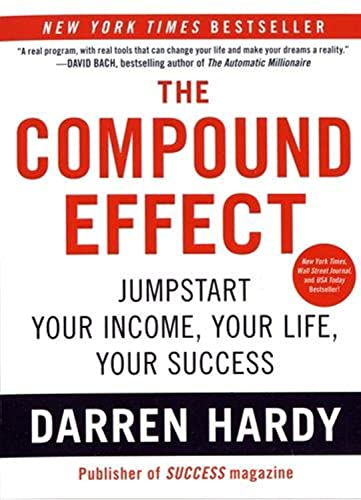
Most wealth advice sounds dramatic: find a breakthrough, make a bold investment, or transform your life overnight. Darren Hardy’s The Compound Effect: Multiplying Your Success One Simple Step at a Time argues for a quieter approach. The outcomes that look extraordinary from a distance are usually built from ordinary choices repeated long enough to become powerful.
That idea is especially useful for money. A budget followed for one week will not create financial freedom. One deposit will not build an investment portfolio. But a repeatable decision—saving before spending, learning a valuable skill, serving customers well, or avoiding expensive debt—can create a direction. Repetition turns direction into momentum.
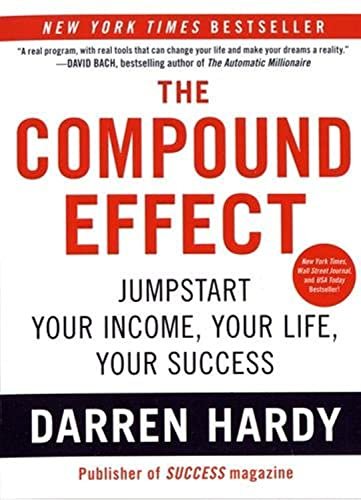
The central idea: small choices become large results
Hardy focuses on the cumulative effect of decisions that seem too small to matter. A purchase, a skipped workout, an hour spent learning, or a conversation with a potential customer may not change a life immediately. Repeated choices, however, create patterns. Patterns shape capability, cash flow, health, and relationships; those conditions then make future choices easier or harder.
This is not a promise of instant riches, and compounding is not perfectly linear. Progress can be invisible for a long time, and external conditions matter. The practical lesson is to stop judging a useful habit by its first few results. Judge it by whether it is affordable, repeatable, and pointed toward a worthwhile outcome.
Lesson 1: Choose a direction before choosing a habit
Write one specific 12-month outcome for your finances: eliminate a debt, build a reserve, increase income, or invest a defined amount. Then ask which daily or weekly behavior most directly supports it. A habit without a destination can become busywork; a destination gives the habit meaning.
Step 1: Take ownership of the starting point
One of Hardy’s most useful themes is personal responsibility. Ownership does not mean pretending that everyone begins with the same income, opportunities, health, or obligations. It means identifying the part of the situation that can be influenced now. Blaming circumstances may be understandable, but it rarely produces a next action.
Start with a factual snapshot. Record monthly take-home income, fixed bills, flexible spending, debt balances and rates, savings, and investment contributions. Do not use the exercise to criticize yourself. Use it to replace a vague feeling with a map. Financial clarity is an asset because it shows where a small change can have a large effect.
Lesson 2: Build a one-page baseline
On one sheet, list your current cash reserve, highest-interest debt, monthly surplus or shortfall, and automatic transfers. Circle the biggest controllable leak and the smallest action that can improve it this week. Keep the baseline and update it once a month.
Step 2: Track choices before trying to change them
People often try to fix money habits through willpower alone. Tracking is more reliable because it makes the invisible visible. For two weeks, record every purchase without attempting to be perfect. Mark each item as necessary, useful, enjoyable, or forgettable. Also track the moments that trigger unplanned spending: fatigue, social pressure, convenience, or boredom.
The objective is not to eliminate every pleasure. It is to find repeated choices whose cost is out of proportion to their benefit. One recurring subscription, delivery habit, interest charge, or upgrade may matter more than dozens of tiny economies. The same method works for earning: log how time is spent and identify the activities that produce skills, relationships, or revenue.
Lesson 3: Use a 14-day decision log
Record spending, focused work, learning, and exercise in a simple note or spreadsheet. At the end, highlight the three choices that most improved your future position and the three that repeatedly pulled resources away. Change the environment around one of the latter rather than relying on motivation alone.
Step 3: Install a small financial habit
Make the first habit nearly impossible to misunderstand. For example, arrange an automatic transfer on payday into an emergency account, or direct a fixed amount toward high-interest debt. If the amount is modest, that is fine. The first objective is to establish the behavior and prove that the system can run repeatedly. Increase it after a stable period.
Automation matters because it moves the decision to a calm moment. Spending then happens after the priority has been funded, not before. Keep a buffer in the everyday account so an unexpected bill does not force the habit to fail. If debt is expensive, paying it down may be a more dependable first use of extra cash than taking additional investment risk.
Lesson 4: Make progress automatic
Choose one transfer that fits your real cash flow. Schedule it for the day income arrives, name the account for its purpose, and review the amount after the first month. A system that survives ordinary life is better than an ambitious plan that collapses after one surprise expense.
Step 4: Protect momentum
Hardy describes momentum as a force that makes continued action easier. In practical terms, a visible streak lowers the friction of starting again. Use a calendar, balance chart, or weekly checklist to show evidence of consistency. Celebrate keeping the promise, not only reaching the distant goal.
There will be interruptions. A missed day does not erase the previous work, but it should not become a reason to quit. Create a recovery rule: resume at the next opportunity, reduce the task to its smallest version, and identify what caused the interruption. Resilience is part of the habit design.
Lesson 5: Create a restart rule
Write: “If I miss a contribution, review, or learning session, I restart within 24 hours with the minimum version.” Then define minimum: one transfer, ten minutes of study, or a five-minute account review. Removing the debate protects momentum.
Step 5: Compound your earning power
The book’s framework applies beyond cutting expenses. Wealth can grow faster when you repeatedly improve the value you create. Choose a skill connected to a real market need—clear communication, analysis, sales, software, management, or a specialized trade—and practice it on a schedule. Seek feedback from people who can judge the result, not just the effort.
At work, document contributions that save time, increase revenue, reduce errors, or improve customer retention. In a business, test small offers and keep the ones that create healthy profit after costs. Compounding becomes more meaningful when the action improves both competence and access to opportunity.
Lesson 6: Run a weekly earning experiment
Reserve one hour to improve a marketable skill or make one useful offer. Record the output and response. After four weeks, keep the experiment with evidence of demand, revise the one with promise, and stop the one that produces only activity.
A 30-day compound-effect plan
- Week 1: Define one financial outcome and create your baseline.
- Week 2: Track choices and identify the highest-impact leak or opportunity.
- Week 3: Automate one transfer and schedule one earning or learning block.
- Week 4: Review the evidence, celebrate consistency, and raise the difficulty only slightly.
Keep the plan small enough to repeat during a normal, imperfect month. Then review it monthly. A habit that feels boring may be doing exactly what a wealth habit should do: quietly moving resources and capability in the right direction.
Final takeaway
The Compound Effect is a reminder that financial progress is usually built through ordinary choices made with unusual consistency. Choose a direction, measure your starting point, automate a manageable action, protect momentum, and invest in the skills that expand your earning power. The result may not be visible tomorrow, but disciplined actions can give time something valuable to multiply.
Sources and credits
This is an original educational article about the book’s ideas and is not affiliated with Darren Hardy, the publisher, or Amazon.