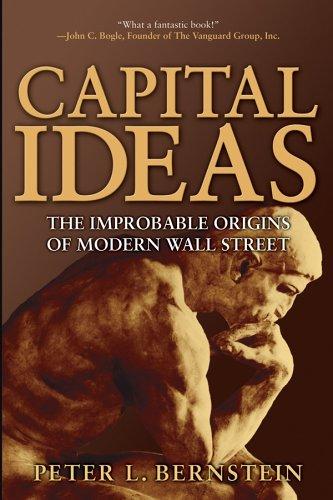
Investing is often presented as a contest of speed: find the next breakthrough, predict the next market move, and act before everyone else. Peter L. Bernstein’s Capital Ideas: The Improbable Origins of Modern Wall Street offers a more useful perspective. It tells the story of the ideas that made modern investing possible—risk, probability, diversification, valuation, and portfolio theory—and shows why good investment decisions depend on disciplined thinking rather than confident guesses.
For anyone building wealth, the book’s central lesson is encouraging: investing is not merely a collection of tips. It is a field of evolving ideas. Understanding where those ideas came from helps us ask better questions about uncertainty, evidence, and the trade-offs behind every potential return. Bernstein’s history is not a stock-picking manual, but it is a practical guide to thinking more clearly about money.
What Capital Ideas is about
Bernstein traces the intellectual development of modern Wall Street, beginning with early attempts to describe the behavior of markets and continuing through major advances in risk measurement, investment theory, and professional portfolio management. The book brings together mathematicians, economists, academics, and practitioners whose work changed how investors understand prices and uncertainty.
The narrative matters because many familiar practices—spreading money across assets, thinking in terms of expected return and risk, comparing results with a benchmark, and evaluating a portfolio as a whole—were once unfamiliar or controversial. They emerged through debate, experimentation, and better data. That history should make investors humble: even useful frameworks are models, not crystal balls.
Five practical lessons from the book
1. Treat uncertainty as a fact, not a personal failure
Markets contain information, emotion, randomness, and surprises. No investor can know every future outcome. The mature response is not to abandon analysis; it is to make decisions that remain survivable when the forecast is wrong.
Before making an investment, write down what you believe, what would disprove it, and what could go badly. Consider a range of outcomes instead of a single target price. This simple habit turns vague confidence into a testable decision and reduces the temptation to confuse a story with certainty.
2. Judge a portfolio as a whole
One holding can look attractive in isolation while making the total portfolio more fragile. Bernstein’s account of portfolio theory reinforces a powerful idea: risk depends partly on how investments interact with one another, not only on the risk of each asset by itself.
Make a one-page inventory of your assets, debts, cash needs, and time horizon. Then look for concentration: one employer, one industry, one country, one property, or one speculative theme. Diversification cannot prevent every loss, but it can reduce the damage caused by being wrong about one narrow outcome.
3. Demand a relationship between risk and reward
A high expected return is not a gift; it is usually compensation for accepting uncertainty, illiquidity, complexity, or the possibility of permanent loss. If an opportunity promises exceptional returns with no meaningful risk, skepticism is a financial skill.
Ask what risk you are actually being paid to bear. Can you sell when needed? Is the cash flow dependable? What assumptions support the valuation? Could debt or leverage turn a temporary decline into a permanent loss? A clear risk explanation is more valuable than an exciting prediction.
4. Prefer evidence to fashion
The evolution of investment theory shows that popular beliefs are not automatically reliable. New technology, a celebrated manager, or a fashionable sector may deserve attention, but novelty alone is not an investment thesis.
Create a repeatable research checklist: business economics, balance-sheet strength, valuation, competitive position, management incentives, and the role the investment will play in your portfolio. If you cannot explain the asset’s value and the main ways you could lose money, keep researching or pass.
5. Let time do more work than activity
Modern finance has made trading easier, but convenience can encourage unnecessary action. A long-term investor does not need to respond to every headline. The right frequency of action depends on the goal, not on the amount of market noise.
Set a written review schedule—perhaps quarterly or semiannually—and define the events that would justify a change. Rebalancing, a broken investment thesis, a changed time horizon, or a new cash need can be valid reasons. Boredom, fear, and social-media excitement are usually weaker ones.
A step-by-step “Capital Ideas” review
- Define the job of your money. Separate near-term spending, emergency reserves, medium-term goals, and long-term capital. Money with different jobs should not automatically carry the same risk.
- Set a time horizon. Record when you may need the money. A long horizon can make volatility more tolerable, but it does not make an unsuitable investment safe.
- Write an allocation policy. Choose broad target ranges for cash, bonds, stocks, real estate, or other assets that fit your circumstances. A policy creates a reference point before emotions rise.
- Measure concentration. Calculate how much of your net worth depends on each major source of income or investment outcome. Reduce hidden correlations where practical.
- Check costs and taxes. Fees, spreads, turnover, and taxes compound too. Compare the expected benefit of a change with its total friction.
- Record the decision. Note the thesis, valuation logic, risks, position size, and review date. A decision journal helps distinguish a sound process from a lucky result.
- Review behavior, not just returns. Ask whether you followed your policy, saved consistently, diversified appropriately, and avoided avoidable mistakes. One year’s performance is not a complete verdict on a process.
What the history changes in everyday investing
The book encourages a healthier definition of expertise. Expertise is not the ability to sound certain about tomorrow. It is the ability to understand the limits of a model, weigh evidence, manage trade-offs, and stay rational when outcomes are noisy.
This is especially relevant for wealth builders who are still accumulating. Savings rate, appropriate diversification, low costs, and patience often matter more than finding a perfect entry point. A strong framework also helps investors recognize when a recommendation is selling excitement rather than explaining risk.
Important limitations
Capital Ideas is a history of financial thought, not individualized investment advice. Theories can be misapplied, markets can behave differently from historical samples, and diversification does not guarantee profits. Your goals, taxes, liabilities, liquidity needs, and tolerance for loss all matter. Before acting, verify current information and consider qualified professional advice where appropriate.
Bottom line
Capital Ideas makes investing feel less like a hunt for secret signals and more like a discipline built from ideas, evidence, and humility. Its most useful takeaway is practical: build a portfolio around your real goals, respect uncertainty, diversify thoughtfully, control costs, and create rules that protect you from your own worst impulses. Wealth grows more reliably when the process is designed to survive both ordinary volatility and extraordinary surprises.
Sources and credits
- Amazon.com product page — Capital Ideas: The Improbable Origins of Modern Wall Street by Peter L. Bernstein, ISBN 0471731749
- Google Books bibliographic record
- WorldCat catalog record
- Cover credit: Open Library cover image for the matched Wiley edition; the article links to the corresponding Amazon.com product page.