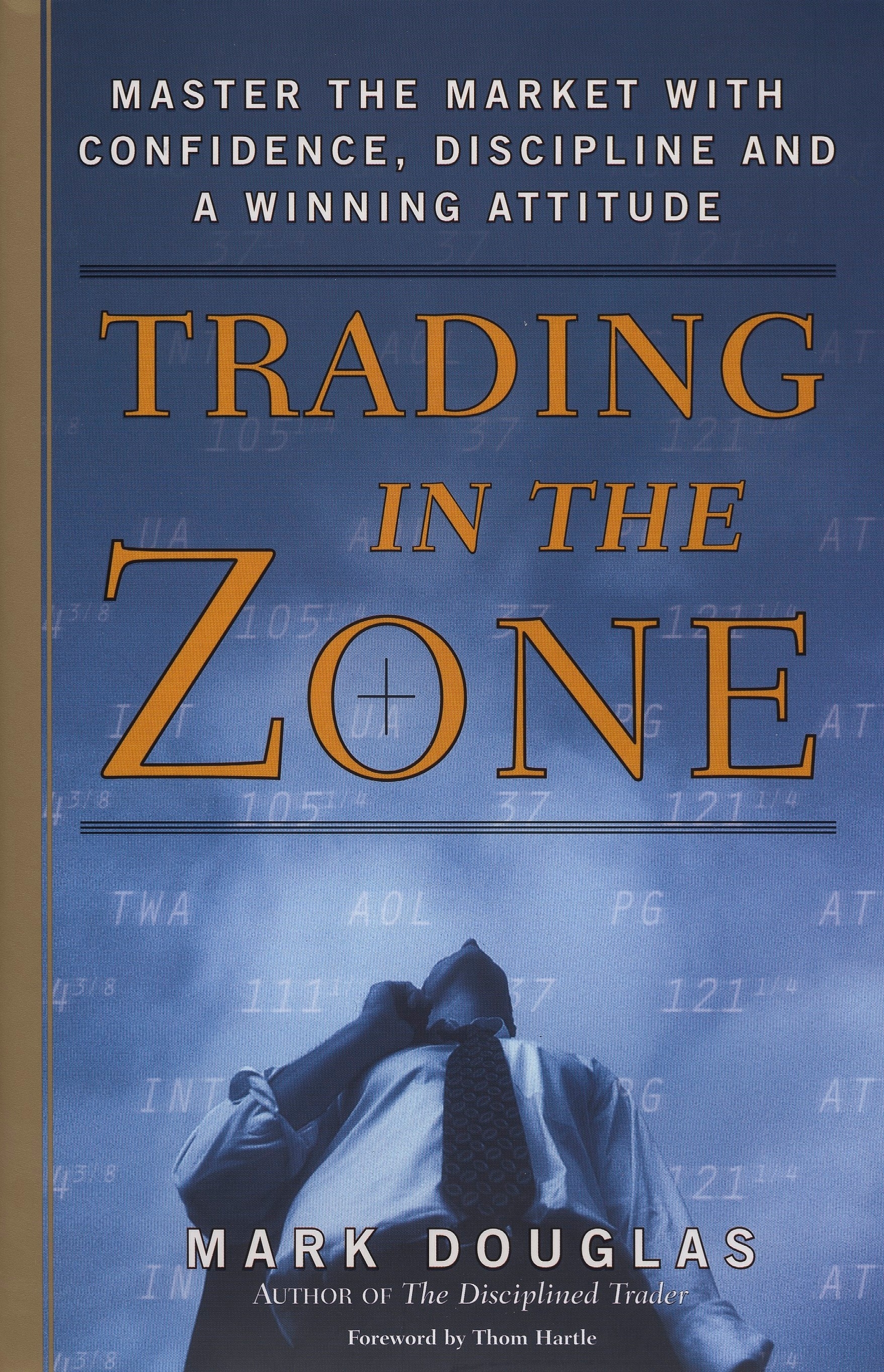
Trading in the Zone by Mark Douglas is a book about the mind of a trader. It does not promise a magic stock, a perfect chart, or a secret signal. Instead, it asks a harder question: can you follow your trading plan calmly when the next result is unknown?
Douglas’s central idea is that good trading is a probability game. A trade can be well planned and still lose. A bad trade can sometimes win. If you judge yourself by one result, your emotions may take over. If you judge yourself by a long series of trades, you can focus on whether your process works.
What the book is about
Published by Prentice Hall Press, the book is a guide to trading psychology. Douglas looks at why traders repeat mistakes such as entering without a plan, moving a stop-loss, taking profits too quickly, or risking too much after a loss.
His answer is not simply “be more disciplined.” He explains that traders need a way of thinking that accepts uncertainty. The market can move in many directions, and no single trade is guaranteed. A trader’s job is to manage risk and act on an edge, not to force the market to be right.
Main ideas
1. Every trade is unique
Past results do not control the next trade. Five winning trades do not make a sixth one certain to win. Five losses do not make a win “due.” Each trade is a new event with its own risk.
2. Anything can happen
This sounds scary, but it can also be freeing. When you accept that anything can happen, you stop treating a prediction as a promise. You can plan for what you will do if the price rises, falls, or does nothing.
3. Think in probabilities
A trading edge is a small advantage that may appear across many trades. It is like a loaded coin: it may still land the wrong way on one toss, but over many tosses its pattern can become clearer. An edge is not certainty.
4. Risk must be accepted before entry
Douglas argues that a trader should know the possible loss before opening a position and be genuinely willing to accept it. If the loss feels unbearable, the position is probably too large or the trade should not be taken.
5. Rules reduce emotional decisions
A written plan can decide when to enter, where to exit, how much to risk, and when to stop trading. Rules do not remove uncertainty, but they give the trader a steady response to it.
Simple explanations of key terms
Trading psychology
Trading psychology means how your thoughts and feelings affect your money decisions. Fear, greed, hope, and anger can all change a plan if you let them.
Probability
Probability is the chance that something may happen. A 60% chance is not a promise. It means the event may happen more often than not over many similar situations.
Trading edge
An edge is a repeatable reason to believe a strategy may make money over a large group of trades. It might come from a pattern, a price rule, or a tested method. It does not guarantee any individual result.
Stop-loss
A stop-loss is an instruction to leave a trade if the price moves against you to a chosen point. It helps limit damage, although it cannot remove all risk.
Position sizing
Position sizing means choosing how much money to put into a trade. Even a good strategy can be dangerous if each trade is too large.
Step by step: applying the book’s ideas
- Write the setup. Describe exactly what must be true before you enter. Do not rely on a feeling.
- Define the exit before entry. Choose where the trade is wrong and where you might take a profit.
- Choose a tolerable risk. Make the possible loss small enough that you can accept it without panic.
- State the uncertainty. Remind yourself that this trade can lose even if the plan is good.
- Record the result and the process. Note whether you followed your rules, not just whether you made money.
- Review a series. Look at many trades together. Search for repeated errors and test whether the strategy has an edge.
What it gets right
The book correctly separates a trade’s quality from its outcome. This is important because a winning trade can reward reckless behavior, while a losing trade can follow a careful plan. Learning the wrong lesson from one outcome can make future decisions worse.
Douglas is also right that discipline is easier when the plan is accepted in advance. It is much harder to decide on risk after money is already on the line. The book’s focus on process is useful for anyone who tends to change rules in the middle of a trade.
What to be careful about
Mindset cannot turn a losing strategy into a winning one. A calm trader still needs a method with evidence behind it, sensible costs, and realistic risk limits. The book also does not replace knowledge of markets, taxes, leverage, liquidity, or the specific product being traded.
Trading is risky. Many people lose money, especially when they use borrowed money or trade too often. Readers should test ideas carefully, use small amounts if they trade at all, and never risk money needed for living expenses.
Bottom line
Trading in the Zone is best understood as a book about accepting uncertainty. Its lesson is simple: you cannot control the next trade, but you can control your preparation, your risk, and whether you follow your rules. For traders who keep chasing certainty, that change in thinking may be the most valuable lesson of all.