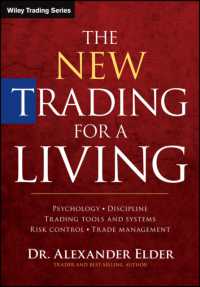
The New Trading for a Living is Alexander Elder’s updated guide to the hard work of trading. It does not present trading as a button you press to get rich. Instead, it treats trading as a skill that needs a calm mind, a repeatable method, and careful control of money.
What the book is about
The 2014 Wiley edition updates Elder’s earlier trading classic for modern markets. The book brings together trading psychology, chart reading, trade planning, risk control, and record keeping. Its central lesson is that a trader must manage three things: the mind, the method, and the money.
That is useful because a clever chart idea is not enough. A trader can have a good idea and still lose money by risking too much, changing the plan halfway through, or trading while angry. Elder’s approach asks readers to build rules before they enter a trade and then follow those rules.
Main ideas
- Mind comes first. Trading can make people fearful, greedy, impatient, or overconfident. A trader needs discipline to avoid letting one emotion control the next decision.
- Use a method, not a guess. Charts and indicators can help organize information, but they are tools—not crystal balls. A method should say what to look for, when to enter, where to exit, and when to admit the idea was wrong.
- Protect your money. Risk control is the seat belt of trading. A trader should decide the possible loss before opening a position and keep that loss small enough to survive.
- Look at more than one time frame. A long-term chart can show the broad direction while a shorter chart helps with timing. Elder’s “Triple Screen” idea uses several views of the market instead of trusting one chart alone.
- Keep a trading journal. Writing down the reason for a trade, the size, the result, and the feelings involved turns experience into lessons.
Simple explanations of key terms
Technical analysis
Technical analysis means studying price and trading activity on charts. It looks for patterns, trends, and changes in buying or selling pressure. It can help a trader make a plan, but it cannot guarantee what happens next.
Stop-loss
A stop-loss is a preplanned exit that limits a loss. It does not prevent every loss, but it can stop one bad trade from becoming a disaster.
Position size
Position size means how much of an asset you buy or sell. If the position is too large, a small price move can hurt badly. If it is small enough, the trader has room to think and continue after a mistake.
Risk-reward ratio
This compares the possible loss with the possible gain. The possible gain is never certain, so this ratio is only one part of the decision.
What the book gets right
The strongest part of the book is its focus on survival. Many trading discussions begin with how to find a winning trade. Elder spends much more time on how not to lose control. A trader who preserves capital can learn, while a trader who suffers a huge loss may be forced to quit.
The book also treats psychology as a practical problem. A written plan, a fixed risk limit, and a journal can make good behavior easier. These tools help a person notice whether the problem is the market or their own decisions.
What to be careful about
Trading is risky, and reading a book does not create a profitable edge. Technical indicators can give false signals. Markets can gap past an exit price. Fees, taxes, spreads, and slippage can reduce results. A plan that worked in one market or time period may fail in another.
Readers should not assume that trading can quickly replace a salary. Learn with paper trading or very small amounts, keep emergency savings separate, and never risk money needed for rent, food, or debt payments. The Triple Screen framework is a way to organize decisions, not a promise of success. Past performance cannot guarantee future results.
Bottom line
The New Trading for a Living is best read as a book about process and self-control. Its lasting message is simple: know why you are entering, know where you will leave, keep the position small enough to survive, and study your own decisions. It offers a disciplined foundation, but it should be paired with realistic expectations and careful risk management.