The Almanack of Naval Ravikant: A Guide to Wealth and Happiness, curated and edited by Eric Jorgenson, gathers Naval Ravikant’s ideas about building wealth, making better decisions, and creating a calmer life. Its central promise is encouraging: wealth is not merely a lucky outcome or a reward reserved for a particular background. It can be approached as a set of skills—creating value, building judgment, earning trust, and using time intelligently.
This is not a conventional personal-finance workbook. It does not give you a budget template or a single investing formula. Instead, it offers principles for thinking: become unusually useful, pursue ownership, use leverage responsibly, play long-term games with trustworthy people, and treat happiness as a practice rather than a finish line. Those ideas are especially relevant to anyone who wants financial independence without sacrificing health, relationships, or freedom.

The book’s central framework
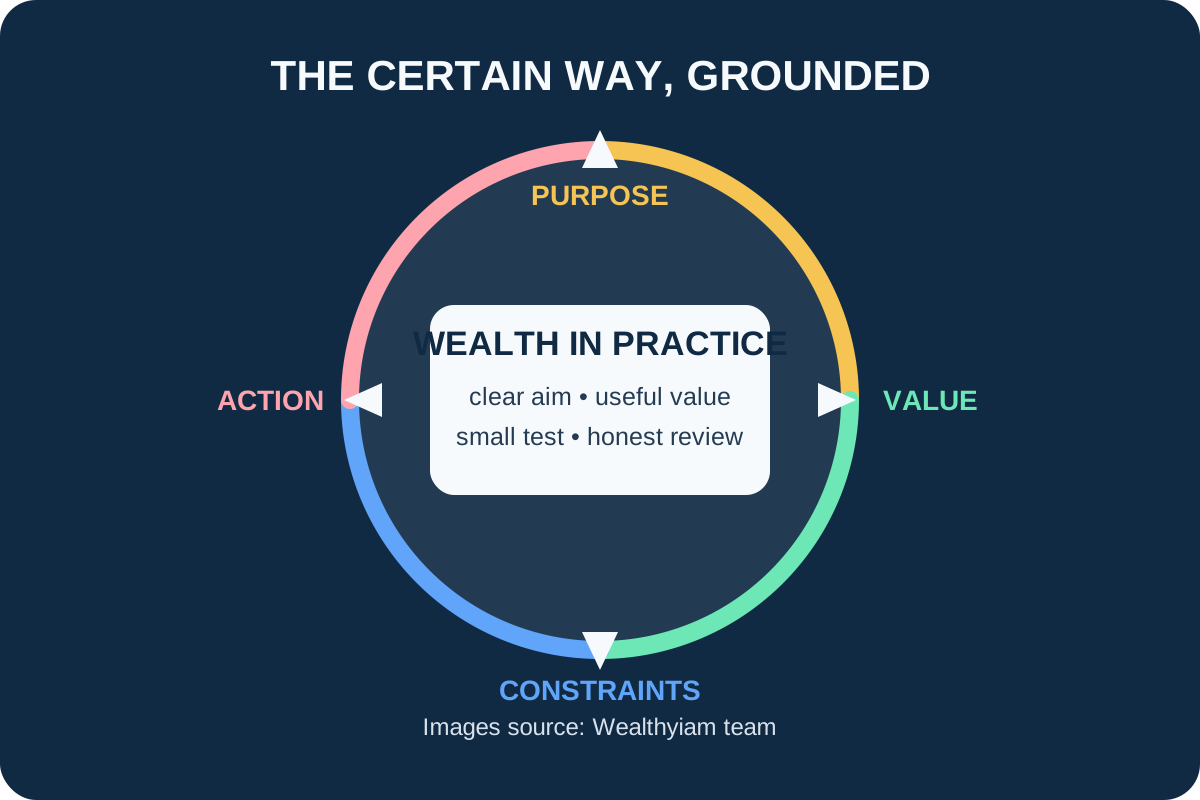
Naval’s wealth framework begins with value creation. Money follows useful work when a person solves a meaningful problem for other people. The next step is ownership: rather than exchanging every hour only for wages, look for ways to own a product, business, intellectual property, or investment that can continue producing value.
Leverage then increases the reach of that value. Code, media, capital, and well-designed systems can multiply the result of one good decision. But leverage is not a shortcut around competence. It magnifies both sound judgment and poor judgment, so the foundation remains learning, responsibility, and a clear understanding of the customer or problem being served.
Practical lessons from The Almanack
1. Find your specific knowledge
Specific knowledge is the combination of skills, interests, and experience that is difficult to teach through a standard checklist. It often appears where curiosity meets practice: a subject you explore voluntarily, a problem you notice earlier than others, or a talent that feels obvious to you but valuable to someone else.
Try this: list five activities that absorb your attention and five problems people regularly ask you to solve. Look for overlap. Then choose one capability to deepen for the next six months. Wealth-building begins with becoming more useful, not with copying someone else’s career.
2. Turn skill into ownership
High income can improve a life, but ownership creates a different kind of optionality. Ownership might mean equity in a company, a small business, a portfolio of productive assets, or reusable work such as a course, software tool, or licensed process. The point is not to reject employment; a job can be an excellent place to learn, save, and build credibility. The question is whether some of your effort can eventually produce value without being tied one-to-one to your hours.
Try this: examine your current work and identify one repeatable asset you could build from it—a documented process, a specialized service, a portfolio, or a productized offer. Test demand before investing heavily.
3. Use leverage carefully
Leverage makes a small team or a single creator more capable. Writing can reach thousands of readers; software can serve customers while you sleep; a trusted team can extend your capacity. Yet leverage also introduces obligations. Debt can amplify gains and losses, automation can spread mistakes, and a large audience magnifies careless claims.
Try this: choose one low-cost, low-downside lever. Publish a useful explanation each week, automate a repetitive administrative task, or build a simple template that improves a customer outcome. Measure whether it saves time or creates demand before adding complexity.
4. Build a reputation for accountability
Accountability means being willing to attach your name to a decision and accept the consequences. It is one reason trust can become an economic advantage. Customers, partners, and employers prefer people who make clear promises, communicate early when circumstances change, and deliver consistently.
Try this: make one specific public or professional commitment with a date and a defined result. Keep it. Over time, a record of reliable execution can open doors that credentials alone cannot.
5. Play long-term games with long-term people
Many valuable outcomes compound: skills improve, relationships deepen, capital grows, and reputation strengthens. Short-term thinking can trade those future benefits for a quick win. The book therefore emphasizes choosing collaborators who value repeated, fair exchanges rather than one-time extraction.
Try this: review your key professional relationships. Who is honest, generous, competent, and consistent? Invest more time in those relationships. Also ask whether your own behavior makes others want to work with you again.
6. Improve judgment through learning
Good judgment is not the same as having strong opinions. It is the ability to notice reality, update beliefs, and make decisions with incomplete information. Reading foundational works, studying incentives, writing down predictions, and reviewing past choices can all sharpen it.
Try this: keep a decision journal for important choices. Record what you believe, why you believe it, what would change your mind, and what happened later. This turns experience into a learning system.
7. Treat happiness as a skill
The book’s second theme is that happiness is not merely a reward for reaching a financial target. Attention, comparison, anxiety, and unexamined desires can keep a wealthy person restless. Practices such as exercise, meditation, gratitude, time away from constant stimulation, and honest relationships can improve the quality of the life that wealth is meant to support.
Try this: remove one recurring source of needless stress and schedule one activity that reliably restores you. Financial progress is more sustainable when your daily life is not permanently postponed until some future number is reached.
A seven-day implementation plan
- Day 1: Write your strengths, curiosities, and the problems you understand unusually well.
- Day 2: Select one customer problem and speak with two people who experience it.
- Day 3: Design a small paid offer focused on a measurable outcome.
- Day 4: Identify one ethical form of leverage—writing, software, systems, or collaboration.
- Day 5: Set a long-term rule for saving, learning, publishing, or serving customers.
- Day 6: Make one promise with a deadline and complete it.
- Day 7: Review what created value, what caused stress, and what you will repeat next week.
Where the ideas need judgment
Naval’s concise principles are stimulating, but they are not a substitute for context. Entrepreneurship carries risk, not every person wants to own a company, and leverage can be dangerous when it involves excessive debt or untested assumptions. Readers should adapt the ideas to their responsibilities, risk tolerance, legal obligations, and stage of life. The strongest takeaway is not “follow a formula”; it is “think clearly about value, ownership, incentives, and time.”
Bottom line
The Almanack of Naval Ravikant is a useful guide for readers who want to connect wealth with autonomy and well-being. Build rare and useful skills, convert some of that value into ownership, use leverage with care, earn trust through accountability, and make choices that can compound. Just as importantly, build a life you actually want to inhabit while the financial plan is working.
Sources and credits
- Amazon.com product page for The Almanack of Naval Ravikant (ISBN-10 1544514212; ISBN-13 9781544514215)
- Official Navalmanack website
- Cover image source: Open Library, matched ISBN 9781544514215
- Bibliographic credit: Eric Jorgenson, editor/curator, with the ideas and words of Naval Ravikant; Magrathea Publishing, 2020 edition.