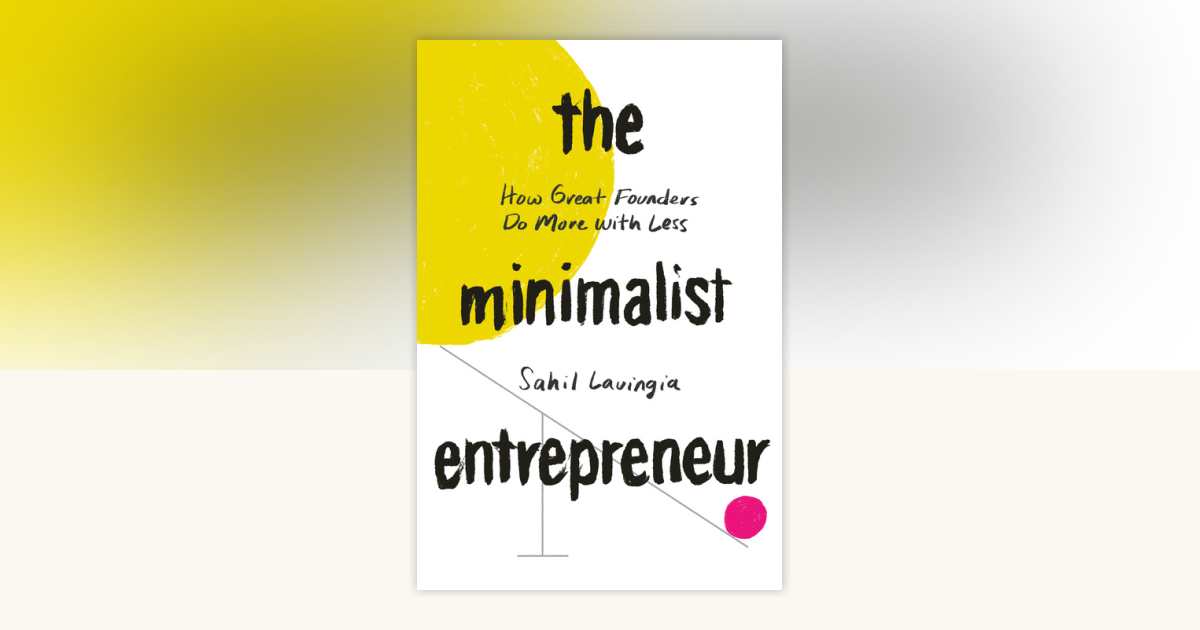
The Minimalist Entrepreneur by Sahil Lavingia presents a timely challenge to the usual startup story. Many founders are told to raise as much capital as possible, hire quickly, pursue explosive growth, and treat scale as the clearest proof of success. Lavingia offers another path: start with real people, solve a meaningful problem, charge early, protect cash and energy, and build a great company rather than merely a big one.
That idea belongs in any conversation about wealth. Wealth is not just revenue or valuation. It can also mean ownership, dependable profit, control over your time, and the freedom to keep working in a way that fits your values. The book draws on Lavingia’s experience building Gumroad and turns it into practical guidance for founders who want sustainability instead of startup theater.
The central idea: build a business worth owning
Lavingia’s minimalist approach is not an argument for thinking small or avoiding ambition. It is an argument for being selective about what deserves to grow. A business can become more valuable by improving its customers’ outcomes, increasing its profit margin, strengthening its community, and giving the owner more independence—even if its headcount remains modest.
This changes the first question an entrepreneur asks. Instead of “How quickly can this become enormous?” ask “Who has a problem I understand, and can I create a durable solution without taking on unnecessary risk?” The answer creates a healthier foundation for wealth because it connects money to actual value rather than to a story about future potential.
Practical lessons from The Minimalist Entrepreneur
1. Start with people you can understand
A common mistake is to begin with a product idea and then search for customers. Lavingia emphasizes starting closer to a community: a group whose needs, language, habits, and frustrations you can observe. This does not guarantee demand, but it gives you better information than building in isolation.
Choose a community you already serve, belong to, or can reach consistently. Read its discussions, conduct conversations, and watch what people repeatedly do to solve the problem today. Existing workarounds are useful clues because they show that the problem is real enough to cost time, money, or attention.
2. Charge before you overbuild
Positive feedback is pleasant, but payment is stronger evidence. The book encourages founders to test willingness to pay before spending months building a polished product. A paid pilot, deposit, pre-order, or small service engagement can reveal what customers value and what they do not.
This is also a wealth lesson: preserve your runway. Every dollar spent on an untested feature is a dollar that cannot fund learning, customer support, or your personal financial stability. Start with the smallest version that can produce a useful outcome. Improve it after real customers show you where improvement matters.
3. Protect both money and energy
Runway is often discussed as a financial number—the months until cash runs out—but Lavingia treats personal energy as equally important. A business that produces sales while exhausting its founder may be technically growing and practically failing.
Track a few plain measures each month: cash on hand, fixed costs, gross margin, hours worked, customer retention, and owner energy. If growth increases complexity faster than profit, pause and redesign. Lower overhead, narrower scope, better pricing, and fewer commitments can create more strategic freedom than a larger sales target.
4. Build community before depending on advertising
Community is more than an audience to monetize. It is a source of trust, feedback, referrals, and insight. Founders who consistently teach, answer questions, and help people make progress can earn attention without paying for every interaction.
Begin with a useful rhythm: publish one genuinely helpful explanation each week, host a small discussion, or respond thoughtfully to recurring questions. Pay attention to which problems people bring up without prompting. Those patterns can guide product decisions while building relationships that outlast a single marketing campaign.
5. Choose sustainability over impressive complexity
Minimalism is a discipline of subtraction. Every new feature, channel, hire, or partnership creates coordination work. Complexity is justified when it improves the customer outcome or the economics; it is not justified merely because competitors have it.
Review the business quarterly and ask: Which offer produces the strongest contribution? Which customer group is easiest to serve well? Which recurring task can be simplified? Which activity creates status but not results? Removing low-value work makes room for the actions that compound—better service, stronger skills, retained customers, and healthier cash flow.
6. Keep ownership aligned with the mission
Outside capital can be useful, but it changes the incentives and expectations around a company. Lavingia’s framework asks founders to consider whether funding helps them serve customers or pressures them into a scale pattern they do not actually want.
Before accepting capital, write down what the money is meant to accomplish, the milestones it should fund, and the obligations it creates. Bootstrapping is not always possible, and venture funding is not always wrong. The practical principle is to understand the trade: money can accelerate growth, but ownership, control, and time may be part of the price.
A step-by-step 30-day application plan
- Days 1–3: define your version of wealth. Write the income, working hours, flexibility, savings, and personal priorities your business should support.
- Days 4–10: interview a community. Speak with at least five people who face the problem. Ask about current solutions, cost, urgency, and what a better result would be worth.
- Days 11–14: design one paid test. Offer a small, clearly bounded result. Set a price and delivery date before building anything elaborate.
- Days 15–21: deliver manually and learn. Watch where customers receive value, where they hesitate, and which steps create unnecessary work. Record the evidence.
- Days 22–26: improve the economics. Calculate revenue, direct costs, hours, and margin. Remove one low-value feature and strengthen one high-value step.
- Days 27–30: choose the next constraint. Decide whether the next investment should be in customer conversations, product quality, documentation, a cash reserve, or your own skills.
What minimalist entrepreneurship does not mean
The book is not a promise that every small business will be easy or that growth is inherently harmful. A company can be small and still be fragile if it depends on one client, one platform, or one exhausted owner. Build reserves, separate business and personal finances, document critical processes, and diversify important relationships where practical.
Nor does “minimalist” mean refusing to hire or invest. A person, tool, or system earns its place when it solves a real bottleneck and produces more value than it costs. The test is intentionality. Add capacity because the evidence supports it, not because the business world treats expansion as a moral obligation.
Bottom line
The Minimalist Entrepreneur reframes wealth creation as the patient construction of a business that remains useful, profitable, and livable. Start with people, validate with payment, protect cash and energy, build trust through community, and remove complexity that does not serve the mission. You do not need to imitate the largest company in your market to create meaningful wealth. You need a business whose economics and ownership help you do valuable work for a long time.
Sources and credits
- Penguin Random House: The Minimalist Entrepreneur by Sahil Lavingia — 2021 Portfolio edition, ISBN 9780593192399
- Amazon.com product page for the matched US edition
- Cover credit: Penguin Random House official cover image for ISBN 9780593192399.