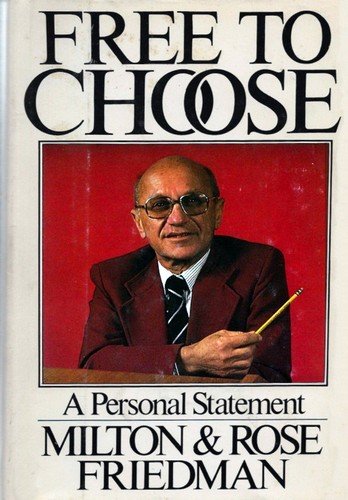
Free to Choose: A Personal Statement, by Milton Friedman and Rose Friedman, is a classic book about how economic choices shape everyday life. First published in 1980 alongside the authors’ television series, it argues that people usually make better use of resources when they can choose freely, trade with one another, and keep the rewards of their work. The book is strongly associated with free-market economics, so it is best read as a clear argument from one point of view rather than as a neutral textbook.
What the book is about
The Friedmans begin with a simple question: who should decide how resources are used? Should a central authority make most of the important decisions, or should millions of people make their own decisions through voluntary exchange? Their answer is that personal and economic freedom often work together. When people can choose what to buy, sell, study, save, or produce, their separate choices can coordinate activity through prices.
A price signal is information carried by a price. If copper becomes scarce, its price may rise. That higher price tells manufacturers to use less copper, miners to look for more, and inventors to search for substitutes. No single person needs to direct every step. Prices act like a set of signposts.
The book applies this idea to a wide range of subjects, including inflation, education, welfare, housing, labor markets, and the role of government. It asks readers to look beyond a policy’s good intention and examine its results.
Main ideas
Economic freedom supports political freedom
The authors argue that people have more independence when they can control at least some of their own work and property. If one institution controls jobs, money, housing, and supplies, disagreeing with that institution can become costly. A wider range of private choices gives people more room to act independently.
This does not mean that markets remove every form of power. Large companies, landlords, employers, and financial institutions can also have influence. The useful question is how power is limited and how people can move to another option.
Voluntary exchange can help both sides
In a voluntary exchange, each side agrees because each expects to be better off. A customer values a book more than the money paid for it, while the seller values the money more than that particular copy. Trade is not automatically fair or harmless, but the basic idea explains why exchange can create value without a central planner.
Government programs can have unintended effects
The Friedmans repeatedly separate a policy’s goal from its effect. A rule designed to help renters may reduce the supply of rental homes. A subsidy meant to help students may raise the price of education. A minimum price may protect one group while leaving another group with fewer opportunities.
Unintended effects are results that were not part of the original plan. Looking for them is one of the book’s most useful habits. It encourages readers to ask, “What will people do after the rules change?”
Inflation is a money problem with real costs
Inflation means that prices, on average, rise and each unit of money buys less. The book treats sustained inflation as closely connected to money creation and government finance. When prices rise quickly, savers, workers, businesses, and retirees have a harder time planning.
For a household, the lesson is practical: do not judge a return only by the number on an account statement. If an investment grows by 5% but prices rise by 4%, the increase in buying power is much smaller. This is called the real return: the result after considering inflation.
Simple explanations of key terms
- Free market: a system in which buyers and sellers make many decisions through exchange, rather than having every choice assigned by the government.
- Competition: a situation where different sellers try to win customers. Competition can encourage lower prices, better service, or new products.
- Monetary policy: the way a central bank influences money, interest rates, and credit conditions.
- Incentive: something that encourages a person to act. A bonus is an incentive to work harder; a tax can discourage an activity.
- Opportunity cost: the best alternative you give up when you choose something else. Spending money today may mean giving up future saving or investing.
What it gets right
The book’s greatest strength is its insistence on asking what happens next. Policies are not only words on paper; they change incentives. If a rule makes one action cheaper or safer, people may do more of it. If it makes another action expensive, they may avoid it. That way of thinking is valuable for investors, business owners, and families.
It also explains why decentralized knowledge matters. A local shopkeeper knows something about customers that a distant office may not know. A worker knows something about their skills and needs. Prices can combine many small pieces of information, even when no one sees the whole picture.
For personal finance, the book offers a useful reminder: freedom includes responsibility. A person who chooses an investment also faces its risk. A person who borrows must consider repayment. Choice is meaningful only when people understand consequences.
What to be careful about
Free to Choose is persuasive, but it is not the final word on every economic question. Markets can fail when pollution harms people who were not part of a transaction, when buyers lack important information, or when a firm gains enough control to weaken competition. Public goods, such as some forms of national defense, can also be difficult to provide through ordinary buying and selling.
The book’s examples and policy debates come largely from the late twentieth century. Some facts, institutions, and technologies have changed. Readers should not treat every historical claim as a current forecast. It is also important to distinguish between a market being useful and every market outcome being morally acceptable.
A balanced reading compares the Friedmans’ arguments with evidence and with other traditions in economics. That does not weaken the book. It makes the reader better at separating a strong question from a conclusion that still needs testing.
Steps to apply the book’s ideas
- List the choice. When considering a purchase, job, loan, or investment, write down the decision you are actually making.
- Check the incentives. Ask what each person or organization gains or loses under the current rules.
- Look for the price signal. Identify what prices, interest rates, wages, or fees are telling you about scarcity and demand.
- Count the opportunity cost. Compare your choice with the best alternative, including saving or investing the money.
- Test the second result. Think about how people may respond after the decision. Look for effects that were not intended.
- Keep responsibility with choice. Use freedom to make decisions, but check risks, contracts, taxes, and facts before acting.
Bottom line
Free to Choose is an accessible defense of economic freedom and a practical lesson in thinking about incentives, prices, and unintended results. Its arguments are not beyond debate, especially on regulation, welfare, and the proper limits of government. But even readers who disagree with parts of it can gain a useful habit: follow a policy or money decision through to the people who must live with its consequences.