The Little Book That Still Beats the Market by Joel Greenblatt offers a simple way to think about stock investing: try to buy good businesses at bargain prices. The book is known for its “Magic Formula,” a rules-based method that ranks companies using two ideas—how good a business is and how cheap its shares are.
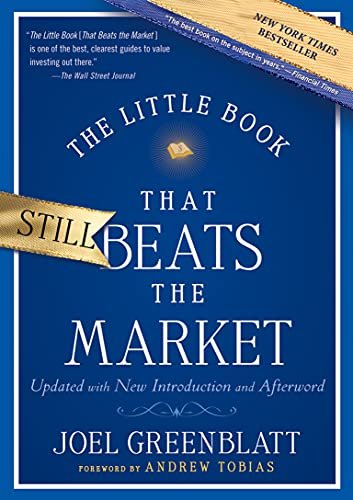
Original cover image from the Amazon listing for the 2010 Wiley edition.
The method is easy to describe, but it is not a shortcut to guaranteed profits. Its real lesson is about discipline: use sensible rules, accept that they may look wrong for a while, and avoid letting fear or excitement control every decision.
What the book is about
Greenblatt starts with a child-friendly example. Imagine buying a small business. You would want a business that earns a lot of money compared with the machines, buildings, and other resources it needs. You would also want to pay a reasonable price for it. Buying a stock is similar because a stock is a small ownership share in a real company.
The book turns that common-sense idea into a repeatable process. First, look for companies that use their business resources effectively. Second, look for companies whose profits are high compared with their share price. Then combine the rankings instead of relying on a story, a hot tip, or a prediction about next week’s market.
The Magic Formula in simple language
1. Find good businesses
Greenblatt uses return on capital to estimate business quality. In plain language, this asks: “How much operating profit does the company produce from the money tied up in the business?” A higher result can suggest that the company is efficient. It does not automatically mean the company is safe or wonderful, because accounting numbers can hide important details.
2. Find reasonably cheap businesses
The second measure is earnings yield. This is a way to compare a company’s profits with the price investors are paying for its shares. If a company earns $10 for every $100 of share price, its simple earnings yield is 10%. A higher earnings yield can mean a cheaper stock, although a low price may also reflect real problems.
3. Combine the two ideas
The formula ranks companies on both measures and favors businesses that score well overall. The goal is not to buy the cheapest companies or the highest-quality companies in isolation. It is to seek a useful mix: a strong business offered at an attractive price.
Key terms explained
- Stock: a small piece of ownership in a company.
- Market price: what buyers and sellers currently agree to pay for a share.
- Profit: money left after a business pays its costs.
- Return on capital: a rough measure of how efficiently a company turns business resources into operating profit.
- Earnings yield: company earnings compared with the share price; it is the reverse of the price-to-earnings ratio.
- Value investing: buying an asset for less than your estimate of what it is worth.
- Back-test: testing a rule on old market data to see how it would have behaved. A back-test is evidence, not a promise.
- Diversification: spreading money across many investments so one mistake does not damage the whole portfolio.
Why the strategy can work
The book argues that markets are not perfectly wise every minute. Investors can become too excited about popular companies and too gloomy about unfashionable ones. A rules-based strategy may take advantage of those repeated human mistakes.
There is also a useful connection between price and quality. A wonderful business can be a poor investment if its price is absurdly high. A very cheap company can be a poor investment if its business is falling apart. Combining quality with price gives investors a better starting point than looking at either one alone.
Steps to apply the book’s ideas
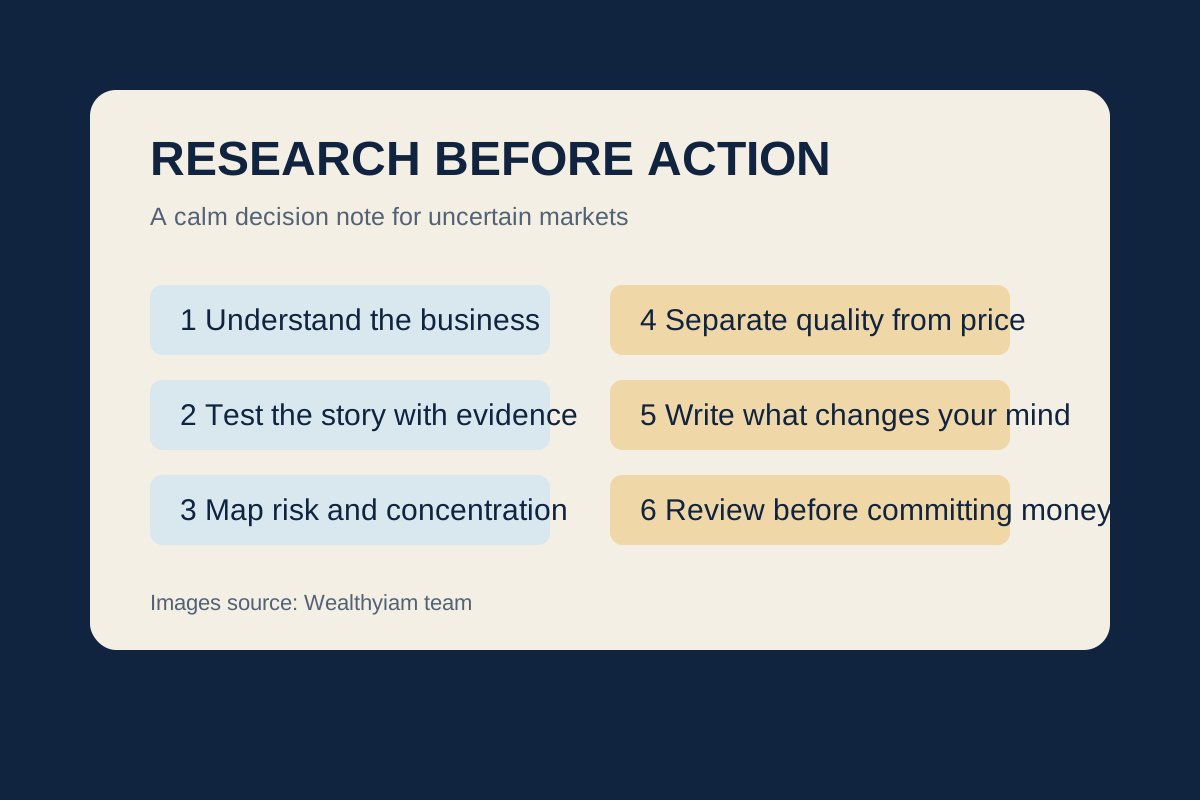
- Learn the business first. Before using a screen, understand what the company sells, how it makes money, and what could hurt it.
- Measure quality and price. Compare return on capital and earnings yield across similar companies, while checking debt, cash flow, and unusual accounting items.
- Build a diversified list. Do not place all your money in one company. A basket reduces the damage from a single bad result.
- Write down your rules. Record why you bought, what could prove you wrong, and how long you expect to hold.
- Expect uncomfortable periods. A strategy can trail the market for months or years. Decide in advance how you will judge it, rather than changing rules after every headline.
- Review calmly. Recheck the business and the numbers on a schedule. Do not trade simply because the share price moved yesterday.
What the book gets right
Its biggest strength is clarity. Greenblatt explains difficult investing ideas with simple examples instead of making readers feel that investing is a secret language. The book also makes an important distinction between a good company and a good stock purchase. Price matters.
Another strength is its focus on process. Investors often say they want to buy low and sell high, but they need rules for doing that when a stock is unpopular. A mechanical checklist can reduce emotional decisions and make it easier to compare opportunities.
What to be careful about
The Magic Formula is not magic and it does not guarantee that every stock will rise. Financial measures can be distorted by debt, one-time profits, cyclical industries, acquisitions, or accounting choices. A screen can create a list of companies to study; it cannot replace studying them.
The method may also behave differently in different countries, time periods, and market conditions. The book’s historical results do not tell you what will happen next. Taxes, trading costs, changing company conditions, and your own need for cash all matter.
Finally, “beating the market” is not the only goal. A low-cost, diversified index fund may be a better fit for many people because it is simple, cheap, and hard to misuse. Any strategy should match the investor’s knowledge, time, risk tolerance, and long-term plan.
Bottom line
The Little Book That Still Beats the Market teaches one durable idea: look for good businesses, seek a sensible price, and follow a patient process. Its formula is useful as a framework for research, not as a promise of easy money. The most valuable lesson may be behavioral—clear rules can help investors stay rational when the market is noisy.