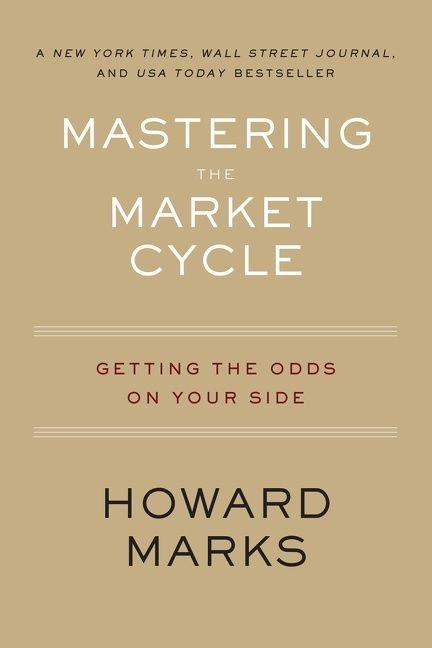
Mastering the Market Cycle is Howard Marks’s book about one big investing truth: markets move in waves. Prices, credit, and investor feelings rise and fall together. Marks does not promise a magic way to call the exact top or bottom. Instead, he teaches readers how to notice where the market stands and how to tilt the odds in their favor. [1][2][3]
In plain words: you do not need perfect predictions. You need a calm eye, a patient mind, and a sense of where risk is getting too hot or too cold.
Book facts
| Author | Howard Marks |
|---|---|
| First published | 2018 |
| Publisher | Nicholas Brealey Publishing / HarperBusiness editions |
| Length | 323 pages in the Google Books edition; Goodreads lists the hardcover at 336 pages. [2][3] |
| Main topics | Market cycles, credit cycles, investor psychology, risk control, and probability thinking. [1][2][3] |
| Why it matters | It helps readers stop guessing and start thinking about the market the way a careful owner would. [1][2] |
What the book is about
Marks argues that the market is never truly still. It moves through phases of optimism, greed, fear, and pain. Those feelings change prices, lending, and the amount of risk people are willing to take.
The book is less about prediction and more about judgment. Marks says investors should learn how to ask, Where are we in the cycle right now? That question is more useful than trying to name the exact day a bubble will burst or a recovery will begin.
Main ideas, explained simply
1. Cycles are real
Markets do not move in straight lines. They swing up and down because people get excited, then scared, then excited again.
2. Credit matters
Credit is borrowed money. When borrowing is easy, risk grows fast. When borrowing is tight, trouble often shows up.
3. Psychology matters
People often buy more when everyone feels brave and sell when everyone feels afraid. That habit can hurt returns.
4. Odds beat certainty
Marks wants investors to think in probabilities. That means asking what is likely, not pretending anyone knows the future for sure.
Simple explanations of key terms
Market cycle
A market cycle is the repeating pattern of rising, peaking, falling, and recovering. Think of it like a tide going in and out.
Credit cycle
This is the part of the cycle tied to borrowing. When lenders hand out money easily, the cycle often gets hotter. When they pull back, the cycle can cool fast.
Probability
Probability means the chance of something happening. In the book, Marks says smart investors care about better odds, not perfect certainty.
Defensive posture
This means being more careful: using less leverage, taking less risk, and protecting capital when conditions look stretched.
What the book gets right
- It respects uncertainty. No one knows the future with perfect accuracy.
- It treats risk as real. Risk is not just price drops; it is also overconfidence, debt, and weak judgment.
- It connects money and emotion. The crowd often gets brave at the worst time and scared at the best time.
- It pushes patience. Long-term results usually come from good habits, not dramatic guesses.
What to be careful about
The book is wise, but it can also feel repetitive because Marks keeps circling back to the same big lesson: do not trust the crowd too much. That repetition is not a mistake, but some readers may want more step-by-step tools.
Also, the book is not a crystal ball. It helps you understand the weather, but it does not tell you the exact minute it will rain. Use it as a guide for judgment, not as a machine that predicts prices.
Kid-simple version: the book helps you notice when the playground is crowded and risky. It does not tell you exactly when the bell will ring.
Bottom line
Mastering the Market Cycle is a clear reminder that investing is not just about buying good things. It is also about buying them at a sensible time, with sensible risk. If you want a book that teaches calm thinking instead of hype, this one is a strong read.