One Up on Wall Street is Peter Lynch’s guide to using everyday knowledge as a starting point for stock research. Lynch, who managed Fidelity Magellan, argues that regular people can sometimes notice promising companies before professional investors do. But noticing a good product is only the beginning: the investor still has to study the business, its finances, and its price.

What the book is about
Lynch’s central message is that investment ideas can appear in ordinary places: a shop, a workplace, or a product used by a family. If many people love a product, that may be a clue that its maker deserves a closer look. It is not proof that the stock will rise. It is simply a reason to begin asking questions.
The book then explains how to sort businesses into broad groups, such as slow growers, stalwarts, fast growers, cyclicals, turnarounds, and asset plays. Each group needs a different kind of investigation because a fast-growing company and a troubled company do not behave in the same way.
Main ideas
- Use what you know, then investigate. Personal experience can produce ideas, but it cannot replace research.
- Buy a business, not a ticker symbol. A stock is a small ownership piece of a real company.
- Look at the numbers. Sales, profits, debt, cash flow, and the price paid all matter.
- Expect patience to matter. A good company may need years to show its value.
- Know why you own it. A clear reason makes it easier to judge whether the original idea still holds.
Simple explanations of key terms
Tenbagger
A tenbagger is a stock that grows to ten times its original value. Lynch uses the term to describe the few very successful investments that can make a large difference in a portfolio. They are rare, uncertain, and never guaranteed.
Price-to-earnings ratio
The price-to-earnings ratio, or P/E, compares a company’s share price with its profit per share. In simple terms, it shows how much investors are paying for each unit of current profit. A low P/E is not automatically a bargain, and a high P/E is not automatically a bad choice.
Cyclical company
A cyclical company earns more or less depending on the economic weather. Car makers, airlines, and some manufacturers may do well when people spend freely and struggle when the economy slows. Their recent profit can therefore be misleading.
Balance sheet
A balance sheet is a snapshot of what a company owns and owes. It helps an investor see assets, debt, and the owners’ remaining share. A strong business with too much debt can still be a risky investment.
What it gets right
The book is right that ordinary observation can be useful. People often see customer behavior directly, while professional analysts may learn about it later. Lynch is also right to insist that a story is not enough. A popular product must lead to questions about competition, growth, margins, debt, and valuation.
Another strength is its focus on matching expectations to reality. A large, mature company cannot usually grow like a tiny fast-growing one. Investors should ask what kind of growth the market already expects and whether the business can deliver it.
What to be careful about
“Invest in what you know” can be misunderstood. Knowing a brand does not mean knowing its finances, and a wonderful company can be a poor investment if its shares cost too much. Individual stock picking also takes time and carries the risk of losing money.
The book’s examples come from earlier market periods, so readers should not copy old company names or past growth rates. Today, a diversified low-cost index fund may be a better fit for people who do not want to research and monitor individual businesses. Diversification means spreading money across many investments so one mistake hurts less.
Bottom line
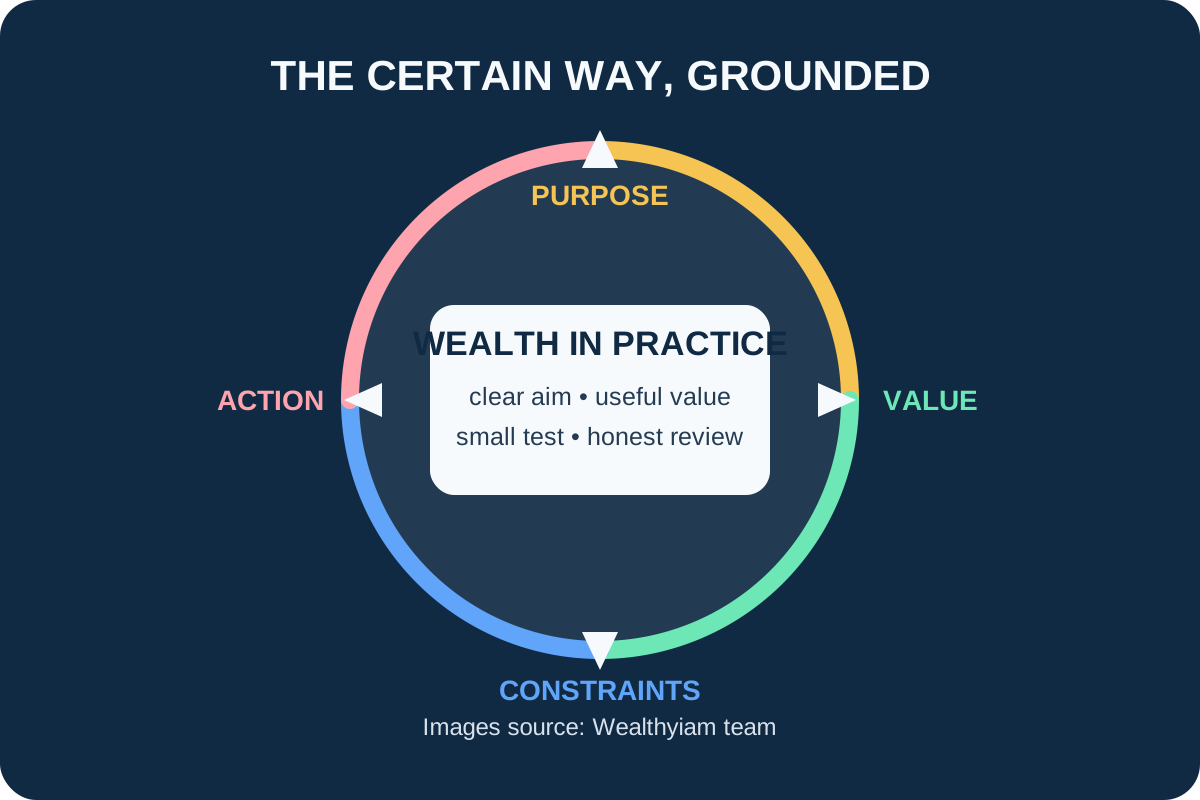
One Up on Wall Street is best read as a lesson in disciplined curiosity. Start with what you notice, but finish with evidence. The practical habit is simple: understand the business, check its financial health, compare the price with reasonable expectations, diversify, and give long-term ideas time to work.
Sources
- Simon & Schuster publisher page
- Open Library edition record
- Publishers Weekly review and bibliographic details
Related reading: For a fuller beginner roadmap, see Investing Basics.