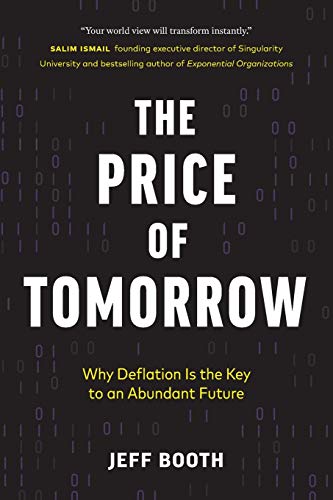
The Price of Tomorrow by Jeff Booth is a clear, provocative book about the meeting point between technology, money, debt, and the future of work. Booth argues that technology naturally makes many goods and services cheaper, while modern economies are built around rising prices, borrowing, and constant growth. The result is a conflict that affects investors, workers, families, and governments.
What the book is about
Booth writes as a technology entrepreneur who has watched online commerce and software change how businesses operate. A computer program can serve more customers without needing a new building for each customer. An automated machine can make more products with less human effort. Competition then pushes companies to offer more value for less money. This is what Booth calls a deflationary force: a force that tends to reduce prices.
Our financial system often moves in the opposite direction. Governments, banks, companies, and households borrow today and expect tomorrow’s income to be larger. Rising prices can make old debts easier to repay in money terms. But if technology keeps lowering costs, or if wages cannot keep up with living costs, the system becomes harder to balance. Booth says policymakers often respond with more credit and money, which may postpone the problem while increasing debt and inequality.
Key terms explained simply
Inflation
Inflation means money buys less than before. If the same basket of groceries rises from $100 to $105, the prices went up and purchasing power went down.
Deflation
Deflation means average prices fall. Falling prices can be harmful when caused by unemployment and a collapsing economy. Booth is mainly interested in a different kind: lower prices created by better technology and greater abundance.
Debt-based growth
This means using borrowed money to create spending and expansion. Debt can help fund a productive business, but it becomes fragile when new borrowing is needed to support old promises.
Exponential change
Linear change adds the same amount each time. Exponential change multiplies. Technology can appear quiet for years and then improve very quickly, while laws, schools, and financial systems usually change slowly.
Main ideas
1. Technology is naturally deflationary
Innovation lets people produce more with fewer resources. Software, automation, online marketplaces, and artificial intelligence can lower the cost of useful work. Booth sees this as the foundation of abundance: more choices and better services for less effort.
2. Debt can hide the real economy
Headline growth is not always healthy growth. If spending increases mainly because people and governments borrow more, the economy may look larger while becoming more fragile. High asset prices can also reward owners of property and shares while making life harder for people who only earn wages.
3. The transition can be unfair
When a machine replaces a task, the owner may gain before the worker finds a new role. This can increase inequality and social tension. Booth’s concern is not only whether technology works, but who receives its benefits.
4. Abundance needs new rules
The book’s hopeful message is that cheaper energy, software, and automated services could raise living standards. But society needs rules that let people share those gains instead of forcing everyone to depend on ever more debt and ever higher prices.
Steps to apply the book’s ideas
- Separate price from value. Ask whether something costs more because it became better, or because money lost purchasing power.
- List your debt. Record each balance, interest rate, payment, and purpose. Productive borrowing and lifestyle borrowing carry different risks.
- Build adaptable skills. Learn to communicate clearly, solve problems, judge information, and use new tools. These skills can work alongside changing technology.
- Create breathing room. Keep an emergency fund and avoid fixed costs so a job change or price shock does not immediately become a crisis.
- Stay humble about forecasts. No one knows the exact path of inflation, deflation, automation, or policy. Diversification and a margin of safety still matter.
What the book gets right
- It connects personal finance with technology instead of treating them as separate subjects.
- It shows that innovation can create both lower costs and painful disruption.
- It asks who benefits when asset prices rise and who bears the cost of adjustment.
- It encourages readers to question easy claims about economic growth.
What to be careful about
The book is deliberately contrarian, so some claims are more confident than the evidence can support. Technology does not make every price fall. Housing, healthcare, education, energy, and scarce land follow different rules. Inflation can also come from supply problems and strong demand, not only from debt and money creation.
Deflation is not automatically friendly. If prices fall because people are losing jobs and companies are failing, families may delay spending and the downturn can worsen. Technology-driven lower prices are different from recession-driven lower prices. Readers should also avoid turning the book into a promise that one asset or investment strategy must win. The lasting lesson is to understand forces, control risk, and remain adaptable.
Bottom line
The Price of Tomorrow is an accessible introduction to the conflict between fast technology and a financial system built on debt and rising prices. Jeff Booth’s strongest idea is that progress can make goods and services abundant, but old rules may prevent ordinary people from enjoying the gains. Read it as a challenge to think about purchasing power, skills, debt, and resilience—not as a guaranteed prediction.