The Psychology of Money is a book about money, but it is really a book about behavior. Morgan Housel shows that people do not make money decisions with pure logic. They make choices with memory, fear, pride, hope, family history, and habits. That is why two smart people can look at the same market or the same paycheck and make very different choices.
The book is popular because it feels honest. It does not pretend that everyone has the same life. Some people grew up with safety. Some grew up with scarcity. Some saw markets rise for years. Others lived through crashes. Those experiences shape the way people think about saving, spending, investing, and risk. The book says that this is normal. No one is crazy. We all bring our own story into every money choice.
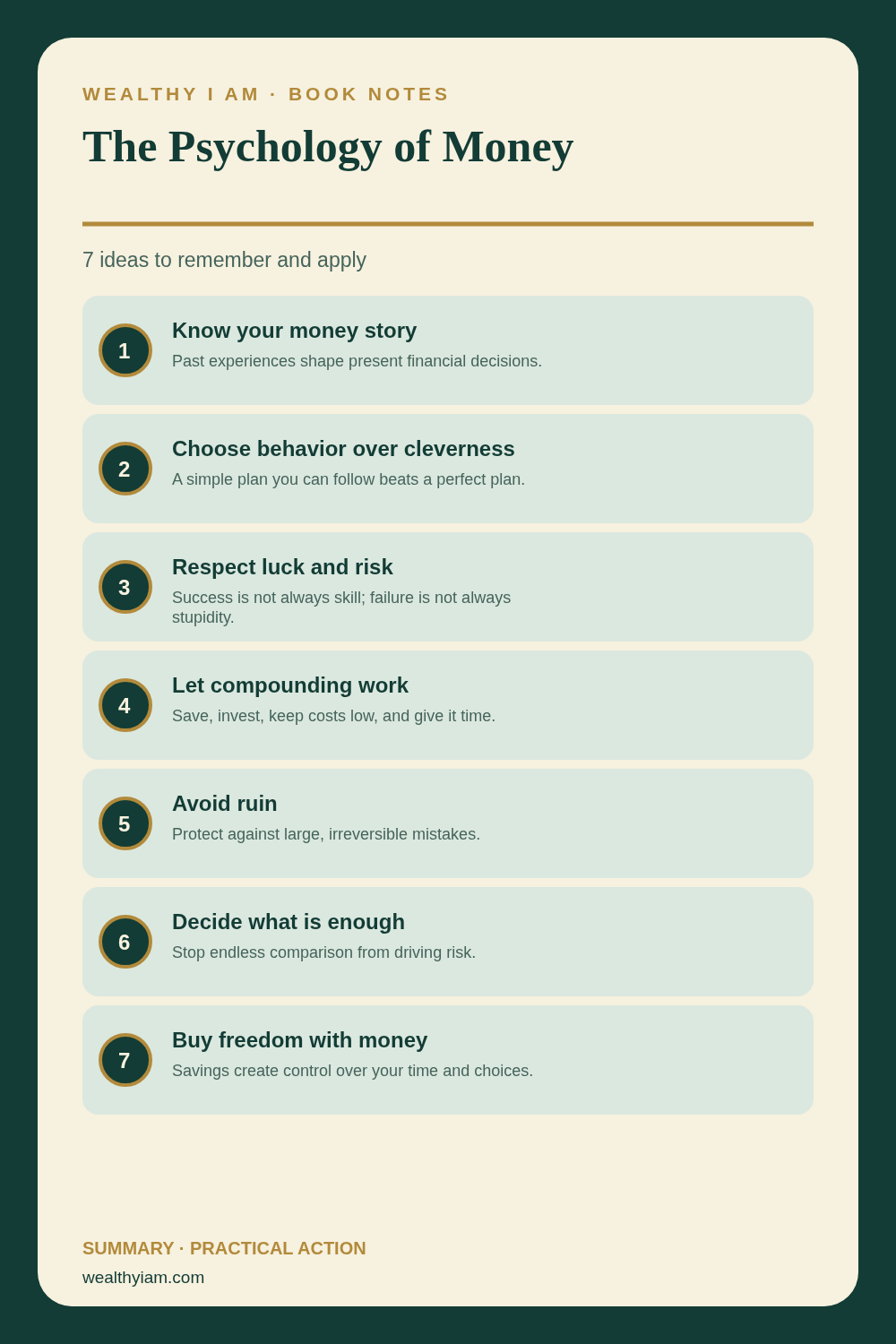
One of the strongest ideas in the book is that money is not only about what you know. It is also about how you behave when things are uncomfortable. Many people know that they should save more, invest regularly, or avoid debt. The hard part is doing those things when life feels busy, stressful, or uncertain. That is why behavior matters more than cleverness. A simple plan that you can follow is often better than a brilliant plan you cannot stick to.
The book also explains luck and risk. We often like clean stories. We want to say that success always comes from talent and hard work, and failure always comes from bad choices. But real life is messier than that. Sometimes good people get lucky. Sometimes careful people get hurt by events they did not control. The lesson is not that effort does not matter. The lesson is that humility matters. When you understand luck and risk, you become less arrogant and more thoughtful.
Another major idea is compounding. Compounding is what happens when growth builds on itself over time. It sounds simple, but it is one of the most powerful forces in personal finance. The book reminds readers that compounding often works slowly at first and then very quickly later. That means patience is not boring. Patience is a strategy. If you keep saving, keep investing, and keep your costs low, the results can become surprisingly strong after many years.
Housel also talks about the difference between getting wealthy and staying wealthy. These are not the same thing. Many people can make a lot of money quickly. Staying wealthy is harder. Why? Because staying wealthy requires avoiding big mistakes. It requires knowing when enough is enough. It requires not taking reckless bets just because life is going well. A person can have a strong investment year and still lose everything later if pride takes over. The book warns against that trap.
The idea of “enough” appears again and again. That word is important because money can quietly change the goalposts. A person may say they want $100,000, then $250,000, then $1 million, then more. The target moves because the mind gets used to every new level. The book asks a difficult question: when will you feel satisfied? That question is not anti-ambition. It is a reminder that chasing more without a stopping point can create stress instead of happiness.
Freedom is another central theme. Money is useful because it can buy time and options. It can give you the power to leave a bad job, slow down when you need rest, or make choices that fit your life. Many people think money is mainly for buying things. The book says money is also for buying control over your calendar. That idea can change the way you save. Saving is not just about future purchases. Saving is about future freedom.
The book is also strong because it lowers the temperature around investing. It does not tell readers to become obsessed with every headline. It does not push constant trading. It teaches that a calm long-term approach is often better than a dramatic one. That matters because many investors lose money by reacting too quickly. They buy after excitement and sell after fear. The book encourages the opposite: build a plan, keep your costs low, and stay invested long enough for time to do its work.
For regular readers, this book is useful because it connects money to everyday life. It is not only about Wall Street or financial jargon. It is about lunch-table decisions, family pressure, comparison, and the stories we tell ourselves. That makes it easier to understand than books that only focus on formulas. The language is simple, but the ideas are deep. You can read it once for motivation, and read it again later for better judgment.
It also helps to notice that the book does not promise perfection. It does not claim that there is one perfect portfolio, one perfect income number, or one perfect age to retire. Instead, it points readers toward good habits. Good habits are realistic. They are the kind of thing ordinary people can keep doing for years. That is why the book feels practical instead of theoretical.
What the book teaches
The main lesson is that money behavior matters more than money knowledge alone. You can know a lot and still make poor decisions if fear or pride takes control. The book also teaches that patience, humility, and consistency are powerful financial tools. Small choices repeated over time can create big results.
It also teaches that wealth is often invisible. A person who looks rich may be in debt. A person who looks ordinary may be financially strong. The book pushes readers to think about net worth, savings, and freedom instead of only visible spending.
Why it matters now
Today, people are surrounded by money advice from social media, influencers, and fast-talking promoters. That can make money feel noisy and confusing. This book is helpful because it cuts through that noise. It reminds readers that you do not need to follow every trend. You need a calm plan you can trust.
It also matters because many people are under pressure. Costs are high. Housing can be expensive. Jobs can feel unstable. In that kind of environment, emotional decisions are more likely. A book that teaches steady behavior is useful in any economy, but especially in one that feels uncertain.
Step by Step: How to apply the book
- Write down your monthly income, fixed bills, and main spending habits.
- Set one simple savings target that you can keep even in a difficult month.
- Build an emergency fund so unexpected costs do not force panic decisions.
- Invest regularly instead of trying to guess the perfect time to buy.
- Keep fees low and avoid products that are hard to understand.
- Review your goals once in a while, but do not keep moving the target every week.
- Remember that freedom is part of wealth, not just a number in a bank account.
If you want a book that explains money in a simple and human way, this one is a great choice. It is honest, practical, and easy to apply. The biggest lesson is that you do not need to be perfect with money. You need to be thoughtful, patient, and steady.
Related reading: Personal Finance Fundamentals is a useful next step for beginners who want to build a simple money system.
Wealthy I AM Action Card
Wealthy I AM Pinterest Copy
TITLE
The Psychology of Money: How to Make Better Money Decisions
DESCRIPTION
A simple English guide to the main lessons from The Psychology of.
KEYWORDS
The Psychology of Money book summary, Psychology Money lessons, personal development, wealth building, productivity books
ALT TEXT
Wealthy I AM visual summary of The Psychology of Money: How to Make Better Money Decisions
ARTICLE URL
https://wealthyiam.com/psychology-of-money-better-money-decisions/