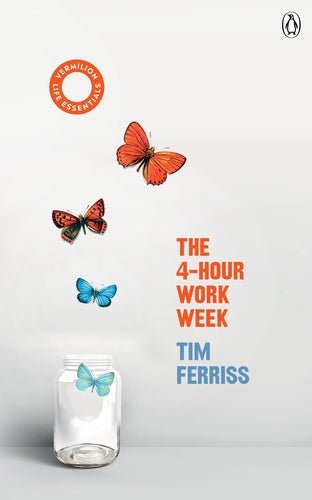
The 4-Hour Workweek by Tim Ferriss is a book about work, money, and freedom. It asks a surprising question: what if a good life is not about working more hours, waiting until old age to enjoy life, and collecting things you do not use?
Ferriss calls his approach lifestyle design. In plain language, that means building work and money systems around the life you actually want. The book is not a promise that everyone can work exactly four hours a week. It is a challenge to notice which work creates value, which work is just noise, and how business can give you more control.
First published in 2007, the book became known for its DEAL framework: Definition, Elimination, Automation, and Liberation. These four steps form the book’s map from a traditional job toward more flexible work.
What the book is about
The book criticizes the old “deferred life” plan: work hard for decades, save what you can, and hope retirement gives you time to live. Ferriss argues that people can sometimes bring useful parts of retirement into the present through remote work, small businesses, outsourcing, and planned breaks.
Its financial idea is important: income is not the same as freedom. A high salary can still leave you trapped if your spending is high, your work cannot be paused, and every task depends on you. The goal is not merely to earn more. The goal is to create a gap between the money you need and the amount of time you must personally spend earning it.
The main ideas
1. Define what “rich” means to you
Ferriss uses the phrase New Rich for people who value time, mobility, and experiences as well as money. This does not mean that money is unimportant. It means that money is a tool. Before chasing a bigger income, decide what the income is meant to buy: a safer home, time with family, travel, creative work, or fewer stressful days.
This is also a lesson in opportunity cost. Opportunity cost means what you give up when you choose one thing. An extra hour at work may earn money, but it also costs an hour that could have gone to health, family, or learning.
2. Use the 80/20 rule
The 80/20 rule, also called the Pareto principle, says that a small number of causes often create a large share of results. In a business, a few customers may provide most of the profit. A few tasks may create most of the useful output.
Ferriss recommends finding those high-value activities and reducing low-value work. The rule is not a perfect mathematical law. Think of it as a flashlight: shine it on your time and ask which actions matter most.
3. Remove unnecessary work
Elimination means stopping work that does not help your main goal. Ferriss questions constant email checking, unnecessary meetings, and the habit of answering every request immediately.
He also discusses Parkinson’s law: work often expands to fill the time allowed for it. If a task gets one week, it may take one week even when it could have taken one afternoon. Shorter, clear deadlines can force better decisions, but only when the work still meets a sensible quality standard.
4. Automate carefully
Automation means using systems, software, or other people to handle repeatable tasks. In business, this might mean a simple online product, a clear customer-support process, or a virtual assistant handling routine administration.
The book’s deeper point is to build a process instead of becoming the process. If only you know how every small task works, the business owns your time. If the steps are documented and tested, the business can keep moving when you are away.
5. Aim for liberation, not just escape
Liberation means gaining control over where and when you work. The book suggests remote work, mini-retirements, and location flexibility. A mini-retirement is a planned break during working life rather than waiting for one large retirement at the end.
Freedom still needs money management. A person with no emergency savings may be mobile on paper but anxious in real life. Flexibility works best when paired with low fixed costs, a cash buffer, insurance, and a realistic income plan.
Simple explanations of key terms
- Cash flow: the money coming in and going out. Positive cash flow means more enters than leaves.
- Fixed cost: a bill that usually stays similar, such as rent or a loan payment.
- Variable cost: a cost that changes, such as meals, travel, or entertainment.
- Outsourcing: paying someone else to do a task so you can focus on work only you can do.
- Productized service: a service sold in a clear package with a set result, price, and process.
- Passive income: money that can continue with limited ongoing work. “Passive” rarely means zero work or zero risk.
Step by step: applying the book’s ideas
- Write your target lifestyle. List the places, activities, people, and level of comfort you want. Put numbers on the important costs.
- Track your time for one week. Mark tasks that create money, health, relationships, learning, or nothing useful.
- Find the vital few. Identify the small group of tasks, customers, or products that create most of your useful results.
- Cut one low-value commitment. Remove a meeting, notification, subscription, or recurring task that does not support your goals.
- Test before quitting. Try remote work, a small product, or a packaged service while keeping your financial base stable.
- Document repeatable work. Write simple instructions and test them with another person before handing over responsibility.
- Build a safety buffer. Keep emergency savings and check taxes, insurance, debt, and legal duties before increasing your freedom.
- Review monthly. Measure both money and time. A plan that earns more but makes life worse needs changing.
What the book gets right
The strongest lesson is that being busy is not the same as being productive. It is possible to spend all day on email and still avoid the one decision that matters. The book also correctly treats attention as a financial resource. Every hour spent on low-value work is an hour unavailable for higher-value work.
It is also useful to think about income quality. Two people can earn the same amount, but the person with lower fixed costs and more control may be financially stronger. A business that depends on one owner for every decision is not as free as its revenue numbers suggest.
What to be careful about
Some examples in the book are dated. Online tools, remote work, advertising, and overseas outsourcing have changed since 2007. Not every job can become location-independent, and not every business should outsource its customer relationships or sensitive data.
The promise in the title can also distract from the real lesson. Building a dependable business often takes much more than four hours at the beginning. Automation can reduce repetitive work, but it cannot replace good judgment, useful skills, customer trust, or legal and tax compliance. Do not quit a job, borrow money, or buy a risky business model simply because a book makes freedom sound easy.
Bottom line
The 4-Hour Workweek is best read as a book about questions, not guarantees. It asks you to define enough, protect your attention, remove needless work, and build systems that make money less dependent on every minute of your day.
Its practical message is simple: earn with purpose, spend with awareness, and design work around a life you value. The four-hour target may not fit everyone, but the search for higher-value work and greater control can improve almost any financial plan.