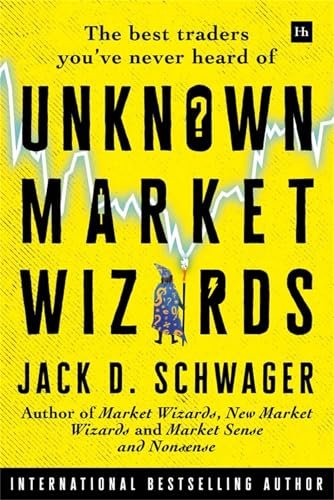
Unknown Market Wizards by Jack D. Schwager looks at traders who became highly successful while managing their own money, often far from the spotlight. Instead of presenting one magic formula, Schwager uses interviews to show how different people built a repeatable process, controlled risk, and learned from mistakes.
What the book is about
The book is part of Schwager’s long-running Market Wizards series. Its special focus is independent traders: people trading their own accounts rather than managing famous mutual funds or large public firms. The 2020 edition presents conversations about their training, methods, best trades, worst trades, and the personal habits behind their results. A revised paperback edition later added interviews about the unusual markets of 2020–2022.
That format matters. A textbook can describe a strategy in neat steps. A real interview shows that trading is messier. People change their minds, suffer losses, adapt to new conditions, and sometimes discover that a method that worked before no longer fits the market.
Main ideas
There is no single winning strategy
The traders profiled do not all use the same tools. Some study company and economic facts. Some read price charts. Some use rules and computer models. Others combine several approaches. Their common ground is not a particular indicator. It is a clear method that matches their personality, skills, time horizon, and tolerance for losses.
This is a useful warning for beginners. A strategy copied from a famous trader may fail if the trader cannot follow it during a losing streak. A good method must be understandable enough to use consistently.
Risk control comes before profit
Trading risk means the chance of losing money. Schwager’s interviews repeatedly point toward protecting capital first. If one bad trade can end your account, the position is too large. If a trader survives many small losses, there is still a chance to benefit when the method finds a good opportunity.
This is different from trying to predict every market move. No trader knows the future with certainty. Risk control accepts uncertainty and limits the damage when a forecast is wrong.
Losses are information, not identity
Successful traders still lose. The difference is how they react. A loss can show that an idea was wrong, timing was poor, or the market simply produced an unlikely outcome. The important question is whether the loss was planned and affordable, or whether fear, pride, and hope made it grow.
Adaptability is a skill
Markets change. A quiet period can become highly volatile, meaning prices move sharply. A trend can reverse. A market that once rewarded one type of trade can stop rewarding it. The book shows why traders need rules for reviewing assumptions rather than blindly repeating yesterday’s behavior.
Performance records need context
A return is the amount an account gains or loses. A 30% return sounds impressive, but it tells us little by itself. We also need to ask: How much risk was taken? How large was the worst decline? How long was the record? What markets were traded? Could the result be repeated after fees and taxes?
Simple explanations of key terms
- Position size: how much money is committed to one trade. Smaller positions reduce the damage from a bad result.
- Drawdown: the fall from an account’s high point to a later low point. It describes a losing period.
- Volatility: how widely and quickly prices move. High volatility means larger swings, not guaranteed profits.
- Trend following: trying to participate in a sustained rise or fall instead of guessing the exact turning point.
- Fundamental analysis: studying underlying facts such as earnings, debt, supply, and demand.
- Technical analysis: studying price and trading-volume patterns to make decisions.
- Trading edge: a repeatable reason to believe a method has better odds than a random choice after costs.
- Risk-reward ratio: a comparison between a possible loss and a possible gain. It does not make a trade safe.
Step by step: applying the book’s lessons
- Choose one market and style. Decide whether you are studying stocks, futures, currencies, or another asset, and whether trades last minutes, days, or months.
- Write a simple hypothesis. State why a trade might work, such as faster-than-expected company growth or a price breakout.
- Define the invalidation point. Before entering, write what evidence would show the idea is wrong. This prevents hope from replacing a plan.
- Set the maximum loss. Choose an amount that will not threaten rent, bills, emergency savings, or long-term investments.
- Size the position from the risk. Work backward from the affordable loss, rather than starting with the largest trade you can buy.
- Keep a trading journal. Record the reason, entry, exit, size, result, and emotional state.
- Review a group of trades. One win proves little and one loss proves little. Look for patterns across many trades, including fees.
- Change slowly. Adjust one rule at a time so you can learn what actually helped.
What it gets right
Schwager is especially good at showing that trading skill is built from behavior, not just intelligence. The interviews make risk, discipline, patience, and self-knowledge feel practical. They challenge the idea that a trader needs to predict the market perfectly. A method can be profitable even when many individual trades lose, provided gains and losses are managed sensibly.
The book also broadens the reader’s view. A person does not need a famous employer or a dramatic public profile to develop a serious process. But independence does not mean easy money. It means taking full responsibility for decisions and results.
What to be careful about
Exceptional traders are not a normal sample of market participants. The book selects people with unusual records, so it can create survivorship bias: we hear from winners and not from everyone who tried a similar path and failed. Their stories are educational, but they are not proof that most readers can earn similar returns.
Interviews contain personal explanations of success. Those explanations may be honest and useful, but they do not replace audited, complete performance data. Trading involves costs, taxes, leverage, technology risk, and the possibility of losing all the money committed. Most people should keep long-term investing separate from speculative trading.
Bottom line
Unknown Market Wizards is less a recipe for copying trades than a study of how disciplined people deal with uncertainty. Its clearest lesson is simple: build a method you understand, risk little enough to survive, record what you do, and stay humble about results. The book may inspire a trader, but it should not be treated as a promise of fast wealth.