The Sovereign Individual, by James Dale Davidson and William Rees-Mogg, is a book about how technology can change money, work, government, and personal freedom. First published in 1997, it asks what happens when computers and communication networks let people work, earn, and move around with fewer ties to one place.
The authors call this shift the move from an industrial age to an information age. Some predictions have aged poorly, while others now sound familiar, such as remote work, online learning, digital payments, and people selling valuable knowledge across borders. The useful way to read the book is not as a perfect forecast, but as a debate about how technology changes power and financial choices.
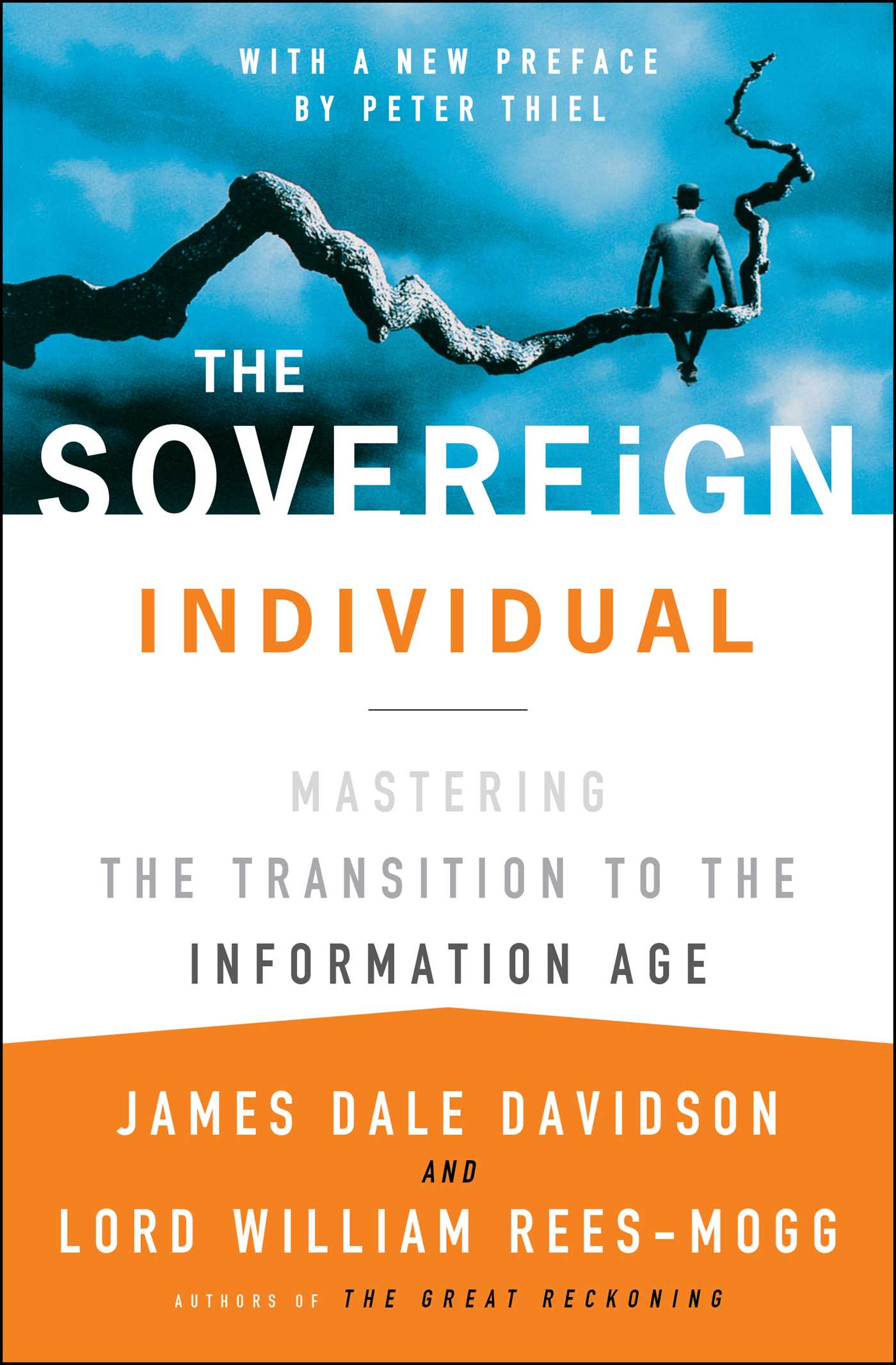
Original book cover from Simon & Schuster.
What the book is about
Davidson and Rees-Mogg describe history as a series of major economic stages. Hunting and gathering came first, followed by farming, then industry. They argue that the next stage is built on information: software, networks, data, ideas, and services that can travel quickly.
In an industrial economy, a factory, a city, and a national government are very important. Workers often need to live near an employer. In an information economy, a person may serve customers from another country with a laptop and internet connection. That can make location less important and give skilled individuals more choices.
The book calls a person who can control their own work, money, and location a “sovereign individual.” This does not mean a person becomes a king. It means the individual has more bargaining power and more responsibility.
Main ideas
- Technology can move power. When information and money move easily, large institutions may have less control over workers and businesses.
- Skills can become portable assets. A useful skill, trusted reputation, or digital product can earn money in many places.
- Governments compete for mobile people and capital. If workers and businesses can relocate, taxes and rules may affect where they choose to live or operate.
- Privacy and security become economic issues. Digital life creates opportunities, but also risks involving identity, fraud, surveillance, and cybercrime.
- Independence requires preparation. More freedom is not the same as an easier life. A person must manage income, savings, insurance, taxes, and risk.
Simple explanations of key terms
Information economy
An information economy is one where knowledge, software, data, and services create much of the value. A programmer, designer, analyst, or online teacher may sell useful work without owning a factory.
Human capital
Human capital means the useful abilities inside a person. Education, experience, judgment, and relationships can help someone earn more. Like a tool, a skill can become more valuable when practiced.
Capital
Capital is wealth used to produce more wealth. A business, investment account, computer used for paid work, or rental property can all be forms of capital.
Portability
Portability means being able to take an asset with you. A portable skill or online business may continue working when you change cities.
Transaction costs
Transaction costs are the time, fees, and effort needed to make a deal. Technology can lower some of these costs by making it faster to find customers, send money, or sign an agreement.
Steps to apply the book’s ideas
- List your portable skills. Write down what you can do that helps another person or business.
- Make one skill easier to buy. Turn it into a clear service, product, course, template, or portfolio.
- Build a safety buffer. Keep emergency savings and avoid depending on one customer or employer.
- Learn the rules where you live. Taxes, business registration, employment law, and financial regulations differ by country.
- Protect digital access. Use strong, unique passwords, two-factor authentication, backups, and careful payment practices.
- Invest without confusing excitement with wealth. Technology changes quickly, but a sensible plan still needs diversification, reasonable costs, and a suitable time horizon.
What it gets right
The book was early in noticing that computers could make work and money less tied to geography. Its central financial lesson is still useful: develop valuable skills and avoid relying completely on a single institution. It also makes readers think about the hidden cost of being unable to move, change jobs, or serve customers directly.
Its discussion of digital money is interesting for readers studying crypto. The authors understood that electronic payments and private digital networks could challenge old ideas about money. That does not prove every prediction was correct, but it explains why the book remains part of modern technology-and-finance conversations.
What to be careful about
The authors present a strong story about the decline of nation-states and the rise of private power. Real life is more mixed. Governments still provide courts, roads, education, public health, currencies, and emergency services. Those systems may change, but they do not disappear simply because information travels quickly.
The book can also make independence sound like a personal choice available to everyone. In reality, health, family duties, immigration rules, access to education, and unequal starting points matter. Not everyone can work remotely or move to a cheaper country. A portable income is helpful, but it is not a substitute for social support or fair institutions.
Technology does not automatically make people richer. New tools can lower costs, but they can also create competition, scams, job disruption, and concentrated power. Treat the book’s forecasts as scenarios to test, not promises to believe.
Bottom line
The Sovereign Individual is best read as a provocative guide to the financial effects of technological change. Its strongest message is practical: build skills that travel, keep financial reserves, protect your digital life, and think carefully about dependence on one employer, bank, platform, or government program.
The future is unlikely to match every prediction in the book. But its main question remains important: when technology gives individuals more choices, will we use those choices to become more capable, or simply become dependent on new systems? The answer starts with skills, savings, clear thinking, and a realistic understanding of risk.