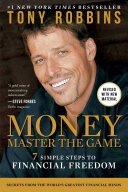
Original book cover. Cover source: Simon & Schuster.
MONEY Master the Game: 7 Simple Steps to Financial Freedom by Tony Robbins is a wide-ranging personal-finance guide. Robbins interviews well-known investors and turns their ideas into a plan for saving, investing, reducing costs, and building income for the future. The book’s message is easy to understand: money works better when you give it a job and follow a clear plan.
What the book is about
Robbins treats financial freedom as a system rather than a single lucky investment. First, understand where your money goes. Then protect yourself from large mistakes, save regularly, invest in a diversified way, and create a plan for the years when work income may stop. The book also discusses fees, taxes, inflation, risk, and the difference between saving for growth and saving for income.
Its seven-step structure helps readers move from confusion to action. Robbins draws on conversations with investors such as John Bogle, Warren Buffett, Ray Dalio, and others. Their approaches differ, so the book is best read as a menu of ideas to test—not as one perfect portfolio for everyone.
Main ideas
- Take control first. Know your income, spending, debts, savings rate, and goals before choosing investments.
- Automate good decisions. Regular transfers reduce the need to rely on willpower.
- Protect against disaster. Emergency savings, suitable insurance, and manageable debt can keep one bad event from destroying a long-term plan.
- Keep costs low. An investment fee is money taken from your account for managing or operating an investment. Small fees can reduce growth over many years.
- Diversify. Spread money across different investments so one failure does not decide your whole future.
- Think about income later. Retirement planning is not only about a large balance; it is also about dependable spending money.
Key terms in simple language
Compound growth
Compound growth means your earnings can earn more earnings. Like a snowball, money may grow faster when returns stay invested. Growth is never guaranteed, and losses can compound too.
Asset allocation
Asset allocation is how you divide money among stocks, bonds, cash, and other assets. The right mix depends on when you need the money and how much price movement you can handle.
Index fund
An index fund tries to follow a market list, such as a broad basket of stocks, instead of choosing every holding through frequent trading. It can offer diversification, but it still has risk and costs.
Inflation
Inflation is a broad rise in prices. If prices rise faster than your money grows, your money buys less.
Lifetime income plan
This is a plan for turning savings and other resources into money you can use throughout retirement. It must account for spending, taxes, health costs, market losses, and how long you may live.
Steps to apply the book’s ideas
- Write down the facts. List monthly income, essential bills, flexible spending, debts, cash savings, and investments.
- Set a safety layer. Build an emergency reserve appropriate for your situation and address expensive debt.
- Choose a target. Give each goal a date and an amount.
- Automate contributions. Move a chosen amount from each paycheck into savings and long-term investments.
- Use a simple diversified mix. Match it to your time horizon and risk tolerance. Review fees and avoid products you cannot explain.
- Check the plan, not the headlines. Revisit it at set times and avoid abandoning long-term investments because of one news cycle.
- Stress-test future income. Ask what happens if returns are lower, inflation is higher, or a large expense arrives.
What it gets right
The book’s strongest point is behavior. A complicated strategy is not useful if a person cannot stick with it. Automatic saving, attention to fees, and a written plan can matter more than finding the next exciting investment.
It also makes financial language less scary. Asking about risk, costs, taxes, and income helps a reader become an informed customer rather than someone who accepts a product because it sounds sophisticated.
What to be careful about
Some examples, forecasts, and product discussions can age. Rules, tax systems, interest rates, and investment fees change. Historical returns do not promise future returns, and no famous investor can remove uncertainty.
Be cautious with promises of financial freedom, especially when they sound fast or guaranteed. The SEC says risk, time horizon, and diversification should fit the individual investor. A broad fund may suit one goal, while cash or bonds may suit money needed soon. Tax and retirement decisions also depend on your country and circumstances.
Bottom line
MONEY Master the Game is most useful as a motivation to organize your financial life. Its practical core is clear: save deliberately, reduce avoidable costs, protect against setbacks, invest for the time you have, and build a plan that can survive ordinary bad luck. The goal is not to predict every market move. It is to make steady decisions that give your future self more choices.