If you understand your work but struggle to make people feel that you are present, credible, and genuinely interested, the problem may not be a lack of value. It may be that your value is not being communicated clearly.
Who this is for
This summary is for readers who want a practical introduction to The Charisma Myth and a grounded way to apply its ideas in work, leadership, sales, and wealth-building relationships. It is not a promise of guaranteed persuasion or a substitute for professional help with serious anxiety, financial decisions, or regulated advice.
The early answer is yes: Olivia Fox Cabane’s central premise is that charisma is not only an inborn trait. It can be approached as a set of observable behaviors and mental habits. The seven lessons below are a Wealthy I AM synthesis of the book’s broad framework, not a claim that Cabane presents this exact numbered list.
The useful boundary matters. Charisma is not manipulation, guaranteed influence, or a substitute for competence. The practical goal is to become more present, calm, warm, and clear while respecting another person’s ability to say no.
What this book can help you change
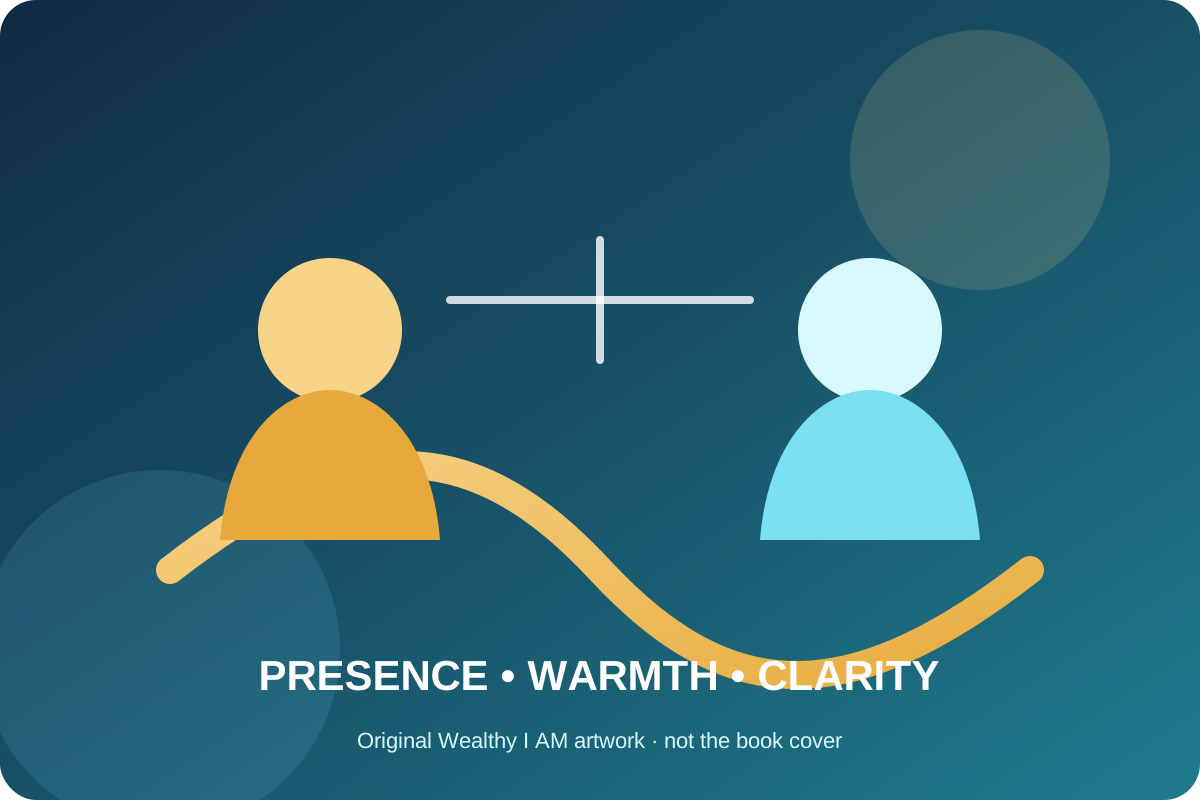
The Charisma Myth: How Anyone Can Master the Art and Science of Personal Magnetism combines communication guidance with exercises around presence, power, warmth, mental habits, and interaction. The Open Library record identifies the book as covering charisma, communication, leadership, and skill development. It is most useful for a reader who wants a practical way to improve conversations rather than a personality label.
The promise is not that every interaction will produce a desired result. It is that changing your attention, emotional state, and signals can change the quality of an interaction. That distinction keeps the advice useful and realistic.
1. Presence comes before performance
Presence means directing your attention to the person and conversation in front of you. A distracted listener may be technically polite while still making the other person feel hurried or ignored. Cabane treats attention as a trainable part of charismatic behavior.
Wealthy I AM application: In a business conversation, do not begin by trying to sound impressive. First identify the other person’s actual question, constraint, or concern. A useful service is easier to explain when you understand the problem it is meant to solve.
Try this: Before a meeting, write one sentence: “By the end, I need to understand ___.” Put your phone away when practical, take brief notes, and summarize the other person’s point before answering.
2. Warmth and power work together
Cabane’s framework distinguishes two signals people often read in interactions: warmth, or goodwill toward others, and power, or the impression that you have agency and capability. Warmth without clarity can seem vague; power without warmth can feel threatening.
This is not a license to imitate a dominant posture or exaggerate authority. It is a reminder that trust often needs both human regard and competent boundaries.
Example: A freelancer who says, “I understand why the deadline matters; here is what I can complete by Friday and what would require more time,” communicates warmth and a realistic boundary. That is more credible than either a cold refusal or an enthusiastic promise that cannot be kept.
Try this: In your next important message, include one sentence acknowledging the other person’s goal and one sentence stating your actual capability or limit.
3. Mental habits shape visible behavior
A person who feels anxious may focus on self-monitoring: How do I sound? Is my posture awkward? Did I make a mistake? That internal loop can reduce attention available for the conversation. The book’s mental exercises aim to help readers change the state from which they communicate.
This is not medical treatment, and severe or persistent anxiety may call for qualified professional help. For ordinary situational nerves, a short reset can make a conversation more manageable.
Try this three-step reset: Name the feeling without judging it; picture the conversation as a shared problem rather than a test; then choose one concrete intention, such as listening for the decision that must be made. The intention is not to eliminate discomfort but to stop discomfort from directing every action.
4. Confidence should be grounded, not manufactured
People often confuse confidence with certainty. In money and business, that confusion is expensive. A charismatic communicator can still be wrong, and a polished pitch can hide weak evidence.
Use confidence to describe what you know, what you do not know, and what you will check next. This approach is slower than making absolute claims, but it protects credibility.
Wealthy I AM application: When discussing a product, opportunity, or investment idea, separate facts, assumptions, and open questions. For example: “Here is the information we have; here is the assumption that needs testing; here is the downside if it is wrong.” This is general education, not individualized financial advice, and an investment decision requires independent research and consideration of risk capacity.
5. Charisma must not become manipulation
The same communication skills that make someone engaging can be used to pressure people. That is the ethical tension readers should keep in view. Presence is valuable when it helps people understand one another; it becomes harmful when it bypasses informed choice.
Avoid manufactured urgency, concealed conflicts, selective disclosure, and promises of results you cannot support. In sales or negotiation, make the next step reversible where possible and give the other person time to evaluate it.
A practical test: Would you be comfortable with the other person repeating your framing to an independent adviser? If not, slow down and disclose the missing context.
6. Practice in small, repeatable situations
A communication skill improves through feedback, not through reading alone. Start with low-stakes settings: greeting a colleague by name, asking one better follow-up question, or explaining a project in plain language. Observe what happened without turning one awkward exchange into a verdict about your personality.
A useful weekly practice is the PRESENCE loop: Prepare one intention; Remove avoidable distractions; Engage with a question; State facts and limits; Invite a response; Notice what worked; Change one behavior; Evaluate the result. This is an original Wealthy I AM tool inspired by the book’s emphasis on trainable behaviors.
Track actions, not imagined charisma scores. For example, note whether you asked a clarifying question and whether the other person understood the next step. Do not treat a positive outcome as proof that a technique caused it; timing, context, and other factors matter.
7. Let communication serve value creation
Charisma is not the asset. It is one possible amplifier of an underlying offer, skill, relationship, or decision. If the work is weak, better delivery may only make the weakness easier to notice later.
For a founder, that means pairing compelling communication with customer evidence, sound cash-flow controls, and a product that solves a real problem. For an employee, it may mean pairing clear self-advocacy with reliable work and useful skills. For an investor, it means resisting the urge to confuse a persuasive spokesperson with a sound business or suitable investment.
One-hour application: Choose one important conversation. Write the problem being discussed, the evidence you have, the uncertainty that remains, your boundary, and the smallest useful next step. Then have the conversation with the goal of clarity—not winning.
Mistakes to avoid
- Performing instead of listening: A rehearsed persona can reduce presence.
- Treating confidence as proof: Delivery does not validate a claim.
- Using warmth to hide a hard sell: Respect requires honest disclosure and room to decline.
- Copying body language mechanically: Context and culture matter; comfort and clarity matter more.
- Expecting instant transformation: Communication habits usually require repeated practice and feedback.
- Applying business advice as a guarantee: Better conversations can support opportunity, but they cannot guarantee income, promotion, funding, or investment returns.
Frequently asked questions
Is charisma an innate personality trait?
The book argues that aspects of charisma can be learned and practiced. That does not mean everyone will communicate in the same style or receive the same response. Temperament, culture, context, and power differences still matter.
Is The Charisma Myth a sales book?
It has clear relevance to sales and leadership, but its broader subject is interpersonal presence and influence. Use its ideas to improve understanding and trust, not to pressure someone into a decision.
How can a shy person apply the book?
Begin with presence and one genuine question. You do not need to become highly talkative. A calm, attentive listener who states boundaries clearly can be effective without adopting an extroverted persona.
Can charisma replace expertise?
No. It may help expertise be heard, but it cannot replace a useful capability, sound evidence, or dependable follow-through.
What is a safe first exercise?
In one low-stakes conversation this week, remove distractions, ask a clarifying question, summarize the answer, and state one honest next step. Review the interaction without judging your identity.
A grounded next step
Choose one conversation that matters this week. Prepare one intention, listen without multitasking, acknowledge the other person’s goal, state what you can and cannot do, and invite questions. Then write down one observation. This small practice is more useful than trying to “be charismatic” all day.
Conclusion
The Charisma Myth offers a hopeful but bounded idea: presence, warmth, power, and mental habits can be practiced. The Wealthy I AM lesson is to use those skills in service of clearer work, fairer exchanges, and stronger relationships—not as a shortcut around competence or consent. Build the underlying value, communicate it honestly, and let the other person decide.
The next useful move is not to perform confidence. It is to make one conversation clearer while keeping the other person free to choose.
Sources / Further reading
- Olivia Fox Cabane, The Charisma Myth: How Anyone Can Master the Art and Science of Personal Magnetism, Open Library work record: https://openlibrary.org/works/OL16240171W/The_charisma_myth
- Open Library Covers API image used for the exact-title cover reference: https://covers.openlibrary.org/b/id/13882953-M.jpg?default=false
The Open Library record supports the book’s identity, broad subject areas, and listed table of contents. The numbered lessons, PRESENCE loop, examples, and business applications above are editorial synthesis and practical interpretation, not claims that Cabane authored this exact structure. Cover reuse permissions should be confirmed by the publisher before publication.