A simple investing plan is more useful than a confident prediction
New investors often face two unhelpful choices: do nothing because investing feels complicated, or follow a tip because a prediction sounds easier than a process. A better starting question is: What diversified, low-cost plan can I understand well enough to keep using?
That question fits the broad territory associated with Andrew Hallam’s Millionaire Teacher: The Nine Rules of Wealth You Should Have Learned in School. The book was first published in 2011 and is cataloged under personal finance and investing. This guide does not reproduce Hallam’s nine rules or claim to summarize every chapter. Instead, it offers six cautious, beginner-friendly applications built around financial education, diversification, costs, consistent saving, and investor behavior.
This article is general education, not individualized financial, tax, or legal advice. Account rules, taxes, available products, and suitable risk levels vary by country and person.
Who this guide is for
This guide is for a beginner who wants:
- a plain-language investing checklist;
- a calmer way to think about fees and diversification;
- a repeatable process that does not depend on forecasting markets; and
- questions to ask before choosing an account or investment.
It is not a portfolio prescription. The right choices depend on your goals, time horizon, emergency savings, debt, income stability, tax situation, and ability to tolerate losses.
Six practical applications for a calmer investing process
1. Learn the vocabulary before choosing a product
Financial education should come before product selection. Start with the terms that shape the decision:
- Diversification means spreading exposure across investments so one company, sector, or region does not determine the entire result.
- An index fund is a fund designed to track a specified market index rather than relying on a manager to select investments continually.
- A fee is a cost charged by a fund, platform, adviser, or transaction. Small recurring costs can matter over long periods, although their effect depends on the product and account.
- Risk can mean price declines, permanent loss, inflation, concentration, needing cash at the wrong time, or simply misunderstanding what you own.
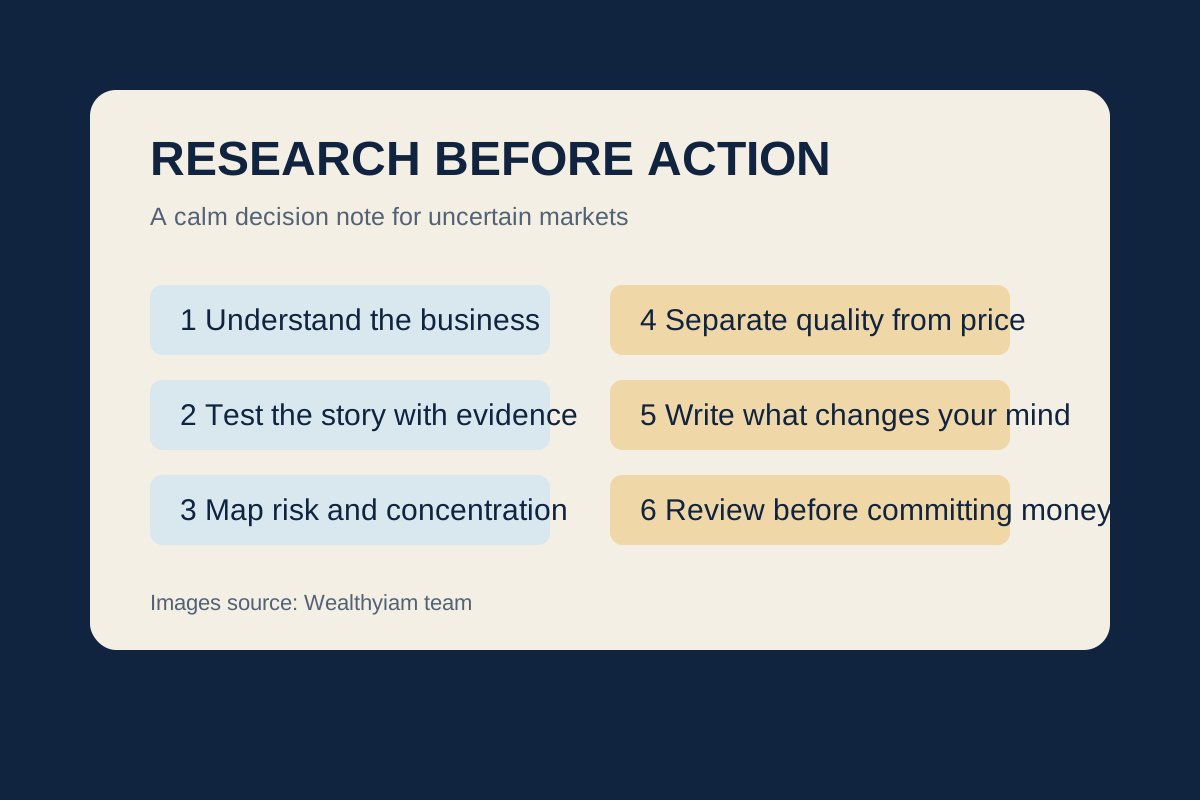
Try this: Write a one-sentence description of any investment before buying it. If you cannot explain what it owns, how it can lose money, and what it costs, pause and research further.
2. Treat low cost as a design constraint, not a slogan
A low-cost investment is not automatically suitable. Cost is simply one feature you can inspect before committing money.
Compare the expense ratio or ongoing fund charge, account and advisory fees, trading costs, bid-ask spreads, taxes where relevant, and any entry or exit charges. Do not assume a product is inexpensive because its marketing calls it “simple” or “passive.” Also consider what service or exposure a fee pays for; one percentage in isolation does not tell the whole story.
Try this: Add a total-cost section to your investing notes. Record recurring and one-time charges using the provider’s current documents, not an advertisement or an old comparison article.
3. Diversify before trying to be clever
Diversification is a risk-management tool, not protection from every loss. A diversified portfolio can still decline when markets fall. Its purpose is to reduce dependence on a single company, narrow theme, sector, or region compared with a concentrated holding.
The appropriate mix of investments depends on when you need the money, what the money is for, your other financial resources, and how you would respond to a substantial decline. A portfolio that looks diversified by number of holdings may still be concentrated if those holdings share the same underlying risks.
Try this: List your holdings by asset class, geography, and major sector. Look for accidental concentration and overlapping funds. If the portfolio requires a complicated argument to prove it is diversified, clarify what each holding contributes before adding another.
4. Make saving and investing repeatable
A sound idea that happens once is not a system. A recurring transfer can reduce the number of decisions you must make, provided it fits your pay cycle and leaves room for essential bills and an appropriate cash reserve.
Automation should not be blind. Review the amount when income, expenses, debt, or goals change. A modest contribution that you can sustain is more useful than an aggressive target that forces expensive borrowing or leaves you unable to meet near-term needs.
This is a practical Wealthy I AM application, not a claim that Hallam prescribes a particular transfer date or contribution percentage.
Try this: Choose an amount you can review monthly. Name the account’s purpose and set a periodic review reminder instead of checking prices every day.
5. Separate the quality of a decision from its short-term outcome
A profitable trade does not prove the decision process was sound, and a loss does not prove every decision was foolish. Markets are uncertain, and luck can dominate short periods.
For example, a diversified investment can lose value during a broad market decline even when it matches the investor’s intended allocation. That result may be painful without proving that a short-term forecast would have produced a better decision.
Try this: Keep a short decision journal. Record what you bought, why it fits the plan, its main risks, what would make it unsuitable, and when you will review it. Never record a future return as if it were known.
6. Write a behavior policy before markets become stressful
Investor behavior belongs inside the plan. Before volatility arrives, write down what would cause you to rebalance, reduce risk, raise cash, or seek qualified advice. Avoid making a major change solely because a headline is alarming or a recent return is exciting.
That does not mean “never sell.” Goals and circumstances change, a holding can become unsuitable, and a portfolio can drift away from its intended allocation. The point is to make the reason explicit and test it against the plan.
Try this: Create three columns: “planned review,” “evidence that could change my plan,” and “noise I will not act on by itself.”
A 30-minute beginner worksheet
Use this exercise to organize your thinking, not to select a portfolio automatically:
- Write the goal. Is the money for a near-term purchase, retirement, education, or something else?
- List the constraints. Note the time horizon, emergency-cash needs, debt obligations, tax jurisdiction, and how much loss you could withstand without abandoning the plan.
- Describe the exposure. For each candidate investment, record what it owns, how diversified it is, and how it can lose money.
- Measure total cost. Use current official documents and include recurring and transaction costs where available.
- Choose a review rule. Decide when you will review the plan and what evidence could justify a change.
- Name one unknown. Write down a fact you still need to verify. Visible uncertainty is safer than hidden uncertainty.
The worksheet is complete when it produces better questions. It does not need to produce an immediate purchase.
Common mistakes to avoid
- Confusing a book’s framework with personal advice. A general principle cannot determine your allocation, tax treatment, insurance needs, or ideal account.
- Assuming low cost means no risk. Fees and investment risk are separate questions.
- Chasing a recent winner. Past performance does not promise future results.
- Counting holdings instead of examining exposure. Several funds may own many of the same securities.
- Over-automating. Review transfers and account details when circumstances change.
- Treating an illustration as a forecast. Hypothetical examples explain mechanics; they do not predict returns.
- Ignoring the source boundary. A catalog record verifies a book’s identity, not every argument, statistic, or anecdote in its pages.
Frequently asked questions
Is Millionaire Teacher a stock-picking book?
This guide should not be read as a list of stocks or funds from the book. It focuses on a broad process—education, diversification, cost awareness, saving discipline, and behavior—rather than a current product list or market prediction.
Can a beginner apply these ideas without an adviser?
A beginner can learn concepts, inspect documents, and organize questions independently. Whether professional advice is useful depends on the complexity of your taxes, debts, legal circumstances, goals, and comfort with making investment decisions. Check an adviser’s qualifications, services, conflicts, and fees rather than relying on a title alone.
Does diversification guarantee a profit?
No. Diversification can reduce concentration risk, but diversified investments can lose value. It cannot eliminate market risk or guarantee that you will reach a goal.
How should I compare investment costs?
Start with current product and account documents. Compare recurring fund charges, platform or advisory fees, transaction costs, spreads, taxes where applicable, and other conditions. Consider the service and exposure provided, not only the lowest number on the page.
What is the most useful first step?
Write down your goal, time horizon, near-term cash needs, and one investment you want to understand. Then read its official documents and explain its exposure, risks, and total cost in plain language. If you cannot, keep researching or ask a qualified professional.
Make the plan boring enough to repeat
The useful distinction is between the book’s identity, which reliable catalog records establish; its complete argument, which requires the full text; and the practical framework offered here, which is an editorial application. The application is simple: understand the exposure, know the cost, protect near-term needs, automate only what fits, and review decisions against a written plan.
That approach is less exciting than a prediction. Its value is that it gives you a way to act without pretending uncertainty has disappeared.
Sources and further reading
- Millionaire Teacher by Andrew Hallam — Open Library catalog record. Used to verify the title, subtitle, author, 2011 publication record, subjects, editions, and cover identity.
- Financial Conduct Authority: Five questions to ask before you invest. Current regulator guidance on understanding an investment, risk, access to money, and when to consider advice; product rules and protections vary by jurisdiction.
Reading a personal-finance book cannot guarantee wealth or remove market uncertainty. A clear, affordable, diversified, and reviewable process is the part you can work on today.