If investing decisions are being driven by headlines, tips, or fear of missing out, the immediate problem is not a shortage of ticker symbols. It is the absence of a repeatable research process. A process cannot remove uncertainty, but it can make the assumptions behind a decision visible.
The short answer: the most useful way to approach Jim Cramer’s Get Rich Carefully is to replace rumor-driven action with deliberate homework: understand the business, separate its story from the evidence, consider risk and portfolio concentration, and define what would make your view change.
Scope note: Open Library identifies the book as Jim Cramer’s Get Rich Carefully by Jim Cramer and dates its first publication to 2013. Its catalog description promotes a cautious, methodical approach to stock investing. The seven lessons below are a Wealthy I AM editorial synthesis—not Cramer’s verified chapter order or a promise that following them will make an investor rich.
What the book is about—and who it may help
The catalog description presents Get Rich Carefully as a stock-investing guide built around prudence, discipline, long-term themes, and specific company and sector ideas. Open Library classifies the work under subjects including investment analysis, personal finance, stocks, and investing.
That makes the book a useful starting point for a reader who wants to examine an investment idea more deliberately before acting. It is not a substitute for current company filings, independent research, or a personal financial plan that reflects income, emergency savings, time horizon, taxes, and capacity for loss. General education is not individualized financial advice, and a strategy published in 2013 may not fit every investor or today’s market conditions.
The seven lessons at a glance
- Start with a business, not a ticker.
- Turn an attractive story into testable questions.
- Treat research as a discipline, not a one-time opinion.
- Understand risk before seeking return.
- Use diversification deliberately.
- Separate business quality from the price paid.
- Write down what would change your mind.
The last lesson is easy to skip, but it helps prevent research from becoming a search for confirmation.
1. Start with a business, not a ticker
A ticker is a trading identifier. A business is the economic activity that may create value—or fail to do so. Beginning with the business shifts attention from “What is moving today?” to “What does this company sell, who pays for it, and what could weaken that arrangement?”
A practical business-first screen
Before looking for a forecast, write a short description in plain language:
- What product or service does the company provide?
- Who is the customer?
- How does the company bring in revenue?
- Which costs or dependencies matter most?
- What could make customers leave or margins deteriorate?
Hypothetical example: imagine a subscription software company. “It is a technology stock” is not useful research. “It sells scheduling software to small clinics, charges recurring fees, and depends on customer retention and reliable service” is a starting hypothesis. It is not a recommendation or forecast.
Try this: keep a one-page business brief before making a buy decision. If you cannot explain the business without repeating promotional language, pause and learn more.
2. Turn an attractive story into testable questions
A market story can be plausible and still be incomplete. “This company will benefit from a large trend” should lead to questions, not an automatic conclusion. What must happen for that trend to improve the company’s economics? What evidence would show that customers are adopting the product? Who could compete with it?
A useful sequence is:
Story → mechanism → evidence → disconfirming fact
For the fictional software company, the story might be “more clinics will digitize scheduling.” The mechanism could be growth in paid accounts and stronger retention. Evidence might include customer figures and financial disclosures that a reader verifies in current company filings. A disconfirming fact could be persistent customer losses or rising service costs. These facts must be checked rather than invented.
This sequence reduces the temptation to collect only evidence that supports the original idea.
3. Make research a discipline, not a one-time opinion
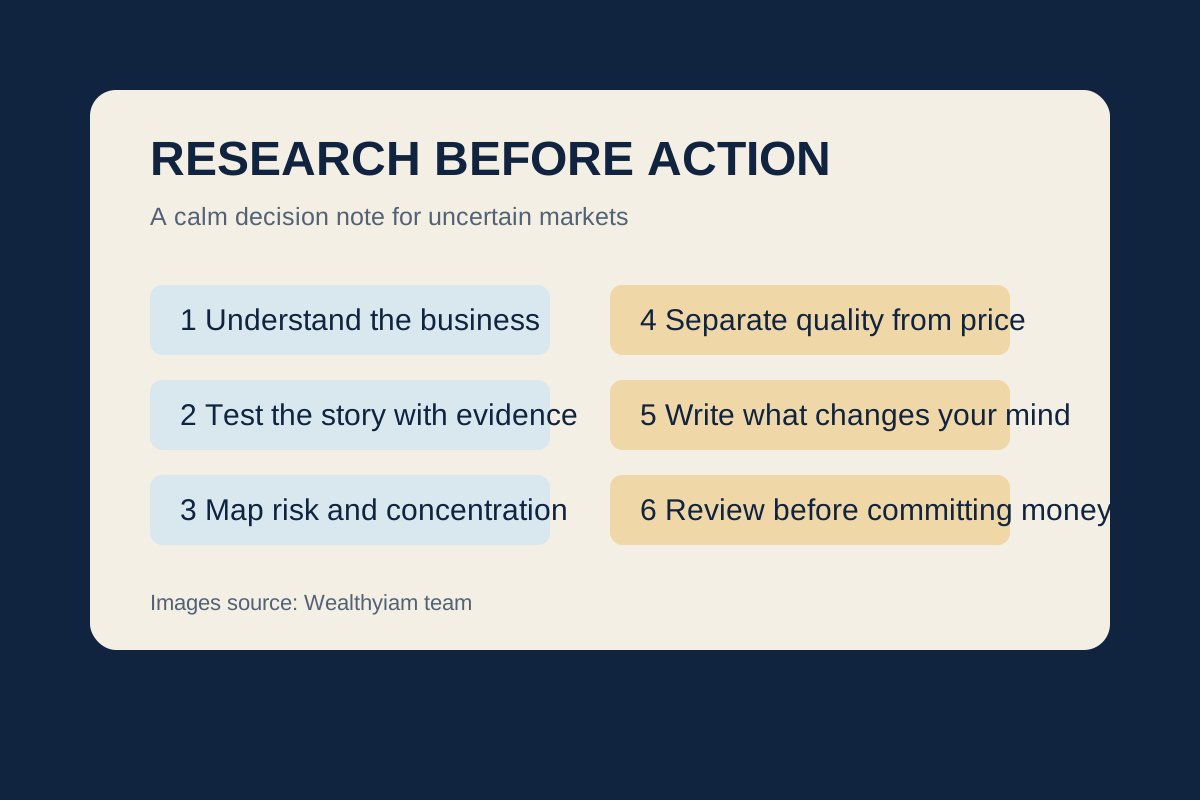
Research is not complete because an investor has read one article or watched one interview. A disciplined process has a starting question, a record of assumptions, and a review point. Cramer’s catalog description emphasizes prudence and method; the following note turns that broad theme into a manageable routine.
A one-page research note
For a company you are investigating—not yet buying—record:
- Business description: explain it in one or two sentences.
- Three to five value drivers: customer retention, pricing, sales volume, cost control, or other relevant factors. These are questions to investigate, not assumptions of success.
- Key risks: competition, debt, customer concentration, regulation, execution, or other material threats.
- Evidence checked: name each filing, investor-relations document, or reliable independent source and record its date.
- What the current price appears to require: state this cautiously; do not claim a precise valuation without appropriate data and skill.
- One fact that would change your view: write it before emotion takes over.
The note cannot reliably identify winners. Its purpose is to make the reasoning auditable by your future self.
4. Understand risk before seeking return
Risk is more than a price moving down. It can include permanent loss of capital, a weakening business model, excessive debt, poor liquidity, concentration, fraud, or a mismatch between an investment and the investor’s time horizon. Volatility—the size and speed of price movements—is one form of risk, but not the whole definition.
A careful investor asks, “What can go wrong, how would I notice, and could I withstand it?” This matters especially when investment marketing uses confident language about wealth or attractive returns. Confidence is not evidence that an outcome is likely.
Try this: write a downside paragraph before a purchase. Include the business-specific failure modes you can identify, your time horizon, and the practical consequence if the thesis is wrong. Avoid leverage and do not invest money needed for near-term necessities merely because an idea sounds compelling.
5. Use diversification deliberately
Diversification means spreading exposure so one company, sector, asset type, or event has less power over the whole portfolio. It can reduce concentration risk, but it cannot eliminate losses or guarantee a positive result. An appropriate mix depends on a person’s circumstances, goals, time horizon, and capacity for loss.
Diversification should not be a decorative word added after a stock pick. Ask what the portfolio already depends on. Someone whose income, employer equity, and investments are all tied to one industry may have more concentrated exposure than the brokerage statement suggests.
Try this: create a simple exposure map. List major holdings, broad asset categories, employer or industry concentration, and the purpose of each allocation. Consider any change as part of a written financial plan rather than a reaction to today’s news.
6. Separate business quality from the price paid
A strong business can still be a poor purchase at an unsuitable price. A low price can also reflect serious problems rather than a bargain. This distinction prevents a good company story from becoming an automatic investment case.
Three terms help:
- Value: an estimate of what an asset may be worth based on assumptions about future cash flows or other evidence.
- Price: what the market is currently asking.
- Margin of safety: room for error between an estimate of value and the purchase price—not a guarantee against loss.
An investor does not need false precision to ask whether a price assumes near-perfect execution. Any estimate should make its assumptions visible, use current reliable information, and acknowledge uncertainty. If you cannot explain the assumptions, do not present the estimate as fact.
7. Write down what would change your mind
A thesis without a disconfirming condition can become a story that survives every warning. Before acting, write three statements:
- I believe… State the central business claim.
- I need to verify… List the facts that must support it.
- I would reconsider if… Name a specific, measurable condition that would challenge it.
This is not an automatic sell signal or trading rule. It is protection against moving the goalposts. Review the note on a schedule appropriate to the investment, not whenever a headline appears. If a condition changes, return to the evidence and reconsider the original assumptions.
Mistakes to avoid when applying these ideas
- Confusing a book’s broad themes with current evidence. Read the source, then verify present-day facts separately.
- Treating a named company or sector as a recommendation. An example is not an endorsement.
- Using “low risk” to mean “no risk.” Every investment involves uncertainty and possible loss.
- Counting holdings without examining exposure. Many securities can still depend on the same industry or economic driver.
- Doing research only after buying. Record the thesis and risks before committing money.
- Mistaking activity for rigor. More tabs, alerts, and commentary do not necessarily improve a decision.
- Ignoring personal constraints. A research method cannot replace emergency reserves, debt planning, tax review, or individualized professional advice.
A calm next step: run the research note, not the trade
Choose one company you are curious about and complete the six-part research note without buying it. Use at least one current primary company source, such as a regulatory filing, and record its date. Then review your assumptions after the initial excitement has passed.
If the business description, value drivers, risks, and disconfirming fact remain unclear, that is useful information. You have found a knowledge gap before risking capital.
Frequently asked questions
Is Get Rich Carefully a guarantee of investment success?
No. A book can offer ideas and examples, but it cannot guarantee an outcome. Results depend on evidence, price, diversification, costs, taxes, time horizon, behavior, and conditions no reader can completely control.
Is this article a stock recommendation?
No. It does not recommend a company, fund, sector, trade, or return target. It offers general education about turning a broad research principle into a written decision process.
How much research is enough?
There is no universal number of minutes or documents. Research becomes more useful when it addresses the business model, key drivers, risks, price assumptions, and disconfirming conditions using dated evidence. A short, honest note is better than a long collection of unexamined opinions.
Should beginners avoid individual stocks?
Not necessarily, but individual-company investing adds company-specific risk and research demands. A diversified approach may be more suitable for some goals and circumstances. Consider your plan, costs, taxes, and risk capacity; a qualified professional can help with individualized questions.
Sources and evidence boundary
- Open Library work record for Jim Cramer’s Get Rich Carefully — title, author record, subjects, description, and cover identity.
- Open Library edition record — 2013 edition, ISBNs, page count, and cover ID.
- Open Library cover source — exact-title cover; reuse rights must be confirmed before publication.
The practical checklist, definitions, hypothetical example, and cautions in this article are Wealthy I AM editorial applications. They are not quotations or claims that the book presents this exact seven-part structure.
Conclusion
The cautious path is not passive. It is active in a different way: understand the business, test the story, map the risks, diversify with purpose, distinguish quality from price, and define what evidence would change your mind. Get Rich Carefully can prompt a shift from market excitement to research discipline.
The next step is modest and concrete: write one research note, verify its sources, and make no purchase merely to feel that you have made progress.