Search intent and the short answer
Search intent: Readers who want to understand Peak by K. Anders Ericsson and Robert Pool, learn what deliberate practice means, and turn skill-building into a realistic plan for better work and long-term wealth.
Short answer: Peak argues that high performance is developed through purposeful practice, useful feedback, and mental models—not simply discovered through talent. Applied carefully, that idea can help you build a skill that creates value. It cannot guarantee a higher income, and it does not replace market demand, health, opportunity, or sound financial planning.
Who this is for: Readers considering a career transition, a higher-value capability, or a small side-project experiment who want a cautious application of the book’s ideas—not a promise of income or individualized financial advice.
If you work hard but your results are not compounding
You can spend years being busy without becoming meaningfully better at the work that matters. Repeating comfortable tasks may preserve competence, but it may not stretch the specific ability that customers, employers, or a business value. That is the reader problem this book helps clarify: effort alone is not a strategy for building career capital.
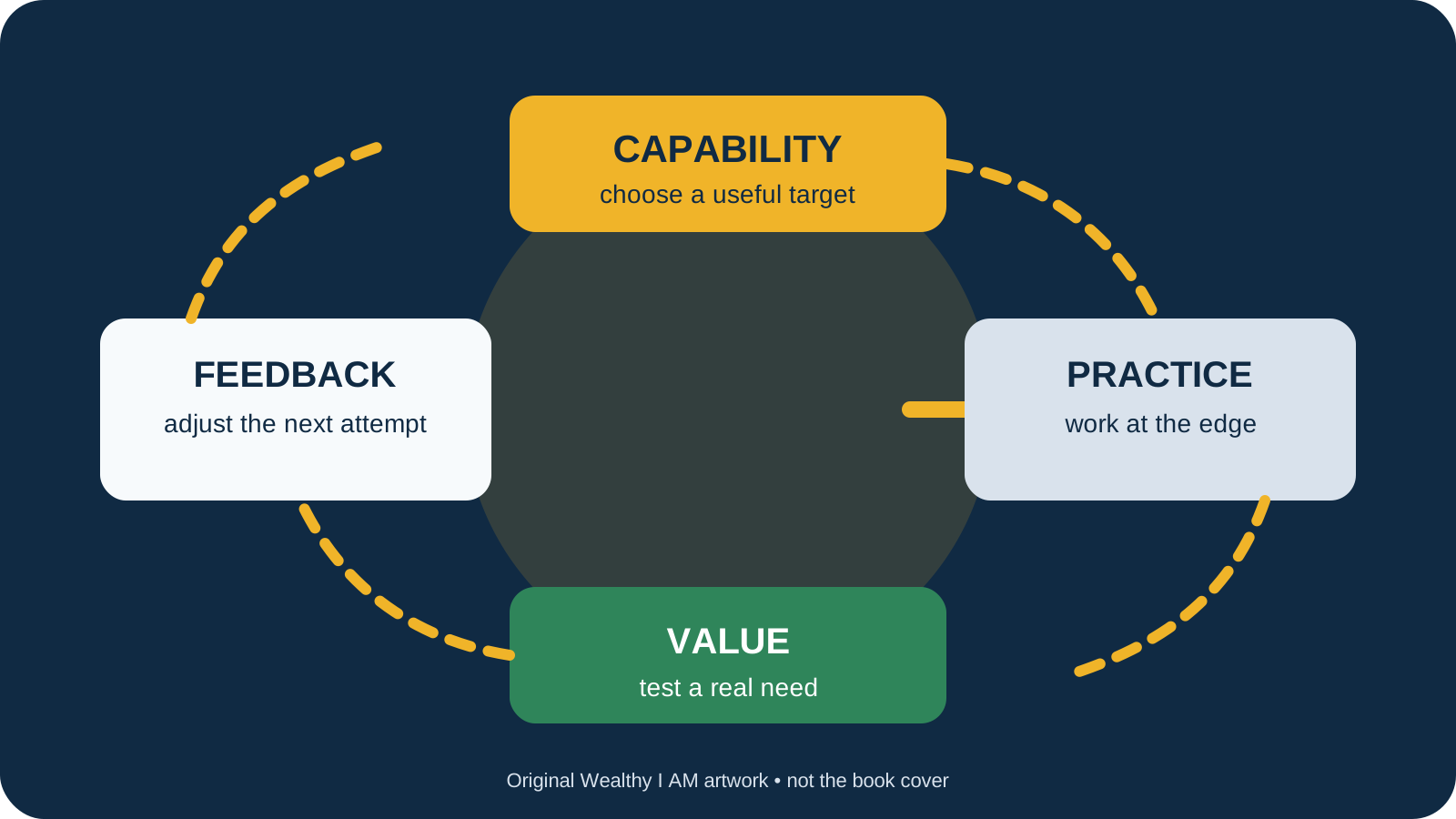
The early answer is to make practice more specific. Choose one valuable capability, define what better looks like, work at the edge of your current ability, obtain feedback, and adjust. The same hour of effort can have very different value depending on whether it produces information about the next improvement.
This article is an original Wealthy I AM synthesis of ideas associated with the book. The seven lessons below are not presented as the authors’ exact numbered framework. They are a practical interpretation for readers thinking about skills, work, and wealth.
What Peak is about—and what it does not promise
The book explains research on deliberate practice, mental representations, and exceptional performance across fields. Deliberate practice is structured activity intended to improve a defined aspect of performance. It usually involves a task that is neither completely easy nor impossibly difficult, guidance or feedback, and repeated correction.
That is different from claiming that anyone can achieve any outcome with enough effort. Skills develop within constraints. Access to coaching, time, money, education, physical condition, genetics, social support, discrimination, luck, and demand can all affect results. A valuable skill also has to meet a real need; excellence in an unwanted activity may not produce income.
Seven practical lessons for building wealth-supporting skills
1. Pick a capability before you pick a goal
“Make more money” is an outcome, not a practice target. Translate it into a capability such as explaining complex ideas clearly, analyzing a business, negotiating scope, designing a useful product, or managing a reliable process.
Why it matters: A capability can be practiced and observed. A vague income goal cannot tell you what to do in the next hour.
Action: Write one sentence: “I help [a specific person or organization] achieve [useful result] by doing [capability].” Then list three visible behaviors that demonstrate the capability.
Book idea versus Wealthy I AM advice: Peak supplies the skill-development lens. The connection to earning power is an application, not a promise that practicing one skill will produce a particular salary or business result.
2. Work at the edge of your current ability
Comfortable repetition can feel productive while revealing little about what to improve. Practice should be challenging enough to expose a weakness but bounded enough that you can attempt it, review it, and try again.
For a writer, that might mean revising one unclear explanation after reader feedback rather than drafting another easy page. For an analyst, it might mean explaining a conclusion from a real dataset and checking the reasoning. For a manager, it might mean rehearsing a difficult conversation and asking for specific feedback afterward.
Action: Choose a task you can complete in 20 to 45 minutes. Make the difficulty concrete: speed, accuracy, clarity, completeness, or judgment. Stop before fatigue turns feedback into noise.
3. Seek feedback that changes the next attempt
Praise can be encouraging, but useful practice needs information. Ask what was unclear, where the process broke, which assumption was weak, or what a competent alternative would look like. The goal is not to collect opinions; it is to identify the next correction.
Action: After a practice session, record what you attempted, what happened, what you could observe, and what you will change next time. If no direct feedback is available, use a rubric, comparison with a reliable example, or a test with a defined result.
4. Build mental representations, not just procedures
A mental representation is an organized understanding that helps you notice patterns, anticipate consequences, and decide what matters. Memorizing a sales script is different from understanding the customer problem the script is meant to uncover. Following an investing checklist is different from understanding why a business’s economics matter.
Action: After learning a concept, explain it without notes, draw the relationships between its parts, and describe one situation in which it would not apply. This tests understanding rather than recognition.
5. Break complex work into trainable subskills
Large goals hide many different abilities. “Become a better entrepreneur” could include customer research, pricing, sales conversations, cash-flow management, hiring, and operations. Treating the whole goal as one practice task makes improvement hard to see.
Action: Decompose the capability into three to five subskills. Pick the one that is both important and weak. Design a small exercise that isolates it, then reunite the subskill with the real work once it improves.
6. Protect recovery and attention
More practice is not automatically better practice. Concentration, sleep, breaks, and a sustainable workload affect whether a person can notice errors and learn from them. A plan that damages health or crowds out essential responsibilities is not a durable wealth strategy.
Action: Schedule practice when your attention is usually strongest. Define a stopping rule, keep a short log of energy and quality, and adjust if the routine consistently creates exhaustion or displaces necessary care.
7. Convert skill into value through small experiments
A skill becomes economically useful when it solves a problem for someone who can choose to use or pay for the solution. Practice alone does not establish demand. Before making a large investment in a new career or venture, test the connection between capability and need.
Action: Offer a small, clearly scoped version of the work to a real audience, ask what changed for them, and record objections. Treat the result as evidence about fit—not as proof that the entire business model will work.
A 30-day skill-building and wealth check-in
Use this sequence without assuming a guaranteed financial outcome:
- Define the capability. State the user, problem, and observable result.
- Set a baseline. Complete one representative task and save the output.
- Schedule three practice blocks weekly. Keep the scope small enough to repeat.
- Create a feedback loop. Use a person, rubric, test, or customer response.
- Review weekly. Name one improvement, one recurring error, and one adjustment.
- Run a low-cost demand test. Seek a real conversation, sample project, or work product before buying expensive equipment or courses.
- Protect the downside. Do not fund the experiment with money needed for essential bills, high-interest debt payments, or emergency reserves.
The output at day 30 should be evidence: a baseline, practice log, revised samples, feedback, and a clearer view of whether the capability is useful. It should not be a fabricated forecast of income.
Mistakes to avoid
Confusing hours with deliberate practice
Time logged is an input. Improvement requires a defined target, challenge, feedback, and correction.
Treating the book’s examples as guarantees
A compelling story can illustrate a possibility without establishing a universal result. Ask what conditions made the outcome possible and what remains unknown.
Practicing a skill with no user or market
Technical progress does not prove demand. Test usefulness with real people before making a large commitment.
Ignoring opportunity cost
Every course, side project, and practice block competes with rest, paid work, relationships, and financial priorities. Choose deliberately.
Using debt or speculation to accelerate learning
Do not convert an uncertain career or business experiment into an obligation that could impair essential finances. Seek independent professional advice for decisions involving significant money, tax, legal, or regulated matters.
Frequently asked questions
Does Peak say talent does not matter?
The book emphasizes development through practice, but that should not be simplified into “talent never matters.” Resources, starting points, biology, environment, instruction, opportunity, and motivation can all affect development. The practical lesson is to avoid treating current ability as a fixed verdict.
How much deliberate practice should a beginner do?
The book does not create a universal safe or effective schedule for every person. Start with a manageable block, monitor quality and recovery, and increase only when the routine remains sustainable.
Can deliberate practice make me rich?
No outcome is guaranteed. Skill can improve capability, but wealth also depends on value created, demand, pricing, savings, investing decisions, risk, time, and circumstances.
Is this an investing book?
No. Peak is primarily about expertise and performance. Wealthy I AM applies its ideas to earning power and entrepreneurship; that application is separate from individualized financial advice.
What should I do first?
Choose one skill tied to a real problem, complete a baseline task, and ask for feedback on one specific weakness. Keep the first experiment low-cost and reversible.
A grounded conclusion
Peak offers a useful correction to the idea that success comes from motivation alone: improvement is more likely when practice is designed, difficult in the right way, informed by feedback, and supported by recovery. For a Wealthy I AM reader, the most practical application is to build one valuable capability and test it against a real need without risking essential financial stability.
Start with one baseline task this week. Save the result, obtain one specific piece of feedback, and make one deliberate change. That modest loop can tell you more than another hour of vague effort—and it keeps the promise appropriately limited: better learning may expand your options, but it is not a guarantee of wealth.
Sources / Further reading
- Open Library catalog record for Peak: Secrets from the New Science of Expertise — catalogued 2016 edition and author attribution.
- Official Peak book site — publisher-provided description of the book’s scope and publication context.
- Open Library Covers API image source — cover ID 8138393; image provenance and reuse terms should be checked before publication.