AI COMPANY PROFILE
Variance: How AI Agents Are Rewriting Risk Investigations
Variance is building AI agents for compliance and fraud investigations, combining audit trails, security controls, and regulated deployment options for enterprise risk teams.

Summary: Variance is turning KYC, KYB, AML, and fraud review into an agentic workflow problem: collect evidence, apply a playbook, produce a traceable decision, and do it inside deployment models that regulated customers can actually approve.
Company snapshot
AI agents for risk investigations, with a current emphasis on compliance and fraud review.
Variance’s press release says it was founded in 2023 by Karine Mellata and Michael Lin after their work on Apple’s fraud engineering and algorithmic risk team.
The company and third-party profiles place it in San Francisco, California.
Led by Ten Eleven Ventures; the company says total funding is $26M.
The platform also targets transaction monitoring, customer due diligence, and fraud investigations.
Variance says it supports SSO, RBAC, encryption, dedicated environments, private VPC peering, on-premise, and air-gapped deployment.
What Variance does
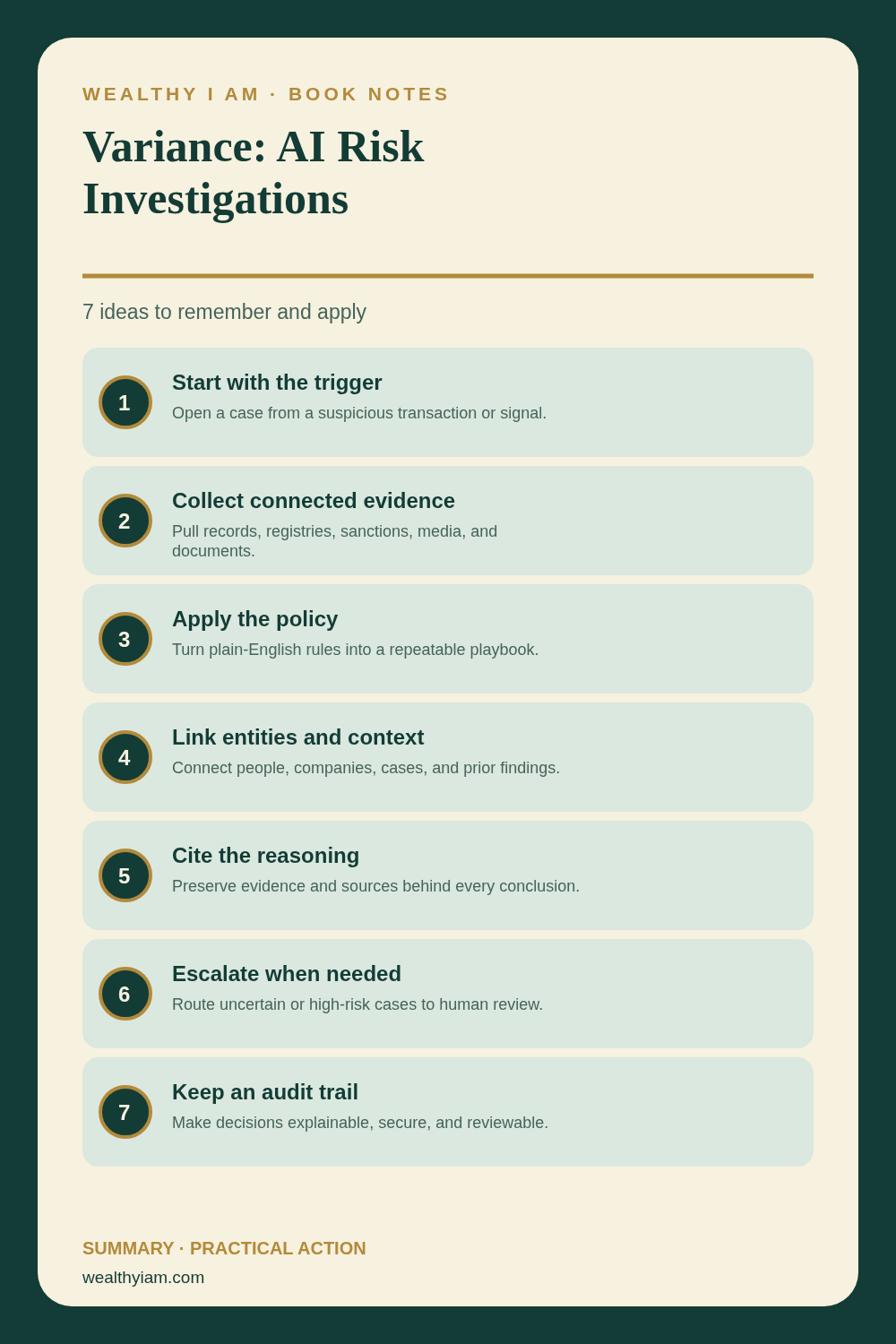
Variance builds autonomous agents that investigate and decide on compliance cases. The company’s product language is deliberately operational, not abstract: write policy in plain English, connect the data sources relevant to a case, and let the agent gather evidence, reason across it, and return a decision with a visible audit trail.
That matters because the work it targets is notoriously repetitive and brittle. Fraud and compliance teams often move between internal logs, business registries, sanctions databases, adverse media, ticketing systems, and identity-verification tools. Variance’s pitch is that the human analyst should not have to orchestrate every step manually.
Company thesis: In adversarial workflows, the bottleneck is not just intelligence. It is reliable evidence collection, repeatable enforcement, and a deployment model that meets security and governance requirements.
On its homepage, Variance says its agents collect 90% of the evidence for each case and can reduce investigative cycles by 10x. That is a company claim, not an audited benchmark, but it helps explain the product direction: not just summarization, but end-to-end case handling.
Leadership and origin
Variance is led by co-founder and CEO Karine Mellata and co-founder Michael Lin. The company says the pair worked on Apple’s fraud engineering and algorithmic risk team before starting Variance, which gives the team direct experience with large-scale abuse, trust, and operational risk.
The company formerly operated as Intrinsic. YC and other third-party profiles still reference that earlier name, which is worth remembering when tracing older coverage, launch posts, or early hiring materials.
2023
Company founded
BusinessWire says the company launched in 2023.
2025
Rebrand phase
YC and social posts show the transition from Intrinsic to Variance.
2026
Series A
The company announced a $21.5M Series A led by Ten Eleven Ventures.
Products and platform
The product page breaks Variance into a few core components. First are custom agents that follow a customer’s playbook. Second are first-party tools that can extract, parse, and verify documents such as IDs and incorporation filings. Third are external-intelligence connections that query the open web, sanctions lists, OSINT databases, and adverse-media sources in real time.
Variance also emphasizes entity linkages. In practice, that means building a broader graph around an individual or company: ownership, associated entities, related cases, behavior patterns, and evidence scattered across systems. That kind of context is useful in KYC, KYB, sanctions, fraud, and due-diligence work because the hard part is usually not one document — it is the relationship between many fragments.
The company’s own example workflow shows how it wants the product to behave: a suspicious wire triggers a case, the system pulls registry data, extracts a director from a filing, checks sanctions and adverse media, searches the web for supporting evidence, and then returns an escalated verdict with artifacts attached.
- Custom agents encoded from plain-English policies.
- Document extraction and verification tools.
- Real-time web, sanctions, and adverse-media enrichment.
- Entity linkage and case history across systems.
- Audit logs and cited reasoning on every decision.
Business model and go-to-market
Variance appears to sell into regulated B2B buyers rather than the open-ended developer market. The messaging is built around demos, enterprise trust, and “trusted by Fortune 500s” positioning. That suggests a sales motion closer to security software and regtech than to consumer AI or self-serve SaaS.
The company’s revenue model is not publicly detailed, but the product shape points toward enterprise subscriptions and deployment-based contracts, potentially with implementation and support attached. The security page’s cloud, VPC, and on-premise options also imply that deployment flexibility is part of the commercial pitch, not just an engineering preference.
That is sensible for the category. Compliance teams are often willing to pay for systems that reduce analyst load, accelerate investigations, and create better auditability — but only if the vendor can clear procurement, security, and governance reviews.
Market context and competition
Variance sits at the intersection of regtech, fraud operations, and trust-and-safety automation. Its nearest competitive set is not one single product category. Instead, it faces a mix of screening vendors, fraud orchestration platforms, compliance workflow tools, and broader AI-agent infrastructure startups trying to win regulated enterprise use cases.
The upside of that position is that the category is large and messy: there is plenty of manual work left to automate. The downside is that buyers already have stacks in place, and the winning vendor must prove it can slot into existing workflows without becoming another point solution.
Variance’s strongest differentiation is probably not “we use AI.” It is the combination of agentic investigation, plain-English policy encoding, audit trails, and deployment choices for sensitive environments.
Traction and signals
The clearest public signal is funding. BusinessWire says Variance raised $21.5 million in Series A financing led by Ten Eleven Ventures, with participation from 645 Ventures, Y Combinator, Urban Innovation Fund, and Okta Ventures. The same release says the company’s total funding reached $26 million.
Traffic and credibility signals are also helpful. YC lists Variance as Winter 2023 and active; the company’s own site says it is trusted by Fortune 500s; SecurityWeek notes a data access layer spanning more than 150 sources globally; and the homepage says the platform is already collecting 90% of evidence for each case in its target workflow.
Includes the newly announced $21.5M Series A.
KYC, KYB, AML, transaction monitoring, customer due diligence, and investigations.
A meaningful signal for procurement in regulated environments.
Technology and deployment
Variance’s technical story is anchored by three ideas: context, evidence, and control. Context comes from linking cases to entity graphs, internal systems, and external data. Evidence comes from traceable citations and step-by-step reasoning. Control comes from deployment and security features that let risk teams decide where data lives and how the system behaves.
The security page is especially important because it shows the company understands that many AI products fail at procurement, not proof-of-concept. Variance says it offers enterprise authentication and SSO, role-based access, encryption at rest and in transit, 24/7 SIEM monitoring, zero-data-retention configurations, and options for private VPC peering or on-premise / air-gapped deployment.
That positioning helps it compete for work that would otherwise be too sensitive for generic AI tools. It also makes the company’s trust posture part of the product, not an afterthought.
| Security claim | SOC 2 Type II, AES-256 at rest, TLS 1.3 in transit, and SSO / RBAC controls. |
|---|---|
| Deployment claim | Cloud, dedicated VPC, on-premise, and air-gapped options. |
| Audit claim | Every action and decision is logged with cited sources and audit-ready traces. |
Risks and constraints
Variance’s biggest risk is the standard one for regulated AI: good demos are easy, trusted production deployments are hard. A compliance agent that is right most of the time can still be too unreliable if the wrong 1% creates false negatives, legal exposure, or an audit problem.
There are also commercial risks. The company has to prove it can fit into existing bank, fintech, and marketplace workflows rather than sit beside them. It must also convince buyers that its mix of agents, context engines, and workflow enforcement will stay useful as the broader market for AI agents changes quickly.
- Reliability under adversarial conditions.
- Long enterprise sales cycles and procurement friction.
- Competitive pressure from larger regtech and fraud platforms.
- Security and data-governance scrutiny in every deal.
Maturity assessment
Variance looks like an early scale-up rather than an experimental prototype. The funding round, the security posture, the deployment options, and the specificity of its use cases all point to a company trying to become infrastructure for a narrow but expensive operational problem.
It is still early, though. The company has not publicly disclosed detailed revenue, retention, or usage metrics, so it is better understood as a venture-backed specialist with growing validation than as a proven category leader.
Assessment: Variance is at the stage where product-market fit signals matter more than hype. The next proof point is not another AI feature; it is repeatable deployment in regulated production environments.
What to watch next
- Named customer stories or case studies from financial institutions and marketplaces.
- Whether the company expands beyond KYC/KYB/AML into adjacent risk workflows.
- More evidence that the deployment model works across cloud, VPC, and air-gapped environments.
- Whether the company publishes concrete accuracy, cycle-time, or analyst-productivity benchmarks.
Analyst take
Variance is interesting because it is not trying to sell “AI” in the abstract. It is trying to turn investigations into a software problem with guardrails, auditability, and deployment flexibility built in from the start. That is a more credible wedge than generic agent theater.
If the company keeps converting manual review work into consistent, auditable flows, it could become one of the more useful operational AI companies in regtech. If it stalls, the reason will likely be trust, not demand: regulated buyers are often eager to automate, but only when the system is demonstrably safer and more controlled than the manual process it replaces.
Sources
- Variance: AI Agents for Risk Investigations — official website; credibility high; official_source=true; accessed 2026-07-09
- Homepage positions Variance as AI agents for risk investigations.
- Homepage says the company serves anti-money-laundering workflows and is trusted by Fortune 500s.
- Homepage states the agents collect 90% of the evidence for each case and reduce investigative cycles by 10x.
- About | Variance — official company page; credibility high; official_source=true; accessed 2026-07-09
- Company page describes Variance as building AI agents that investigate and decide on complex compliance cases.
- Page includes an “In the news” section referencing coverage by Business Wire, Axios, and SecurityWeek.
- Product | Variance — official product page; credibility high; official_source=true; accessed 2026-07-09
- Product page says Variance AI agents investigate, reason, gather context, and decide.
- Product page describes custom agents, custom tools, external intelligence, entity linkages, and auditable decisions.
- Use cases include KYC, KYB, transaction monitoring, and customer due diligence.
- Security at Variance | Variance — official security page; credibility high; official_source=true; accessed 2026-07-09
- Security page says Variance is SOC 2 Type II certified.
- Security page lists AES-256 at rest, TLS 1.3 in transit, SSO, fine-grained RBAC, dedicated environments, cloud, private VPC peering, and on-premise/air-gapped deployment.
- Security page says the company offers zero-data-retention configurations and audit logs for agent and human decisions.
- Variance Raises $21.5M Series A to Transform Risk Workflows with AI Agents — press release syndication; credibility high; official_source=false; accessed 2026-07-09
- Business Wire press release says Variance raised $21.5 million in Series A funding led by Ten Eleven Ventures.
- Press release says total funding is $26 million and the company was founded in 2023 by Karine Mellata and Michael Lin.
- Release says Variance is headquartered in San Francisco and serves fraud, risk, compliance, and KYC/AML workflows.
- Variance Raises $21.5M for Compliance Investigation Platform Powered by AI Agents — trade publication; credibility high; official_source=false; accessed 2026-07-09
- SecurityWeek says the new funding brings the company’s total to $26 million.
- SecurityWeek describes the platform as handling fraud detection, risk management, KYC, KYB, AML, transaction monitoring, and customer due diligence.
- SecurityWeek reports on the context engine, compliance enforcement layer, and access to more than 150 data sources globally.
- Variance: AI Agents for Fraud Review and Investigations | Y Combinator — startup profile; credibility medium; official_source=false; accessed 2026-07-09
- Y Combinator lists Variance as Winter 2023 and Active.
- YC describes the company as AI agents for fraud review and investigations for Fortune 500s, marketplaces, and regulated financial services.
- YC lists founders Karine Mellata and Michael Lin and notes the company was previously Intrinsic.
- Variance raises $21.5M for AI risk investigations – Axios — trade publication; credibility high; official_source=false; accessed 2026-07-09
- Axios coverage frames the raise as demand for faster review workflows as AI makes bad actors harder to catch.
Wealthy I AM Action Card
Wealthy I AM Pinterest Copy
TITLE
Variance Profile: How AI Agents Are Rewriting Risk Investigations
DESCRIPTION
Variance builds AI agents for compliance and fraud investigations, combining audit trails, security controls, and regulated deployment options for enterprise risk.
KEYWORDS
Variance Profile book summary, Variance Profile lessons, personal development, wealth building, productivity books
ALT TEXT
Wealthy I AM visual summary of Variance Profile: How AI Agents Are Rewriting Risk Investigations
ARTICLE URL
https://wealthyiam.com/variance-ai-risk-investigations-profile/