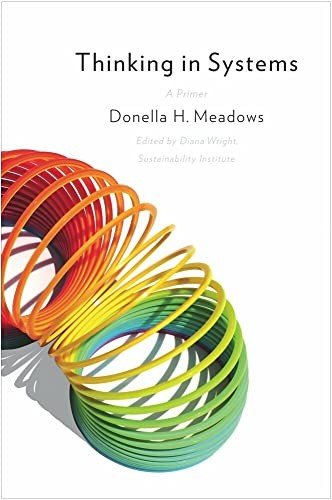
If you searched for a Thinking in Systems summary, you probably want more than a definition. You want to know what Donella H. Meadows’s book is about, which ideas matter for money and business, and how to use them without pretending a framework can remove uncertainty.
Short answer: Meadows shows how outcomes are shaped by interacting parts, feedback, delays, accumulations, and limits—not by isolated events alone. For Wealthy I AM readers, the practical implication is to inspect the structure producing a financial or business result before reacting to the latest result.
This is a concise, beginner-oriented interpretation of the book’s documented scope, not a chapter-by-chapter substitute for reading it. The seven lessons below are Wealthy I AM editorial synthesis, not a claim that Meadows presents this exact numbered list. The money applications and examples are original applications; hypothetical examples are labeled as such.
Why reacting to symptoms can make a system worse
A household may respond to a cash squeeze by using expensive credit. A business may respond to slowing sales by adding discounts. An investor may respond to a disappointing quarter by abandoning a long-term plan. Each action can feel reasonable in the moment, yet the underlying pattern may remain untouched—or become more fragile.
Systems thinking asks a broader question: What keeps producing this result? The answer may involve incentives, information, time delays, constraints, habits, or a reinforcing loop.
The approach can reveal useful leverage points, but it does not make complex outcomes predictable. The same intervention can work differently in a different context, and any model can omit an important factor. Its value is a disciplined way to improve the questions you ask before committing money, time, or attention.
Seven practical lessons for better decisions
1. Look for the whole system before blaming one event
A visible outcome is often produced by several connected conditions. A bank balance, profit number, or project deadline is an output; it may reflect many inputs and rules rather than one person’s effort or one market event.
When a monthly surplus disappears, list income timing, fixed costs, variable spending, debt payments, irregular bills, and automatic transfers. Cutting one discretionary purchase may help, but it may not solve a timing or recurring-cost problem elsewhere in the system.
Try this: Write a one-page map of the result you want to improve, its likely inputs, and the decisions that connect them.
2. Distinguish stocks from flows
A stock is an accumulation. A flow changes that accumulation over time. Cash saved, debt outstanding, inventory, and skill can accumulate. Income, spending, repayments, sales, and learning hours are flows that add to or subtract from those stocks.
Confusing a one-time flow with a durable stock can distort a decision. For example, a one-time bonus may improve a household’s cash stock temporarily, but it does not by itself establish a recurring surplus. That example is illustrative, not a forecast.
Try this: For one goal, record the current stock, weekly or monthly inflows and outflows, and the delay before a change becomes visible.
3. Expect delays between action and result
A system can respond later than the decision that changed it. Training, hiring, debt reduction, saving, and product development can take time to show results. A delayed response can make it tempting to reverse course too soon or to overcorrect.
Before changing a plan, define the observation window and the evidence that would justify a change. This is not a reason to ignore urgent warning signs; it is a reason to distinguish an expected delay from a deteriorating condition.
Try this: Add a decision date, first meaningful review date, and stop-or-change trigger to any material project or financial habit.
4. Separate reinforcing loops from balancing loops
Feedback can amplify change or counteract it. A reinforcing loop produces effects that support more of the same pattern. A balancing loop pushes toward a target or constraint. These labels describe behavior, not whether a loop is good or bad.
Hypothetical example: A business that serves customers well may receive referrals, bringing more customers and resources to improve service. Growth may also increase delays, causing complaints and cancellations that push growth back down. Neither pattern is guaranteed; the point is to inspect the loop.
Try this: Ask, “What result feeds back into this decision?” Then identify whether the feedback accelerates, limits, or redirects the behavior.
5. Treat limits to growth as part of the model
Growth can encounter a limiting condition: a resource, capability, demand constraint, bottleneck, or quality problem. More effort aimed at the visible growth mechanism may have little effect if the limit is elsewhere.
If sales increase but delivery quality falls, adding more marketing may not be the highest-leverage move. Capacity, process design, staffing, or customer fit could be the constraint.
Try this: For every growth goal, name the most likely limiting factor and the evidence that would show it is binding.
6. Prefer leverage points that improve information and rules
Some changes alter a system’s structure more than others. A small parameter adjustment may have less durable effect than improving information flows, changing a rule, clarifying a goal, or redesigning a relationship. The right leverage point depends on the system; there is no universal shortcut.
Try this: When a problem repeats, compare three interventions: a temporary parameter change, a better information signal, and a rule or process change. State the cost, downside, and test for each before choosing.
7. Update the model when reality disagrees
A model is a useful representation, not reality itself. If results repeatedly differ from expectations, inspect assumptions, boundaries, measurements, and missing feedback instead of defending the original story.
For a major business or investing decision, keep a decision journal: what you believed, what evidence you used, what would disconfirm it, and what happened. This supports learning without implying that every outcome was foreseeable.
Try this: Schedule a review that asks which assumption failed, which signal was missing, and what you will do differently—not merely whether the outcome was positive.
A five-step systems review for money and business decisions
Use this as a low-risk thinking exercise before a significant commitment. It is not individualized financial, tax, legal, or investment advice.
- Name the outcome. State the result in observable terms, such as maintaining a cash buffer, without assuming the target suits every household.
- Map stocks and flows. List what accumulates, what changes it, and where timing matters.
- Draw the feedback. Identify incentives, information, reinforcing patterns, balancing constraints, and likely delays.
- Test the bottleneck. Ask which limit is most plausible and what low-cost observation could test that assumption.
- Set a review rule. Record the decision, uncertainty, stop-or-change triggers, and date for revisiting the model.
For an investing decision, this process can improve questions about a business or portfolio. It cannot establish a fair price, guarantee a return, or replace appropriate due diligence and professional advice.
Common mistakes to avoid
- Treating the framework as a prediction machine. It organizes questions; it does not eliminate randomness or incomplete information.
- Calling every correlation a feedback loop. A relationship needs a plausible mechanism and time direction before you act on it.
- Ignoring boundaries. A household, company, or market model can omit legal, social, operational, and human factors.
- Changing too many variables at once. When possible, make a small, reversible change so you can learn what happened.
- Using a hypothetical illustration as evidence. Examples clarify ideas; they do not prove a forecast.
- Confusing patience with passivity. An expected delay does not excuse ignoring a safety, liquidity, or compliance warning.
Frequently asked questions
Is Thinking in Systems a personal-finance book?
No. It is an introduction to systems thinking and applies across personal, business, social, and environmental problems. This article applies its documented concepts to money and business decisions; it does not present the book as a personal-finance plan.
What is the main idea in one sentence?
Outcomes often arise from interacting structures, feedback, accumulations, delays, and limits, so changing the structure may matter more than reacting to a single event.
What should a beginner learn first?
Start with the distinction between stocks and flows, then practice mapping one feedback loop in a decision you can observe without risking essential money.
Does systems thinking tell me what investment to buy?
No. It can help you examine assumptions, incentives, constraints, and delayed effects, but it does not provide a recommendation or guarantee. Consider your goals, time horizon, risk capacity, and professional guidance where appropriate.
Who may benefit from reading it?
Entrepreneurs, leaders, investors, and anyone trying to understand complex situations may find the framework useful. Readers who want a simple, guaranteed formula for wealth should understand that this is not what the book promises.
One practical next step
Choose one recurring money or business result and draw its stocks, flows, feedback, delays, and likely constraint on a single page. Review the map with a trusted, appropriately qualified adviser if the decision involves money you cannot afford to lose.
Conclusion
Thinking in Systems offers a useful shift from isolated events to the structures that produce patterns. Its strongest Wealthy I AM lesson is modest but practical: before reaching for a quick fix, map what accumulates, what changes it, what feeds back, and where the delays or limits sit. Use the framework to ask better questions, update your assumptions, and make smaller, more reversible decisions.