People trying to improve their careers or finances often collect courses, notes, and productivity systems while avoiding the practice that would make them more capable. The problem is not always motivation. It is often a weak learning loop: no clear target, no useful feedback, no recovery plan, and no way to tell whether effort is producing better work.
Josh Waitzkin’s The Art of Learning draws on his experience in competitive chess and martial arts to explore learning, resilience, and performance under pressure. The seven lessons below are a Wealthy I AM synthesis, not a numbered framework presented by the book. They translate its broad themes into a cautious, practical method for developing a skill that may be useful at work or in business.
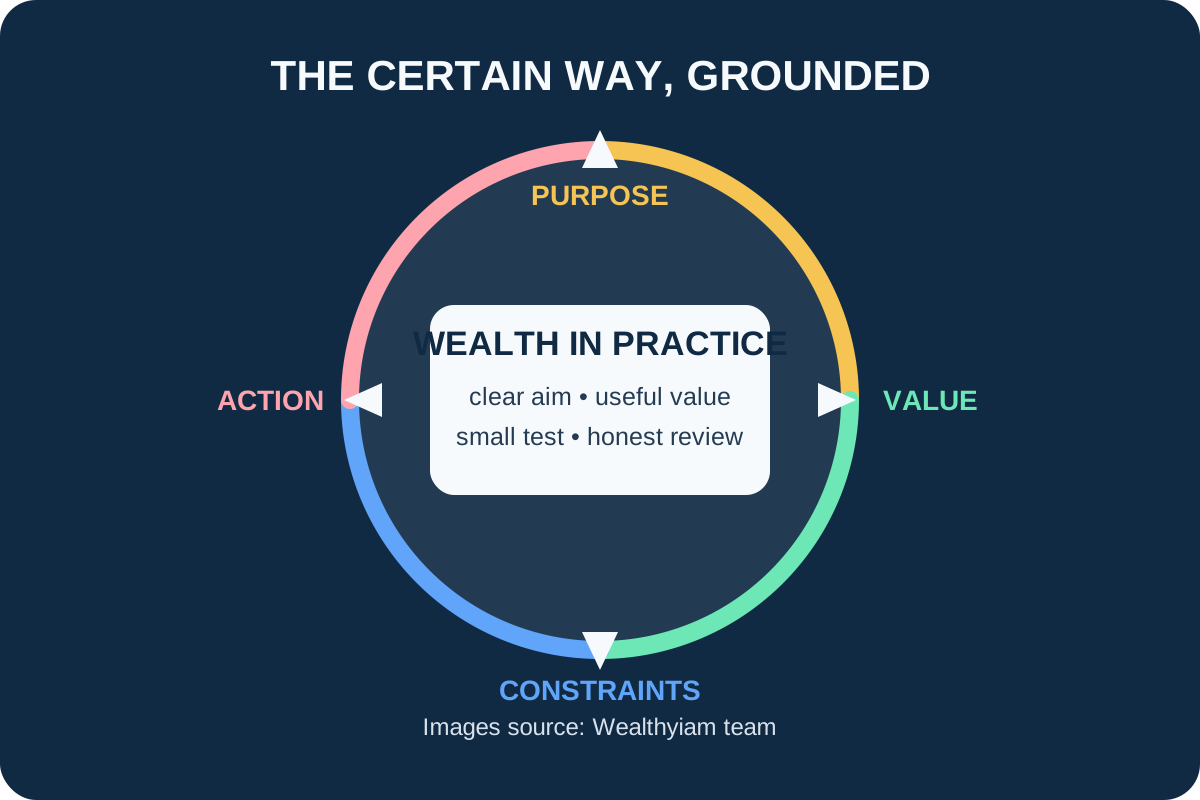
The short version: choose one economically relevant skill, define observable performance, practice at the edge of your current ability, study errors, recover, and repeat. This process cannot guarantee higher income. It can give you better evidence about whether your capability is improving.
The learning loop at a glance
- Define a capability in terms of work you can demonstrate.
- Break performance into decisions you can examine.
- Practice where mistakes are visible and correctable.
- Treat recovery as part of sustained performance.
- Get feedback close to the real work.
- Rehearse under safe, limited pressure.
- Apply the skill to a bounded, useful problem.
What the book contributes—and what it does not prove
Waitzkin’s book is a memoir and reflection on learning through chess and martial arts. It is not a personal-finance manual, an investment guide, or proof that a particular routine creates wealth. Its useful contribution here is a way to think about skill development: performance grows through focused practice, feedback, adaptation, resilience, and composure.
The career and financial applications below are original Wealthy I AM guidance. They are general education, not individualized financial, legal, tax, medical, or career advice.
1. Define the capability before choosing the course
A vague goal such as “learn business” does not tell you what to practice. A useful capability has an observable output: write a clear sales page, reconcile a cash-flow report, conduct a customer interview, analyze a business model, or explain a technical process to a non-specialist.
Write one sentence:
In 30 days, I want to be able to ___ for ___ audience, under ___ constraint.
The constraint might be time, word count, budget, or a realistic test environment. Choose a skill that could improve your work or business, but do not assume the skill will produce income without demand, execution, and opportunity.
2. Break performance into smaller decisions
Beginners often judge an attempt as simply good or bad. A more useful question is: which decision helped or hurt the result?
In a hypothetical freelance project, a disappointing outcome could come from weak scoping, unclear positioning, poor follow-up, or work that did not solve the client’s problem. Each diagnosis calls for different practice.
After an attempt, record three things:
- the decision you made;
- the evidence available at the time; and
- what you would change on the next attempt.
This turns mistakes into information without pretending that every failure has one certain cause.
3. Practice at the edge, not only in your comfort zone
Repeating easy tasks can create fluency without much growth. Useful practice is difficult enough to expose a weakness but controlled enough to permit correction. That might mean analyzing a more complex case, presenting an idea to a skeptical colleague, or completing a small project with a deadline.
Difficulty alone is not evidence of effective practice. If a task is too large to review, reduce its scope. A small, demanding exercise usually produces clearer feedback than an ambitious project whose mistakes are impossible to diagnose.
4. Use recovery as part of the system
Attention is limited. Waitzkin’s broader performance approach includes resilience, stress, recovery, and the ability to reset around demanding work. For a knowledge worker, that may mean ending a practice block before judgment deteriorates, protecting sleep, and separating review of the work from personal self-criticism.
This is not a health prescription. If fatigue, stress, or another health concern is persistent, seek appropriate professional guidance. As a work habit, schedule demanding practice when you can think clearly and leave enough time to examine what happened.
5. Build feedback close to the work
Delayed or vague feedback is easy to ignore. A useful loop has four parts: attempt, observation, adjustment, and another attempt.
Ask a customer to complete a specific task, have a qualified peer critique a real deliverable, or compare your analysis with primary evidence. Praise can be encouraging, but it is not a measurement system.
Choose one leading indicator you control, such as completed practice reviews, customer conversations, or revised drafts. Pair it with one outcome indicator that matters, such as fewer errors or more qualified enquiries. Neither guarantees financial success. Together, they help distinguish activity from evidence.
6. Learn to stay functional under pressure
A skill that works only in a quiet practice setting may fail when money, time, or reputation is involved. Add a small amount of pressure safely: use a timer, explain your reasoning aloud, or rehearse likely questions before a meeting. The goal is not bravado. It is to preserve decision quality when conditions become less comfortable.
For consequential financial decisions, pressure is a reason to slow down rather than gamble. A written checklist, a cooling-off period, and a second review can reduce impulsive choices, although they cannot eliminate uncertainty or loss.
7. Turn learning into an asset through deliberate application
Knowledge becomes economically relevant when it helps solve a problem someone values. After studying a concept, apply it to a real but bounded situation. Create a sample report, improve a process, test a small offer, or help a legitimate user with a clearly defined need. Then ask whether the result was useful and what evidence supports that conclusion.
Keep the evidence boundary clear: The Art of Learning offers reflections on mastery and performance. A business or career decision still requires market research, ethical conduct, financial judgment, and attention to applicable rules.
A 30-day learning experiment
- Choose one capability. Name the output and its intended audience.
- Set a baseline. Save one representative attempt and record the time, quality, and main weakness.
- Schedule four practice blocks each week. Keep them short enough to complete consistently.
- Use one credible source of feedback. A customer, manager, teacher, or qualified peer is usually more useful than an anonymous reaction.
- Review weekly. Identify one repeated error and design the next exercise around it.
- Apply the skill to a bounded problem. Do not make a substantial financial commitment before testing both the problem and your ability to address it.
- Decide from evidence. Continue, change the method, or stop. Ending an experiment can be valuable if it prevents a larger commitment based on wishful thinking.
At the end of 30 days, keep a one-page record of the original goal, attempts completed, feedback received, measurable change, unresolved weakness, and next decision. It is a learning record, not a promise of income.
Mistakes to avoid
Mistaking intensity for progress
Long hours can conceal weak practice. Examine the quality of decisions and outputs, not only the time spent.
Collecting resources instead of testing skill
Another course cannot replace an attempt that reveals what you do not yet understand.
Copying a champion’s routine
A method that helped one person in one context may not fit your health, responsibilities, resources, or goals. Adapt the principle and test the result.
Treating confidence as evidence
Confidence can rise before competence does. Use observable work and informed external feedback.
Making a large commitment too early
Do not borrow, invest, quit a job, or sign a major contract merely because a learning plan feels inspiring. Consider affordability, downside, alternatives, and qualified advice where appropriate.
Frequently asked questions
Is The Art of Learning a wealth book?
No. It is about learning and performance, drawing on Waitzkin’s experiences in chess and martial arts. The connection to wealth is an editorial application to skill-building and value creation.
Can this approach guarantee a higher income?
No. Income also depends on demand, opportunity, execution, competition, timing, and factors outside a learner’s control. A disciplined practice loop can improve the evidence you have about your capability; it cannot guarantee a financial result.
What should a beginner learn first?
Start with a skill connected to a real problem you understand and can test cheaply. Possibilities include clearer writing, spreadsheet analysis, customer interviewing, or a technical skill relevant to your current work. Validate the choice through feedback rather than status or hype.
How much time should practice take?
There is no universal number. Choose a schedule you can sustain and protect your attention during each block. Consistent practice and review matter more than an impressive plan that repeatedly fails.
Should I buy an expensive course or mentorship?
Not before you can state the problem, the expected learning outcome, and how you will evaluate it. Compare the price with free or lower-cost alternatives, your ability to use the material, and the downside if it does not help.
A grounded next step
Today, choose one capability and save a baseline example. Ask one person who understands the work to identify its biggest weakness. Then schedule your first practice block.
The Art of Learning is most useful here as a reminder that capability is built through a process: choose a target, practice deliberately, study errors, recover, and apply the skill to real problems. Improve what you can observe, protect your downside, and let evidence—not excitement—guide the next decision.
Sources and further reading
- Josh Waitzkin: The Art of Learning — the author’s overview of the book, its subtitle, and its themes of thematic learning, resilience, and performance psychology.
- Open Library: The Art of Learning by Josh Waitzkin — work, author, subjects, editions, and cover records.
- Open Library Covers API: selected cover image — exact-cover source associated with the 2007 Free Press hardcover edition, A Journey in the Pursuit of Excellence.