Many people treat personal finance as a race with no finish line: earn more, save more, delay more, and hope that later arrives with enough time and health to enjoy it. The harder question is what money is for while work, health, family responsibilities, and uncertainty keep changing.
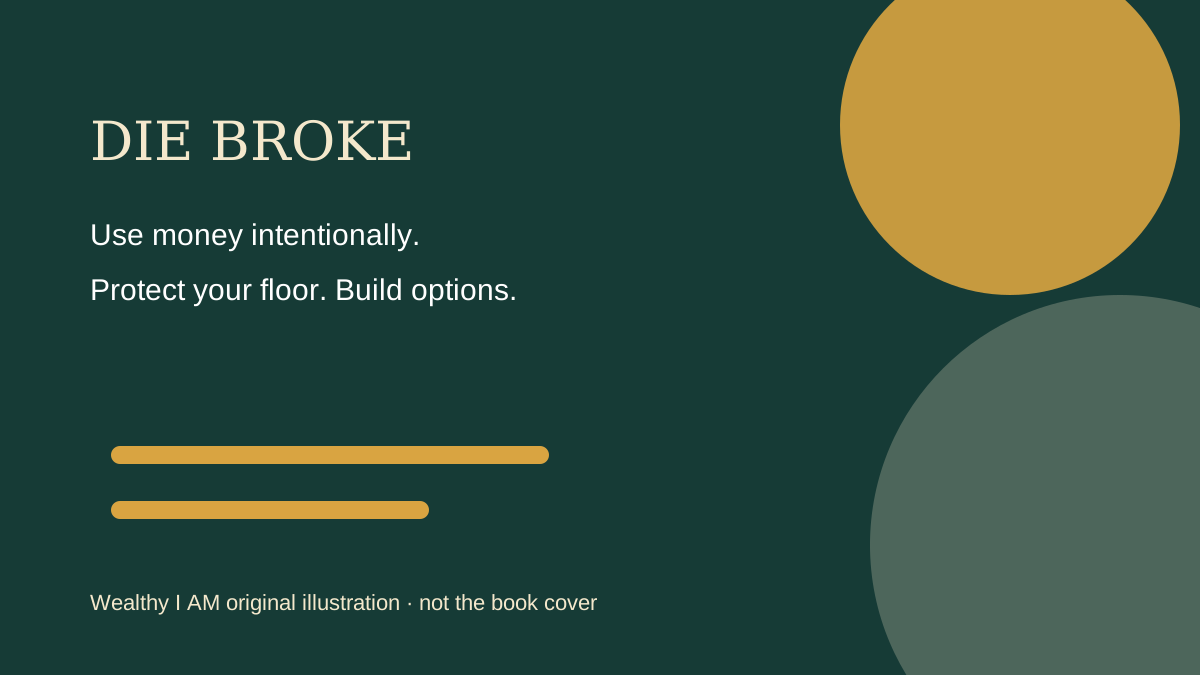
Short answer: Die Broke challenges automatic accumulation and conventional retirement assumptions. Its provocative message can be read as an invitation to use money intentionally, think independently about work and spending, and connect financial choices with a meaningful life. The seven lessons below are a Wealthy I AM synthesis, not a claim that Pollan and Levine present these exact seven headings.
This article is general education, not individualized financial, tax, legal, or retirement advice. Open Library records verify the book’s identity, authors, 1998 publication, and personal-finance subject context; they do not establish every chapter, example, recommendation, or outcome. Read the book itself before treating any summary as the authors’ complete framework.
Who this book may help—and what it is asking
Die Broke may interest readers who are accumulating automatically without defining “enough,” workers questioning a conventional retirement script, and households balancing present quality of life with future resilience. Its title is better treated as a question about priorities than as a literal instruction to end life without assets or safeguards.
The useful tension is simple: can you use money more fully without turning spending into carelessness? Intentional spending is not the same as ignoring risk.
Seven practical lessons
1. Define “enough” before chasing a larger number
A financial goal is easier to evaluate when it has a purpose. “More” can become an automatic response to fear, comparison, or habit. A more useful definition of enough can include essential costs, a reserve for plausible disruptions, and experiences or relationships a household values.
Try this: write three sentences: “Money must protect…,” “Money may enable…,” and “Money does not need to prove….” Revisit them when income, dependents, health, or housing changes.
2. Treat retirement as a transition, not one destination
A conventional plan can make work and retirement look like two separate lives. A flexible view asks what forms of paid work, learning, caregiving, rest, or contribution might fit different seasons. This application does not mean that working longer or retiring earlier suits everyone. Health, caregiving, insurance, taxes, and account rules matter.
Try this: map three plausible five-year scenarios: current work, reduced or changed work, and a temporary pause. List income, essential costs, coverage needs, and uncertainties. These are planning prompts, not forecasts.
3. Make spending express priorities instead of inertia
Spending is shaped by defaults, status pressure, convenience, and old commitments. Intentional spending asks whether an expense supports security, health, relationships, meaningful work, or genuine enjoyment. It does not mean every purchase must be justified or that low-cost living is morally superior.
Try this: for one month, label discretionary spending “restore,” “connect,” “create,” “simplify,” or “drift.” These labels are a Wealthy I AM tool, not a method claimed by the book. Keep what serves you and question what persists only by default.
4. Separate independence from isolation
Managing money on your own terms does not require refusing useful help. A household may need an accountant, licensed financial professional, benefits specialist, attorney, or trusted family conversation. Independence is stronger when decisions are informed and responsibilities are clear.
Try this: list what you can decide with your current knowledge and what needs professional or legal review. Ask advisers how they are paid, what assumptions they use, and what could make a recommendation unsuitable. Avoid promises of certainty or guaranteed returns.
5. Build a floor before increasing freedom
A meaningful life still needs resilience. A financial floor might include manageable fixed costs, accessible emergency savings, appropriate insurance, a plan for high-interest debt, and attention to account and tax rules. The right structure differs by household and jurisdiction.
Try this: create a one-page freedom floor with essential costs, reserves, major coverage gaps, debt obligations, and people who depend on your income or care. Mark each item “known,” “uncertain,” or “needs advice.” The goal is visibility, not a universal target.
6. Use money to buy options, not only objects
A financial choice can create optionality: the ability to leave harmful work, take time for family, learn a skill, or pursue an uncertain project. This is not guaranteed financial freedom; it is a way to evaluate trade-offs.
Hypothetical illustration: a household might compare a higher salary with unpredictable hours against lower pay with a schedule that supports caregiving or a small experiment. This is not a forecast. It shows why headline income may miss the value of time and flexibility.
Try this: for a major choice, write the cash effect, time effect, risk effect, and reversibility. A reversible experiment deserves a different threshold from an irreversible purchase.
7. Spend deliberately while preserving future dignity
The title creates a false binary: hoard everything or spend without restraint. A safer synthesis is to plan both present use and future protection. Travel, learning, generosity, and enjoyment can matter while medical, housing, and care needs remain uncertain.
Try this: hold a quarterly use-and-preserve meeting. Choose one resource to use more intentionally now and one future obligation to protect. Update both when circumstances change.
A low-risk values-to-cash exercise
Use this 30-minute worksheet as an original Wealthy I AM application, not as an exact exercise from Die Broke:
- Name five priorities, such as stability, family time, health, craft, community, or autonomy.
- Circle two that money can directly support and name the behavior or purchase.
- List three risks, including income interruption, large necessary expenses, or obligations to others.
- Choose one small, reversible experiment: change a subscription, schedule a conversation, redirect a modest amount, or research a benefit.
- Set a review date and ask whether alignment improved without weakening your safety floor.
This does not calculate retirement readiness, replace a budget, or produce a recommended portfolio. It turns a broad philosophy into a testable household decision.
Mistakes to avoid
Treating the title as a literal plan
“Die broke” is not a license to ignore dependents, debt, taxes, insurance, or future care. Translate the title into a question about purposeful use, then test any action against your obligations.
Confusing enjoyment with permanent lifestyle inflation
A meaningful purchase can still become a recurring commitment. Check whether the cost is one-time, variable, or difficult to reverse.
Assuming 1998 context fits today
The book was published in 1998, a different labor, technology, financial, and retirement environment. Its questions may remain useful, but current rules, costs, and employment conditions need current authoritative information.
Using philosophy to avoid numbers
Values do not eliminate arithmetic. Track cash flow, essential costs, debt terms, reserves, and obligations before making a large change. Seek qualified advice for regulated decisions.
Frequently asked questions
Does Die Broke tell readers to spend all their money?
The available catalog records verify the book’s identity and financial-planning context, but they do not verify a literal instruction to exhaust assets. The safer reading is to examine whether accumulation has displaced meaningful use while protecting obligations.
Is it a complete retirement plan?
No. A summary or catalog record cannot establish that it supplies a complete plan. The book may broaden how readers think about work, spending, and retirement, but each household still needs current facts and appropriate planning.
Can these lessons justify early retirement?
No. Early retirement depends on spending, health coverage, taxes, assets, income reliability, and setback capacity. The scenarios here are prompts, not approval or forecasts.
What should a beginner do first?
Start with the freedom-floor worksheet: identify essential costs, obligations, reserves, and uncertainties. Then test one small values-aligned change. Avoid irreversible decisions based on a slogan or short summary.
Sources and further reading
- Open Library work record: Die Broke — identity, authors, publication, and subject records.
- Open Library edition record: Die Broke — 1998 HarperBusiness edition details and table of contents.
- Open Library Covers API image — cover ID 6932225 and image provenance.
A measured next step
Read the source record and, if its questions fit your situation, read the book with your own numbers beside it. Define enough, protect your floor, and test one reversible change. Wealth is not only the amount accumulated; it is also the choices money can responsibly support. Neither a book nor this article guarantees a financial outcome.