If you know what you want financially but keep making different choices when you are tired, stressed, rushed, or surrounded by persuasive prompts, the problem may be the situation around the decision—not a permanent character flaw. The Willpower Instinct: How Self-Control Works, Why It Matters, and What You Can Do to Get More of It by Kelly McGonigal examines self-control, attention, temptation, and behavior change.
The short answer: McGonigal presents willpower as a mind-and-body capacity that can be observed and practiced rather than a fixed identity. Applied cautiously to money, that means creating a pause between urge and action, noticing the situations that trigger unhelpful choices, and making the preferred choice easier before a difficult moment arrives. These ideas may support better routines; they cannot guarantee wealth, savings, or investment results.
The seven lessons below are a Wealthy I AM editorial synthesis and application. They are not presented as the book’s exact seven-part framework. The available catalog and edition records establish the book’s subject and broad approach, but they do not verify every chapter claim, exercise, or research conclusion. The practical money boundaries and examples here are editorial applications, not individualized financial advice.
What the book can—and cannot—do for a wealth habit
Saving, spending, investing, and building valuable skills all involve repeated choices, so a self-control framework can be relevant to money. But a behavior framework does not remove income constraints, debt costs, emergencies, market risk, or the need for a suitable financial plan.
Use these ideas as prompts for noticing and testing behavior. Keep a financial experiment specific, reversible where possible, and compatible with essential bills, health, sleep, and obligations. If a habit experiment produces distress or interferes with eating, treatment, work, or relationships, stop or modify it and seek appropriate professional support.
Seven practical lessons for making better money choices
1. Notice the moment before the choice
Self-control often begins before the purchase, transfer, or distraction. The useful question is not only “Why did I do that?” but “What happened in the five minutes before it?” Notice the cue, feeling, thought, action, and immediate reward.
Money application: For seven days, record one discretionary purchase or avoided task without judging it. Write the time, situation, emotion, action, and what you hoped the action would change. This is observation, not a demand to eliminate every pleasure.
2. Separate an urge from an instruction
An urge can feel urgent without being a command. A limited pause can create room for a choice that matches your stated priorities. This is not a promise that every urge will disappear; it is a way to reduce automatic action.
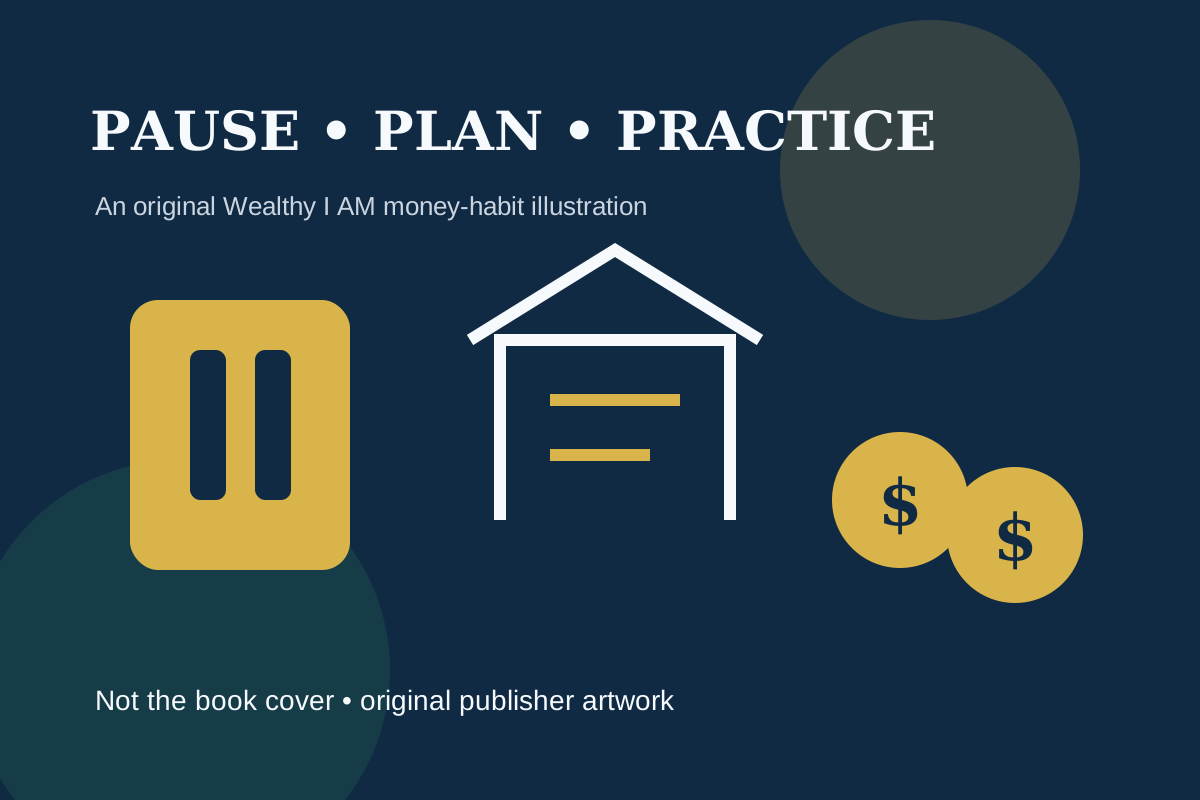
Practical step: Use a ten-minute pause for nonessential purchases above a limit you choose. Put the item on a list, step away from the sales page, and return only if the purchase still fits your plan. Do not use a pause to delay essentials or required payments.
3. Design the environment before willpower is needed
A decision made in a calm moment can protect a future version of you who is busy or depleted. Friction means adding a small obstacle to an unwanted action; convenience means reducing steps for a desired action.
Hypothetical example: A reader who wants to save part of each payday might place a scheduled transfer after confirming that bills and cash needs are covered, remove stored card details from a shopping site, and unsubscribe from promotional messages. This does not create extra income or guarantee a particular balance. It changes the number of decisions made under pressure.
4. Treat attention as a limited resource
Attention is involved in both spending and earning. Repeated notifications can invite purchases, interrupt skilled work, and make a long-term goal feel less salient. A clearer environment can help, but it cannot solve every financial or workplace constraint.
Practical step: Choose one 30-minute block on three days this week for a high-value task: reviewing a bill, learning a marketable skill, or preparing a client deliverable. Put the phone outside reach, define the first action, and record whether the block happened. Measure completion, not a promised income outcome.
5. Replace vague guilt with a specific recovery plan
A lapse is information about a system, context, or need. Shame may consume attention without explaining what to change. A recovery plan turns one imperfect choice into a bounded next step.
Try this three-line review: What happened? What was the trigger? What will I change once? The change might be moving a shopping app off the home screen or adding a weekly money check-in. Do not compensate for one purchase by skipping necessities or creating unsafe restrictions.
6. Make the long-term benefit visible without pretending it is certain
Future goals compete with immediate rewards partly because the future is abstract. A visible plan can make the trade-off easier to discuss. It should remain honest about uncertainty: saving a chosen amount is a controllable action; the future value of an investment is not guaranteed.
Practical step: Write one sentence beginning, “This money is meant to support…” Then identify the time horizon, the next controllable action, and one reason the plan may need revision. Keep emergency needs and near-term obligations separate from money intended for long-horizon risk.
7. Practice self-control as a skill, not an identity
Calling yourself disciplined or undisciplined can hide the actual mechanism. A skill framing invites small tests, feedback, and adjustment. It also leaves room for context: sleep, stress, medication, disability, caregiving, and financial scarcity affect what choices are available.
Practical step: Pick one behavior, one cue, and one measurement for a week. Example: “When payday arrives, I will review my planned transfer after checking essential cash needs; I will mark whether I reviewed it.” At the end, change the design—not your self-worth.
A seven-day money-habit experiment
This is an original Wealthy I AM application, not a quoted exercise or guaranteed method from the book.
- Choose one behavior. Examples include checking a subscription, delaying a nonessential purchase, or completing a short learning block.
- Define the safe boundary. Do not interfere with rent, food, medication, debt obligations, sleep, or emergency access.
- Name the cue. Use an event you can observe, such as opening a shopping app or receiving a paycheck.
- Choose one design change. Add a pause, remove a notification, prepare a list, or put the next action on your calendar.
- Track only completion and context. A simple yes/no plus one sentence is enough.
- Review without exaggeration. Ask what changed, what did not, and whether the experiment was practical.
- Keep, modify, or stop. A useful routine should be sustainable and should support—not replace—a broader financial plan.
Mistakes to avoid when applying willpower ideas to wealth
Treating self-control as a substitute for income or structural support
A behavior framework cannot solve inadequate income, predatory terms, unaffordable housing, medical costs, or an emergency. Use it alongside practical support, negotiation, benefits, debt counseling, or professional advice where appropriate.
Turning a lapse into a financial punishment
Skipping necessities, taking excessive investment risk to “make up” for a mistake, or using extreme restrictions can cause harm. Recovery should be proportionate and safe.
Confusing a good routine with a good investment
A person can automate a contribution to an unsuitable product or invest money needed soon. Behavior supports a plan; it does not determine asset allocation, tax treatment, or risk capacity.
Tracking so much that tracking becomes another burden
The aim is useful feedback. If a journal becomes stressful, reduce it to one cue, one action, and one weekly review.
Claiming that a single exercise proves a cause
A one-week change may reflect timing, workload, or chance. Treat it as a personal observation, not evidence of a guaranteed result or universal law.
Who should read The Willpower Instinct?
It may suit readers interested in the psychology of self-control, attention, temptation, and behavior change who are willing to test ideas cautiously. Readers seeking a complete budgeting system, individualized investment advice, or a solution to urgent financial hardship will need additional resources. The catalog record describes the book as informed by research, but the available record does not establish every study, exercise, or claim in the full text; verify details in the book and authoritative references before presenting them as exact source claims.
Frequently asked questions
Is The Willpower Instinct a personal-finance book?
No. Its listed focus is self-control and behavior. The connections to saving, spending, investing consistency, and focused work are applications for Wealthy I AM readers, not a claim that it supplies a complete money plan.
Can willpower help me save more money?
It may help you notice triggers and design better routines, but results depend on income, expenses, obligations, access, and implementation. Start with one controllable behavior and avoid guarantees.
Should I automate every financial decision?
No. Automation can reduce repeated effort, but review cash needs, fees, terms, taxes, and suitability. Keep access to emergency funds and do not automate a commitment you do not understand.
What is the safest first step?
Observe one recurring money decision for a week without trying to fix everything. Then make one small, reversible environmental change and review what happened.
A practical next step
Choose one money behavior that matters and write its cue, safe boundary, and next action on a note. Run the experiment for seven days, then review the system with curiosity. The goal is not to prove that you are naturally disciplined. It is to make one useful choice easier to repeat.
Sources and image provenance
- Open Library work record for *The Willpower Instinct* — title, author link, subjects, broad description, and cover ID.
- Open Library author record for Kelly McGonigal — author attribution.
- Open Library edition record — title, author, edition description, table of contents, and cover association.
- Open Library Covers API image, cover ID 9475786 — image provenance.
General education disclaimer: This article is not individualized financial, tax, legal, medical, or investment advice. Past performance is not a guarantee of future results.