Readers searching for The Automatic Millionaire Homeowner usually want two things: a clear summary of David Bach’s argument and a sensible way to apply it without treating a house as a guaranteed investment.
The short answer
David Bach’s The Automatic Millionaire Homeowner: A Powerful Plan to Finish Rich in Real Estate presents homeownership and real estate as part of a long-term wealth-building strategy. The Open Library record describes a system centered on building wealth through homeownership, buying a home and investment properties, and using step-by-step actions to make the plan repeatable.
The useful modern takeaway is more cautious: make sensible saving and debt decisions repeatable, then test whether the home still fits your cash flow, liquidity, flexibility, and risk capacity. Automating a transfer can reduce reliance on memory, but automation cannot make an unaffordable property affordable or remove maintenance, interest-rate, market, insurance, tax, and opportunity-cost risks.
The seven lessons below are a Wealthy I AM editorial synthesis of the book’s documented high-level theme, not a claim that Bach presents these exact numbered headings. Public catalog material cannot establish every chapter, calculation, historical claim, or recommendation in the full book. This article is general education, not individualized mortgage, tax, legal, or investment advice.
Image: cover of The Automatic Millionaire Homeowner by David Bach. Source and provenance are recorded below.
Who this summary is for
This overview is most useful for renters considering a purchase, homeowners reviewing their mortgage or reserves, and readers who want a practical framework for evaluating home wealth claims. It is not a substitute for current loan documents, local housing information, or professional advice about a high-stakes transaction.
The central idea: use systems, then check the trade-offs
“Automatic” means arranging a recurring action—such as a transfer or payment—so it happens with less manual effort. A system can make a good intention easier to repeat. It can also repeat a bad decision just as efficiently.
A safer order is: understand the trade-off, choose an amount that preserves breathing room, automate only what remains appropriate, and review the arrangement when circumstances change.
7 practical lessons from the book’s home-wealth theme
1. Treat housing as a cash-flow decision first
A home is not just a purchase price. The household must consider the regular payment, utilities, maintenance, insurance, taxes where applicable, transaction costs, and the effect of the commitment on future choices. Equity—the portion of a property that is not financed by debt—may grow over time, but it is not the same as accessible cash.
Try this: Make a one-page housing budget using conservative income and expense assumptions. Include a line for irregular repairs and a separate emergency reserve. If the plan works only by skipping reserves or relying on future raises, label that dependency rather than hiding it.
2. Automate a sustainable amount, not an impressive one
Automatic saving can help turn a goal into a routine. The amount still has to fit actual cash flow. A transfer that causes overdrafts, missed obligations, or expensive borrowing is not a successful system.
Start with an amount you can maintain after essential bills and a reasonable cash buffer. Review it after several pay cycles. Increase it only when your budget supports the change. Automation is a convenience, not a guarantee of wealth.
3. Understand what mortgage choices change
A mortgage determines more than the monthly payment. Rate type, term, fees, repayment schedule, and early-payoff conditions can change total interest, flexibility, and exposure to future rate changes. The lowest payment is not automatically the lowest long-term cost, and paying debt faster is not automatically best for every household.
Compare at least two clearly documented scenarios: payment, total interest or fees as disclosed by the lender, cash needed at closing, reserve left afterward, and what would happen if income fell. Ask a qualified mortgage or financial professional about terms you do not understand.
4. Separate home equity from guaranteed appreciation
Home equity can come from paying down principal or from a change in the property’s market value. Market value can also fall. Local conditions, property condition, transaction costs, and timing matter. A past rise in one neighborhood is not a forecast for another home or future period.
Build your plan so it remains useful without assuming a specific price increase. If you estimate a possible value, label it as an assumption and test a downside case. Do not count an unrealized gain as spendable cash.
5. Make the property decision fit your life, not only a spreadsheet
A home can provide stability, but ownership may reduce mobility and concentrate resources in one asset. A move for work, caregiving, health needs, relationship changes, or a different lifestyle can make flexibility valuable.
Ask: How long might we realistically stay? What would moving cost? Would the payment still work after a job change? What alternatives offer acceptable shelter and financial flexibility? These questions do not make renting or buying universally superior; they make the trade-off visible.
6. Treat maintenance and risk protection as part of the plan
A property requires attention and can face damage, liability, vacancy, or unexpected repair costs. Insurance terms vary, and coverage is not a substitute for a cash reserve. Safety and legal obligations can also differ by location and property type.
Keep a dated home-maintenance list, understand major exclusions and deductibles in your policies, and reserve cash for foreseeable repairs. For a property with tenants or complex legal obligations, obtain current local advice rather than relying on a general book summary.
7. Review the system when the facts change
A plan created for one income, rate environment, household structure, or property may become unsuitable later. Review is the part that prevents “automatic” from becoming “unnoticed.”
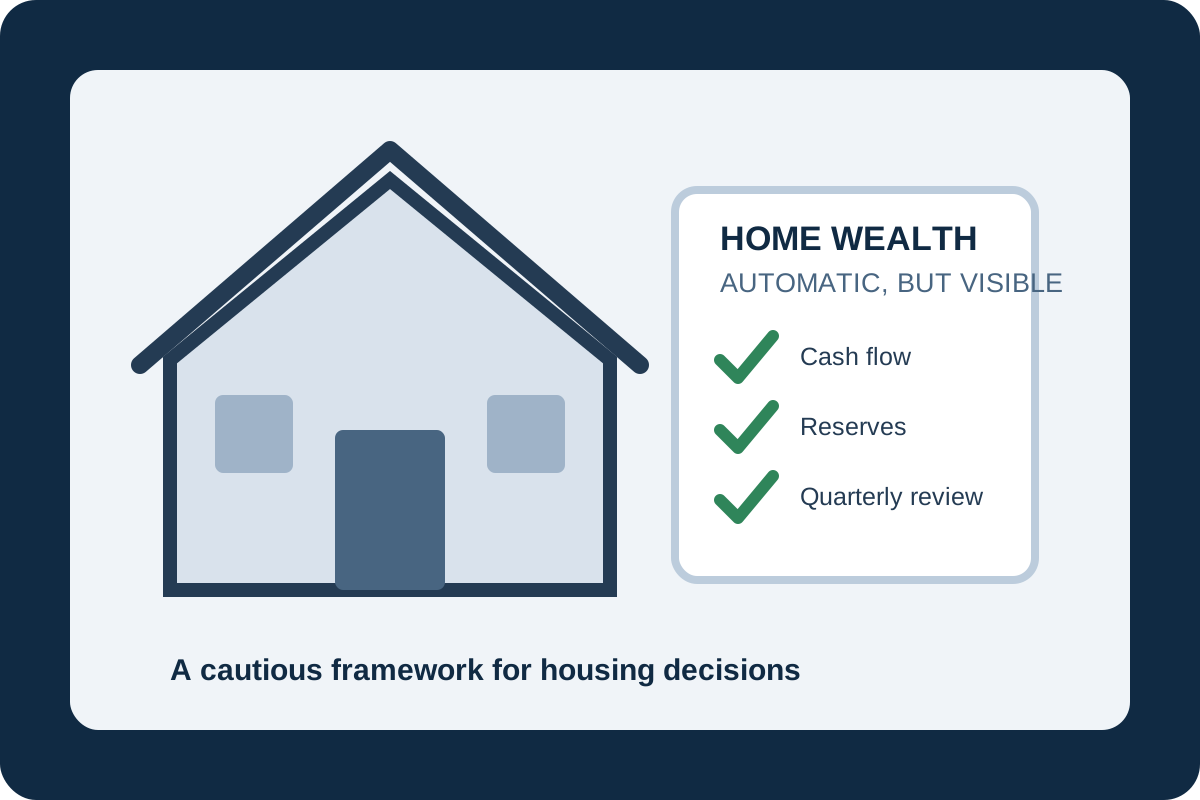
Each quarter, check income, essential spending, debt terms, reserves, insurance, property condition, and the reason the home still fits your goals. Record one assumption that changed and one action that follows. Seek personalized advice for high-stakes decisions.
A cautious home-wealth workflow
1. Define the goal. Is the priority stable housing, flexibility, debt reduction, long-term equity, or some combination? 2. Map total costs. Include recurring, irregular, financing, transaction, and opportunity costs. 3. Stress-test the plan. Consider lower income, a major repair, a move, or a higher payment where relevant. 4. Protect liquidity. Keep an appropriate cash buffer; do not commit every available dollar to a down payment or early repayment. 5. Automate only the tested action. Confirm timing, amount, and how to cancel or adjust it. 6. Review on a schedule. Recheck when income, household needs, debt, policy terms, or property conditions change.
A hypothetical example: making a system safer
Imagine a household considering an automatic extra mortgage payment. In one scenario, the extra payment shortens the loan timeline but leaves too little cash for a likely roof repair. The household might instead pause the extra payment, rebuild a reserve, and compare the loan terms with other uses of the money.
This example is hypothetical, not a recommendation or forecast. The correct choice depends on the household’s contract, liquidity, goals, taxes, and risk capacity.
Mistakes to avoid
- Treating a home as a guaranteed appreciating asset.
- Comparing mortgage payments without comparing fees, terms, reserves, and total trade-offs.
- Automating transfers before checking the real cash-flow calendar.
- Using all available savings for a purchase and leaving no repair or emergency buffer.
- Ignoring the value of flexibility and the costs of moving.
- Treating book-era advice as current mortgage, tax, insurance, or legal guidance.
- Confusing home equity with diversified wealth or readily spendable cash.
Frequently asked questions
Is The Automatic Millionaire Homeowner a guarantee that homeownership creates wealth?
No. The title expresses the book’s framing, but no housing strategy guarantees an outcome. Prices, financing costs, maintenance, taxes, insurance, location, timing, household circumstances, and opportunity costs can change the result.
What does “automatic” mean in this context?
It means using recurring systems—such as scheduled saving or payments—to reduce dependence on memory and momentary motivation. The system still needs review and must be affordable.
Should I pay extra on my mortgage?
Not from this summary alone. Compare the loan terms, liquidity needs, other debts, emergency reserves, taxes, and alternatives. Check the contract and consider qualified advice for your situation.
Is buying always better than renting?
No universal answer follows from the book’s broad theme. Compare total costs, expected time in the home, flexibility, local conditions, maintenance responsibility, and your goals. A spreadsheet should inform the decision, not conceal uncertainty.
Can I use projected appreciation in my financial plan?
Treat future appreciation as uncertain. A safer plan does not require a particular price increase to meet essential obligations. Label hypothetical assumptions and test downside scenarios.
The Wealthy I AM “automatic, but visible” check
Before setting up a recurring housing-related transfer, write down:
- the exact purpose of the payment or saving action;
- the cash reserve that remains afterward;
- the assumption most likely to be wrong;
- the cost of changing course; and
- the date of the next review.
Conclusion: make the system repeatable and revisable
The durable lesson in The Automatic Millionaire Homeowner is not that a house automatically produces financial security. It is that repeated choices deserve a system—and every system deserves a reality check. Automate what you have tested, keep enough flexibility for setbacks, and judge home decisions by their full cash-flow and risk trade-offs rather than by a hopeful price story.
Before your next housing-related commitment, complete the six-step workflow and write down the one assumption you will review next quarter. For a personalized mortgage, tax, legal, or investment decision, use current documents and appropriately qualified advice.
Sources and image provenance
- Open Library work record for The Automatic Millionaire Homeowner — title, author, publication context, broad description, and cover association.
- Open Library Covers API image — exact catalogued cover source.
This article is general education, not individualized financial, mortgage, tax, legal, insurance, or investment advice. Hypothetical illustrations do not guarantee wealth, appreciation, savings, or any other financial result.