Search intent: Readers looking for a practical summary of House of Debt, its main lessons, and a cautious way to think about household leverage, credit risk, and financial resilience.
The reader problem: debt can look manageable until conditions change
A monthly payment can fit a budget today and still leave a household exposed tomorrow. Income can fall, a refinancing option can disappear, an asset can lose value, or several ordinary costs can arrive at once. The difficult question is not simply “Can I make this payment?” It is “How much flexibility will remain if one important assumption stops being true?”
That is the practical doorway into House of Debt: How They and You Caused the Great Recession, and How We Can Prevent It from Happening Again by Atif Mian and Amir Sufi. The book examines the connection between household balance sheets, borrowing, falling asset values, and the Great Recession. Its central idea, in plain language, is that widespread household debt can amplify an economic downturn: when heavily indebted households lose wealth or income, they may cut spending sharply, which can put further pressure on businesses and employment.
Early answer: Use the book as a reminder to stress-test debt rather than judge it only by the current payment. Map the debt, identify the assumptions behind repayment, test a downside scenario, preserve liquidity where possible, and avoid confusing a rising asset price with permanent financial strength.
This is a book-focused educational article, not individualized financial, mortgage, tax, or investment advice. The authors’ macroeconomic analysis is separate from Wealthy I AM’s practical application. The book does not determine whether a particular loan, home, or investment is suitable for you.
What House of Debt is trying to explain
Mian and Sufi focus on the role of household debt in financial instability. The book’s subject is broader than personal budgeting: it asks how borrowing patterns can affect consumption, housing markets, defaults, and the wider economy. The authors’ framework is historical and economic, so readers should not treat it as a prediction about the next recession or as a complete personal-finance system.
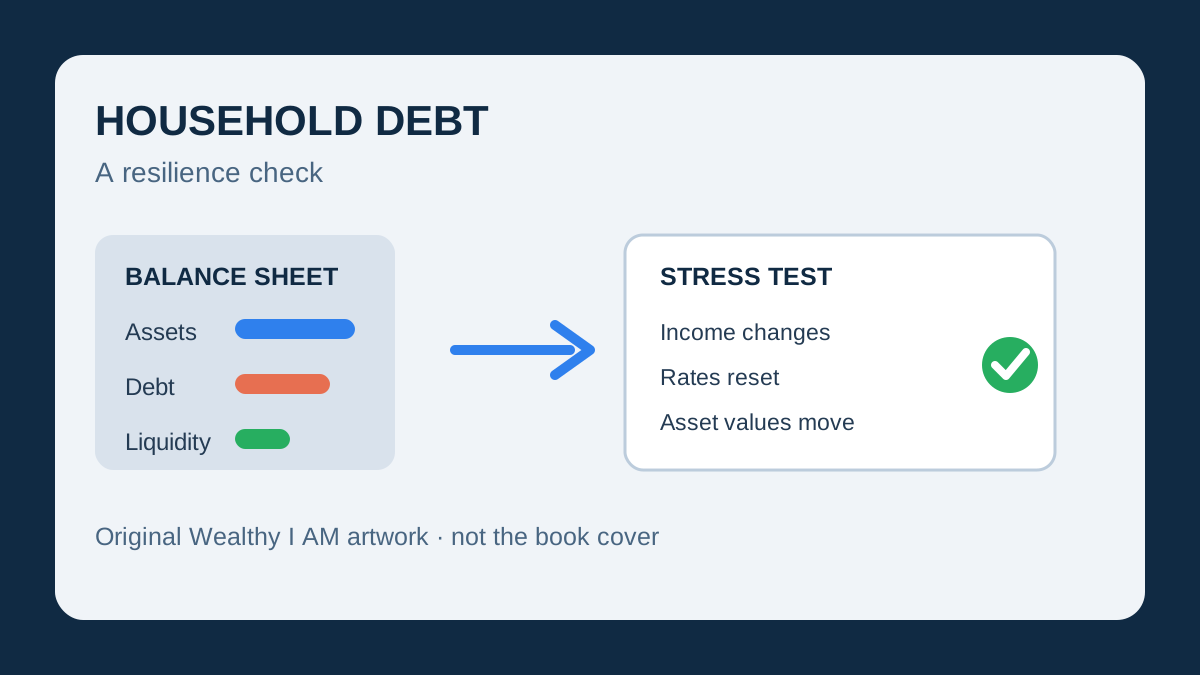
The useful bridge for an individual reader is balance-sheet thinking. A balance sheet is a snapshot of what you own, what you owe, and the difference between the two. A strong income can coexist with a fragile balance sheet if debt is large, liquidity is thin, or the household depends on one optimistic assumption.
The curiosity gap: the payment is only one part of the risk
Two debts with similar monthly payments can create different risks. One may have a stable rate, a large cash buffer, and a realistic payoff path. Another may depend on refinancing, variable income, or an asset retaining a particular value. The payment is visible; the assumptions underneath it are easier to miss.
Five practical lessons from House of Debt
1. Look at leverage, not just the size of the payment
The book’s idea: Debt can make a household more sensitive to shocks because obligations continue while income, asset values, or spending capacity may change.
Plain-language application: Leverage means using borrowed money alongside your own resources. It can increase purchasing power, but it also increases the consequences of a setback. A manageable payment does not remove the risk created by a large outstanding balance or a short repayment horizon.
Try this: List each debt, its balance, interest-rate structure, required payment, maturity or reset date, and whether repayment depends on selling or refinancing an asset. Then mark which item would become hardest to manage if income declined.
Wealthy I AM advice: Treat debt as a claim on future flexibility. Before taking on additional borrowing, ask what useful options the payment will remove from your future self.
2. Stress-test the assumptions behind the debt
The book’s idea: Household debt becomes especially consequential when many people are exposed to the same economic shock. The authors use the financial crisis to examine that interaction at the macro level.
Plain-language application: A personal stress test is not a forecast. It is a structured “what if?” exercise. Test the assumptions that matter most: income continuity, interest rate, rent or housing costs, insurance costs, asset value, and access to credit.
A simple worksheet:
- Write the current monthly debt service and essential living costs.
- Remove or reduce one income source in a hypothetical scenario.
- Add a plausible one-time repair, medical, family, or relocation expense without inventing a probability.
- Test a higher payment if the debt can reset or refinance.
- Note how many months of liquid reserves remain and which expenses could be reduced without creating a new problem.
Label the result hypothetical, not expected. If the exercise reveals a gap, the responsible response may be to delay borrowing, increase reserves, seek qualified advice, or change the size and structure of the commitment.
3. Separate an asset’s market price from household resilience
The book’s idea: The authors connect housing debt and falling asset values to the damage experienced by households and the wider economy.
Plain-language application: A home or investment can be valuable and still fail to provide immediate liquidity. Market value can change, selling takes time, and a sale may create costs or tax consequences. Equity is not the same as cash available for next month’s obligations.
Try this: Keep three lines separate in your records: estimated market value, outstanding debt, and liquid reserves. Do not count an uncertain price increase as a guaranteed source of repayment.
Wealthy I AM advice: Build plans that can survive without requiring the best-case valuation. This does not mean avoiding every asset purchase; it means recognizing that ownership and liquidity solve different problems.
4. Watch for correlated risks
The book’s macro lesson: When many households face similar debt and housing exposures, individual decisions can interact and intensify an economic downturn.
Plain-language application: Correlation means risks move together. A household can be exposed to the same economic driver through its job, home, business, and investments. For example, a property-related worker who owns a highly leveraged property and holds concentrated property-company investments may have several risks tied to one sector.
Try this: Beside each major financial resource, write what it depends on: one employer, one industry, local property prices, variable rates, a single customer, or a particular market. Look for repeated dependencies rather than merely counting accounts.
Diversification can reduce some concentration risk, but it cannot eliminate loss or make an unsuitable investment suitable. The right mix depends on circumstances, time horizon, and capacity to absorb losses.
5. Prefer flexibility when the future is uncertain
The book’s analysis: Debt can constrain household spending and choices when conditions deteriorate.
Plain-language application: Flexibility has financial value. A lower fixed obligation, accessible reserves, a realistic payoff plan, and the ability to postpone a purchase can help a household respond to uncertainty. Flexibility is not the same as maximizing cash at all times; it is preserving choices that may matter later.
Try this: Before a major commitment, compare at least two versions: the larger or faster plan and a smaller plan that leaves more room for reserves, maintenance, education, caregiving, or career changes. Compare the trade-offs without assuming a guaranteed return.
A 30-minute household debt review
Use this as an educational checklist, not a substitute for professional advice.
Step 1: Build the debt map
Record lender, balance, rate type, payment, term, collateral, fees, and any reset or renewal date. If you do not understand a term, ask the lender or a qualified adviser to explain it before relying on your own interpretation.
Step 2: Identify the single-point failures
Ask: What has to go right for this debt to remain comfortable? Common dependencies include overtime, a bonus, a tenant, a sale, a refinance, a rising asset value, or continued access to a credit line. Write them down without judging yourself.
Step 3: Create a downside case
Change one or two assumptions at a time. The goal is to reveal sensitivity, not to produce a precise recession model. If the downside case is difficult to meet, stop and get advice before increasing exposure.
Step 4: Choose a resilience action
Possible actions include building or protecting liquid reserves, reducing high-cost debt, reviewing insurance, improving income diversity, delaying a purchase, or obtaining a second opinion on a complex commitment. The best action depends on the household’s facts.
Step 5: Set a review date
Debt risk changes when rates, income, dependents, employment, health, or asset values change. Choose a date to revisit the map rather than assuming today’s assessment remains valid.
Mistakes to avoid
- Using the current payment as the whole risk analysis. Include rate changes, term, balance, and income dependence.
- Treating home equity as an emergency fund. Equity may not be liquid when needed.
- Copying a book’s historical explanation into a personal prediction. A historical account can improve understanding without forecasting the next event.
- Using leverage because an asset has recently risen. Recent performance is not a guarantee of future value.
- Ignoring concentration. Several apparently separate assets can depend on the same employer, industry, region, or credit condition.
- Making a large move from a general lesson alone. Verify current rates, legal terms, taxes, and suitability with qualified professionals where appropriate.
Who should read this book?
House of Debt may help readers who want an accessible entry point into household leverage, housing cycles, and the financial crisis. It is especially relevant for people who want to understand how personal balance sheets can connect to the broader economy.
It may be less suitable as a stand-alone guide for choosing investments, managing taxes, selecting a mortgage, or designing a complete household budget. The book’s economic argument and a reader’s personal decision are different layers of analysis.
Frequently asked questions
Is House of Debt a personal-finance book?
It is primarily an economic and financial-history analysis of household debt and the Great Recession. Its concepts can inform personal risk thinking, but it is not a personalized debt-payoff plan or investment recommendation.
What is the main lesson of House of Debt?
A concise summary is that widespread household leverage can make downturns more damaging, especially when falling asset values and reduced spending reinforce one another. Applying that lesson personally means examining debt-related fragility, not predicting markets.
Does the book say everyone should avoid borrowing?
The available description supports an analysis of debt-driven risk, not a blanket rule that every form of borrowing is harmful. Borrowing decisions depend on purpose, terms, cash flow, risk capacity, and legal and tax details.
How can a beginner apply the book safely?
Start with a debt map and a hypothetical stress test. Do not borrow, sell, refinance, or invest solely because a summary sounds persuasive. Use current documents and qualified advice for decisions that materially affect your finances.
How does this connect to Wealthy I AM advice?
The connection is a practical emphasis on resilience: build wealth without pretending uncertainty does not exist. The book’s claims belong to Mian and Sufi; the checklist and cautions here are Wealthy I AM’s educational application, not a claim that the authors prescribe this exact worksheet.
A cautious next step
Tonight, list every debt and one assumption behind each repayment plan. Tomorrow, test the most important assumption with a clearly labeled hypothetical downside case. If the result is uncomfortable, treat that discomfort as information—not as a reason to panic or to make a rushed financial move.
Conclusion
House of Debt widens the lens from “Can I make this payment?” to “What happens when many obligations meet a changing economy?” Its most useful personal takeaway is not a prediction or a guaranteed route to wealth. It is a discipline of checking leverage, liquidity, concentration, and flexibility before a commitment becomes difficult to change.
Read the book for its economic argument. Use the checklist as a prompt for better questions. Then make any consequential financial decision only after checking current facts and obtaining advice suited to your circumstances.
Sources / Further reading
- Atif Mian and Amir Sufi, House of Debt, Open Library work record: https://openlibrary.org/works/OL21559651W.
- Book-cover source: Open Library Covers API, exact catalogued work/edition record, cover image. Provenance and reuse rights should be checked before publication.
- This article uses the inventory description and listed bibliographic source. Claims beyond that evidence boundary are labeled as interpretation, hypothetical application, or practical guidance.