Search intent: Readers looking for a practical summary of The 7 Day Startup and a cautious way to test a business idea before committing substantial time or money.
The problem: planning can feel productive while demand stays unknown
A business idea can absorb weeks of naming, branding, feature lists, and financial projections before a founder has learned whether a real person wants the result. That creates a dangerous gap: activity increases, but evidence does not.
The 7 Day Startup: You Don’t Learn Until You Launch by Dan Norris and Rob Walling argues for a faster learning loop. Its central premise, as represented by the available source record and the book’s title, is that a simple launch and real customer feedback can teach more than extended planning for an untested idea. This article turns that premise into a cautious, low-cost experiment—not a promise of revenue and not a prescription to risk essential savings.
Images source: Wealthyiam team
The short answer: launch a small test, not a finished company
The most useful takeaway is not “build a company in seven days.” It is: reduce the idea to a safe, specific offer; show it to likely customers; observe what they do; and improve only after evidence arrives. A launch is a learning event. It is not proof that the business will work.
The seven lessons below are a Wealthy I AM synthesis inspired by the book’s premise, not a claim that these are the authors’ exact numbered chapters or framework.
Seven practical lessons from The 7 Day Startup
1. Start with a customer problem you can describe plainly
A vague idea such as “a platform for small businesses” is hard to test. A clearer problem names the person, situation, and desired change: “Independent tutors need a simple way to collect recurring payments from families.” The clearer the problem, the easier it is to ask useful questions and design a small test.
Try this: Write one sentence beginning, “I help [specific person] make [specific improvement] when [specific situation].” If you cannot finish it without jargon, keep researching the problem rather than building.
2. Make the first version smaller than your ambition
A first offer should test one important assumption. It might be a paid consultation, a manual service, a short workshop, a narrowly defined product, or a basic version of software. Manual work is not automatically a failure; it can reveal what customers actually value before automation consumes money.
Example: A hypothetical bookkeeping service could first offer a one-time cash-flow review to a narrow group of freelancers. That test would not prove recurring demand, but it could reveal which questions customers ask and whether the proposed outcome is useful.
3. Put the offer in front of real people quickly
Research and conversations matter, but a response to an offer is stronger evidence than polite enthusiasm. A test can be as simple as a clear page, direct outreach that respects consent, or a small pilot with transparent terms. Do not represent interest as a sale, and do not use pressure or misleading scarcity.
Try this: Ask a small set of plausible customers to take one concrete action: request details, book a call, join a pilot, or pay for a clearly described service. Track the action and the reason for hesitation without treating a small sample as a market forecast.
4. Charge only when the value and terms are clear
Payment can be informative, but it is not the only signal and it introduces obligations. State what the customer receives, when they receive it, the price, refund terms where applicable, and any limitations. Follow consumer-protection, tax, privacy, accessibility, and other relevant rules in your jurisdiction.
For a low-risk test, avoid borrowing money or spending emergency funds. Set a maximum experiment budget that you can afford to lose before you begin. A result that says “not yet” is less damaging when the test itself was financially contained.
5. Learn from behavior without overclaiming
A customer who says an idea is interesting may still do nothing. Someone who asks a detailed question, completes a pilot, refers another person, or pays under clear terms provides different evidence. None of these signals guarantees a durable business. They simply help you update your next decision.
Create a short record after each interaction:
- What problem did the person describe?
- What did they do, not merely say?
- What part of the offer was unclear?
- What would make the offer more useful or safer?
- What assumption should the next test examine?
6. Improve the offer before adding complexity
Early founders often respond to uncertainty by adding features. That can hide the original question. If customers do not understand the benefit, a new feature may increase confusion rather than value.
Use a simple loop: identify the largest uncertainty, run the smallest reasonable test, review the evidence, then change one meaningful element. Keep a record of what changed so you do not mistake a new result for proof of the entire business model.
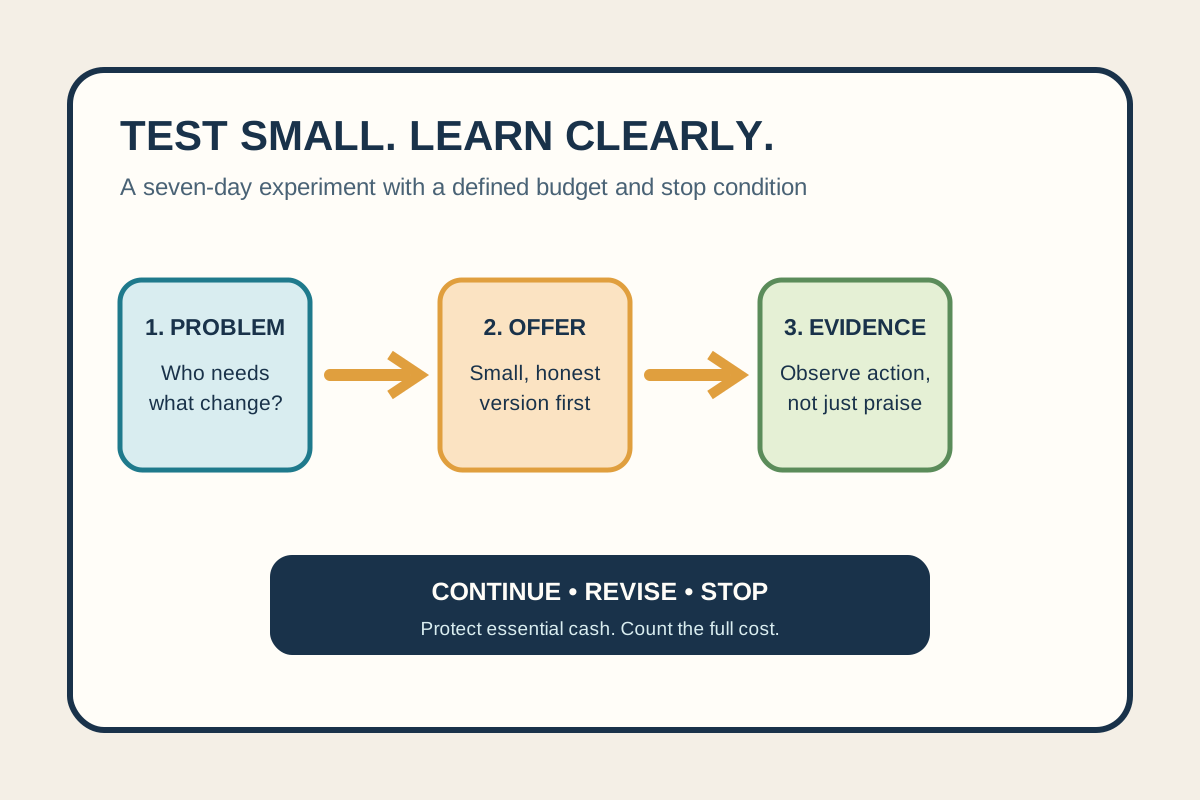
7. Decide deliberately whether to continue, revise, or stop
Speed is useful only when it leads to better decisions. At the end of a test, choose among three paths: continue the same offer, revise the customer/problem/price, or stop and preserve your resources. Stopping a weak experiment is not the same as declaring that entrepreneurship is impossible.
A decision rule can reduce emotional drift. For example, you might continue only if a defined number of people complete the agreed action and the delivery cost remains within your limit. The threshold is your planning tool, not a validated industry benchmark.
A cautious seven-day testing plan
This is an original application of the book’s launch-and-learn idea, not a guaranteed formula.
Days 1–2: define the problem and the constraint
Name the customer, problem, proposed outcome, and one assumption that could make the idea fail. Set a time limit, spending limit, and stop condition. Protect rent, food, debt obligations, emergency savings, and health.
Day 3: create one clear offer
Write what is included, what is excluded, who it is for, the price or pilot terms, and how someone can respond. Remove features that do not help test the central assumption.
Days 4–5: invite relevant people
Use respectful, truthful outreach to people who plausibly experience the problem. Ask for a concrete next step and record responses consistently. Do not scrape personal data, spam, or imply that participation guarantees an outcome.
Day 6: deliver or demonstrate manually
If someone joins, deliver the smallest complete version you can support responsibly. Note questions, delays, unexpected costs, and the part of the experience that created value.
Day 7: review evidence and choose the next move
Compare observed behavior with your original assumption. Decide whether to continue, revise, or stop. Keep cash and personal obligations visible; a promising response is not a reason to abandon prudent reserves or take unsuitable risk.
Mistakes to avoid
- Confusing speed with recklessness: Fast testing does not require debt, unsafe work hours, or spending money needed for essentials.
- Building before defining the test: If you cannot say what the first version is meant to learn, you may be accumulating features instead of evidence.
- Treating compliments as demand: Interest is not a sale, repeat use, or proof of a viable market.
- Using a tiny sample as a forecast: Early feedback can be noisy and unrepresentative.
- Ignoring delivery economics: Revenue is not profit. Include time, tools, refunds, taxes, support, and other costs before judging an offer.
- Skipping legal and ethical checks: Business registration, contracts, consumer rules, privacy, intellectual property, tax, and regulated activities vary by location. Obtain qualified local advice where needed.
- Keeping a weak idea alive because of sunk cost: Past effort cannot be recovered by adding more effort. Use new evidence to decide.
Who should read this book—and who should be cautious?
The book may appeal to a prospective founder who tends to over-plan, has a narrowly defined problem to investigate, and can run a small experiment without endangering essential finances. It may be less suitable as a standalone guide for regulated businesses, businesses requiring substantial capital, or anyone seeking individualized legal, tax, financial, or technical advice. The available source record supports the book’s broad launch-and-learning premise; it does not establish that every venture can be tested in exactly seven days.
FAQs
Does The 7 Day Startup mean a business can be built in one week?
Not necessarily. A short period can be used to test an assumption or launch a small offer. A durable business may require much longer product development, compliance work, customer support, capital, and iteration.
Should a beginner quit a job to launch quickly?
This article does not recommend that. Income needs, benefits, dependents, health, debt, savings, and risk capacity differ. A contained side experiment may be more appropriate, but readers should make that decision carefully.
Is a paid pilot always better than free feedback?
No. Payment can provide one useful signal, while a free conversation, prototype, or trial can answer another. The right test depends on the assumption, the customer, and the ethical terms of participation.
What is the biggest financial lesson?
Treat early entrepreneurship as uncertain capital allocation. Limit downside, measure the full cost of delivery, preserve essential reserves, and do not turn a hopeful signal into a forecast.
A practical next step
Write the one-sentence customer problem today. Then define the smallest honest offer that could test it without risking money required for necessities. Set the stop condition before you seek feedback. The goal is not to force a launch; it is to replace avoidable guessing with evidence.
Conclusion
The 7 Day Startup offers a useful challenge to endless preparation: learn from a real, small, clearly bounded launch. The Wealthy I AM application is deliberately more cautious than a slogan. Start with a specific problem, test one assumption, observe behavior, count the full cost, and be willing to revise or stop. That process cannot guarantee income, but it can make the next decision more informed.
Sources / Further reading
<small><a href="https://openlibrary.org/works/OL20809191W">Open Library record for The 7 Day Startup: You Don’t Learn Until You Launch</a> — bibliographic source for the title and Dan Norris/Rob Walling attribution.</small>
<small><a href="https://covers.openlibrary.org/b/id/10109013-M.jpg?default=false">Open Library Covers API image source</a> — cover image provenance; reuse rights should be checked before publication.</small>