If a price, fee, salary, or business opportunity feels confusing, the problem may not be a lack of intelligence. It may be that the incentives are hidden. We see the purchase, but not the trade-off. We see a discount, but not the pricing strategy. We see a profitable-looking idea, but not the costs it creates elsewhere.
That is the reader problem this article addresses: how can you make clearer personal-finance, investing, and business decisions when the important causes are not obvious?
The short answer
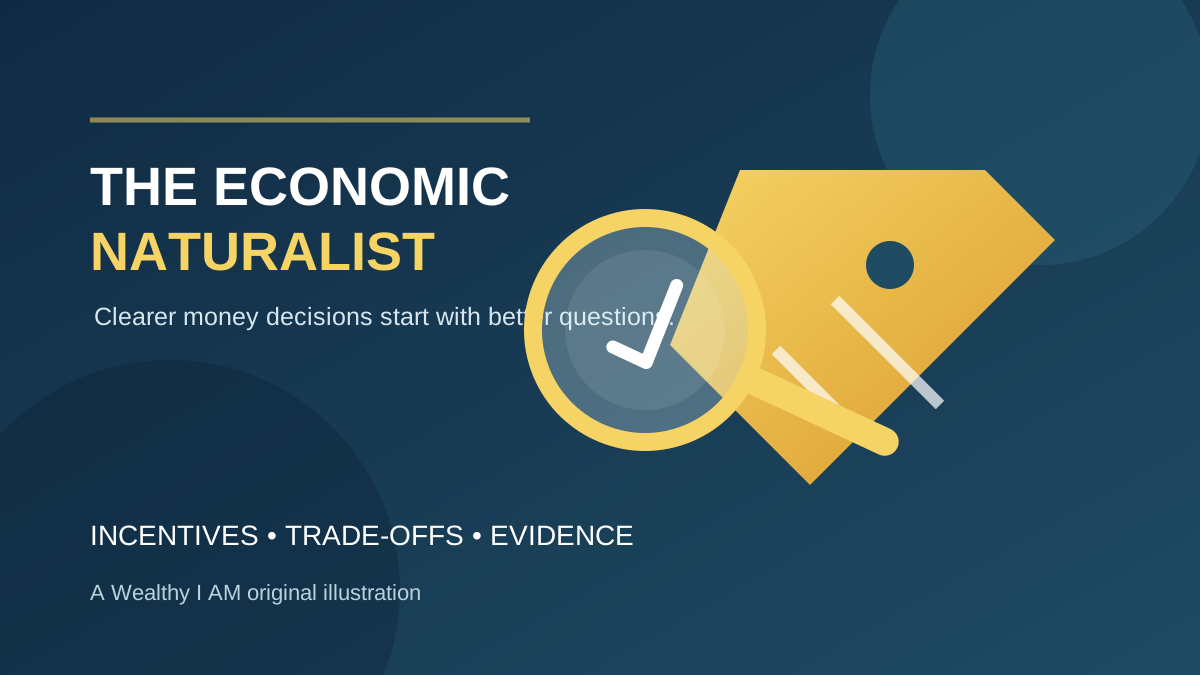
Robert H. Frank’s The Economic Naturalist: In Search of Explanations for Everyday Enigmas uses everyday puzzles to practice economic reasoning. Its central value is not a promise of easy wealth. It is a habit of asking: What incentives, constraints, information, and trade-offs could explain what I am seeing?
The seven lessons below are a Wealthy I AM synthesis of the inventory description and catalog records—not a claim that they are the book’s exact numbered chapters. Use them as a decision checklist, not as a forecast or individualized financial advice.
What does economic thinking add to everyday money decisions?
Economic thinking is a way to look for mechanisms. A mechanism is the chain that connects a choice to an outcome: a fee changes behavior; scarcity changes willingness to pay; competition changes margins; information changes bargaining power; a rule creates an unintended response.
This does not mean assuming that every person is perfectly rational or that markets always produce fair results. It means slowing down before accepting the first explanation. For a household, that can improve spending and borrowing decisions. For an investor, it can sharpen questions about a company’s customers and competitive position. For an entrepreneur, it can reveal where value is created—and where costs or incentives may undermine the idea.
Seven practical lessons from The Economic Naturalist
1. Ask what problem the price is solving
A price is not only a number. It can help a seller cover costs, signal quality, manage demand, or separate customers with different preferences. The same product may be priced differently because the seller is offering different convenience, timing, service, or access—not necessarily because one buyer is being treated irrationally.
Apply it: Before accepting a price, write down what you are receiving besides the object itself. Is it speed, reliability, flexibility, support, status, or simply a habit? Then compare the benefit with the total cost, including recurring fees and switching costs.
2. Look for opportunity cost
Opportunity cost is what you give up by choosing one option instead of the next-best realistic alternative. It is easy to notice the money spent on a course, vehicle, investment, or business tool. It is harder to notice what that money could have done elsewhere, or what time the decision consumes.
Apply it: For a meaningful decision, list three alternatives: keep the money liquid, use it to reduce an expensive obligation, or invest it in a different goal. This is not a command to choose the cheapest option. It is a prompt to make the trade-off visible.
3. Separate incentives from stated intentions
People and organizations may describe their goals sincerely while responding to incentives created by compensation, deadlines, rules, or competition. A salesperson paid on volume may emphasize speed. A manager measured on quarterly results may prioritize visible short-term outcomes. A household using a reward card may spend more attention on points than on the full bill.
The lesson is not to distrust everyone. It is to ask what behavior the system rewards.
Apply it: When evaluating advice, write two columns: “What is being said?” and “What is rewarded?” If they point in different directions, ask for more information before acting.
4. Search for unintended consequences
A rule can solve one problem while creating another. A discount may attract buyers but increase congestion. A bonus may raise output while reducing quality. A convenience feature may save time today but add a subscription cost that persists unnoticed.
The important point is not that unintended consequences always occur. It is that they are worth checking when a decision affects many people or repeats over time.
Apply it: For a new policy, purchase, or business process, ask: “What will people do differently because of this?” Then ask who bears the cost if the response is stronger than expected.
5. Treat information as an economic resource
Information has value because it can change a decision. But information is not automatically reliable, complete, or worth its cost. More headlines may create confidence without improving understanding. A detailed spreadsheet may still be built on a weak assumption.
For investors and business owners, useful information often answers a specific question: Why do customers buy? What makes them stay? Which costs are fixed? What would make demand fall? What evidence would change the thesis?
Apply it: Before researching, write the decision and the one uncertainty that matters most. Stop when additional reading is no longer changing the decision or reducing a material uncertainty.
6. Distinguish correlation from causation
Two events moving together does not prove that one caused the other. A successful company may have a visible habit, but the habit may be a result of its success rather than the cause. A market price may rise after a decision, but the rise does not prove the decision was sound.
This distinction protects readers from turning anecdotes into rules. It also helps with personal reviews: a good outcome can follow a poor process, and a careful process can still meet an unfavorable outcome.
Apply it: When you see a claimed cause, ask what else could explain the result. Look for repeated evidence, a plausible mechanism, and a comparison—not just a compelling story.
7. Use simple models, then test their limits
A model is a simplified explanation. A household budget, break-even calculation, or customer funnel can help organize a decision. But a model becomes dangerous when its assumptions disappear from view.
A practical model should name its inputs, show what it leaves out, and identify the point at which it should be revised. This makes a plan more useful without pretending that uncertainty has been eliminated.
Apply it: For a decision involving money, write a base case, a downside case, and the assumption that matters most. Do not treat these as predictions. Treat them as questions to monitor.
A 20-minute economic-naturalist decision process
The book’s broad premise can become a repeatable practice without turning it into a rigid formula.
Step 1: Describe the puzzle without judgment
Write one sentence: “I do not understand why ___.” Avoid loaded words such as “obviously,” “scam,” or “guaranteed.” A neutral description makes it easier to investigate.
Step 2: Map the actors and constraints
List the buyer, seller, employee, owner, lender, regulator, or other relevant parties. Note time limits, cash limits, information gaps, contractual commitments, and switching costs.
Step 3: Identify the strongest incentive
Ask what each party gains, avoids, or is measured on. This does not prove misconduct. It gives you a reason to examine the decision more carefully.
Step 4: Compare alternatives and second-order effects
Write the next-best option and one possible consequence that appears later. Include recurring costs, maintenance, opportunity cost, and the behavior the decision may encourage.
Step 5: Choose a reversible next action
If uncertainty remains, prefer a small test that protects essential funds and obligations. A reversible step can produce information without requiring a large irreversible commitment.
Step 6: Record what would change your mind
Name one observable fact that would make you continue, revise, or stop. This keeps the process anchored to evidence rather than pride or sunk costs.
A cautious example: evaluating a new service
Imagine a freelancer considering a paid software service. The advertisement emphasizes a lower monthly price than a competing tool. The freelancer should not conclude that the cheaper option is automatically better—or that the competitor is overpriced.
A better analysis asks: Does the cheaper plan include the needed features? Are there usage limits, setup time, migration costs, or cancellation terms? Will the tool save enough time to justify the total cost? Is the low price an introductory offer? What happens if the service becomes essential and the price changes?
This is a hypothetical illustration, not a claim about any named company or a forecast of savings. The economic-naturalist habit is the point: look beyond the headline price to the incentives, constraints, alternatives, and likely responses.
Mistakes to avoid
- Confusing a clever explanation with proof. A plausible mechanism still needs relevant evidence.
- Treating every incentive as bad faith. Incentives influence behavior; they do not establish dishonesty by themselves.
- Ignoring your own incentives. Fear of missing out, embarrassment, convenience, and sunk costs can shape decisions too.
- Using a model without checking assumptions. A spreadsheet can produce precise arithmetic from inaccurate inputs.
- Turning a book idea into a guaranteed strategy. Economic reasoning can improve questions; it cannot remove market, business, employment, legal, or personal uncertainty.
- Over-researching instead of deciding. Information has a cost. Set a question and a stopping rule.
Who may benefit from this book?
The book may be useful for readers who want a more intuitive introduction to incentives, scarcity, pricing, competition, and trade-offs. It can also help professionals and entrepreneurs explain everyday business puzzles in plain language.
It may be less suitable as a standalone investing manual, personal-finance plan, or substitute for professional advice. Readers making decisions involving taxes, contracts, regulated products, debt, employment, or material investment risk should consult current, qualified sources appropriate to their situation.
Frequently asked questions
Is The Economic Naturalist an investing book?
The inventory describes it as an economics and decision-making book using everyday puzzles. Its reasoning habits can inform money and business decisions, but it should not be treated as a stock-picking system or a promise of investment returns.
What is an economic naturalist?
In this article, the phrase means someone who notices an everyday puzzle and looks for the incentives, constraints, information, and trade-offs that could explain it. It is a way of thinking, not a professional designation.
How can a beginner practice this idea?
Choose one recurring money puzzle, such as a fee, price difference, or purchasing habit. Describe it neutrally, list the actors and incentives, compare alternatives, and write what evidence would change your view. Keep the first experiment small and reversible.
Does economic reasoning make decisions objective?
No. It can expose assumptions and trade-offs, but values, goals, incomplete information, uncertainty, and judgment remain. A clearer model is not the same as a certain answer.
Call to action
Today, write down one money or business puzzle you have been accepting without examining. Spend 20 minutes mapping the incentives, alternatives, and hidden costs. End with one small, reversible action—and one fact that would cause you to change course.
Conclusion
The Economic Naturalist offers a useful discipline: replace quick explanations with better questions. When you inspect incentives, opportunity cost, information, unintended consequences, and model limits, you can make decisions with more context and less dependence on stories.
That habit does not guarantee wealth. It can, however, make the next decision more deliberate. Start with one puzzle, test one assumption, and keep the lesson separate from the outcome.
Sources / Further reading
- Open Library work record for The Economic Naturalist
- Open Library search record for The Economic Naturalist by Robert H. Frank
- Open Library Covers API image source
—