If you are good at building software but unsure how to turn that skill into dependable income, the hardest problem is often not coding. It is choosing a business model you can operate, sell, and support without committing to a scale you do not want.
Start Small, Stay Small: A Developer’s Guide to Launching a Startup by Rob Walling, with Mike Taber, is aimed at that problem. Its broad premise is a focused, sustainable software business: find a real customer problem, build a narrow product, charge for value, and operate deliberately. The practical takeaway is not that every developer should start a software company. It is that a smaller business can be designed around fit, cash discipline, and owner independence rather than copied growth narratives.
This article offers seven lessons synthesized from the inventory description and cited bibliographic source. They are not presented as the book’s exact chapter list or as a guarantee of revenue. The best first move is a low-cost test of one customer problem before substantial spending.
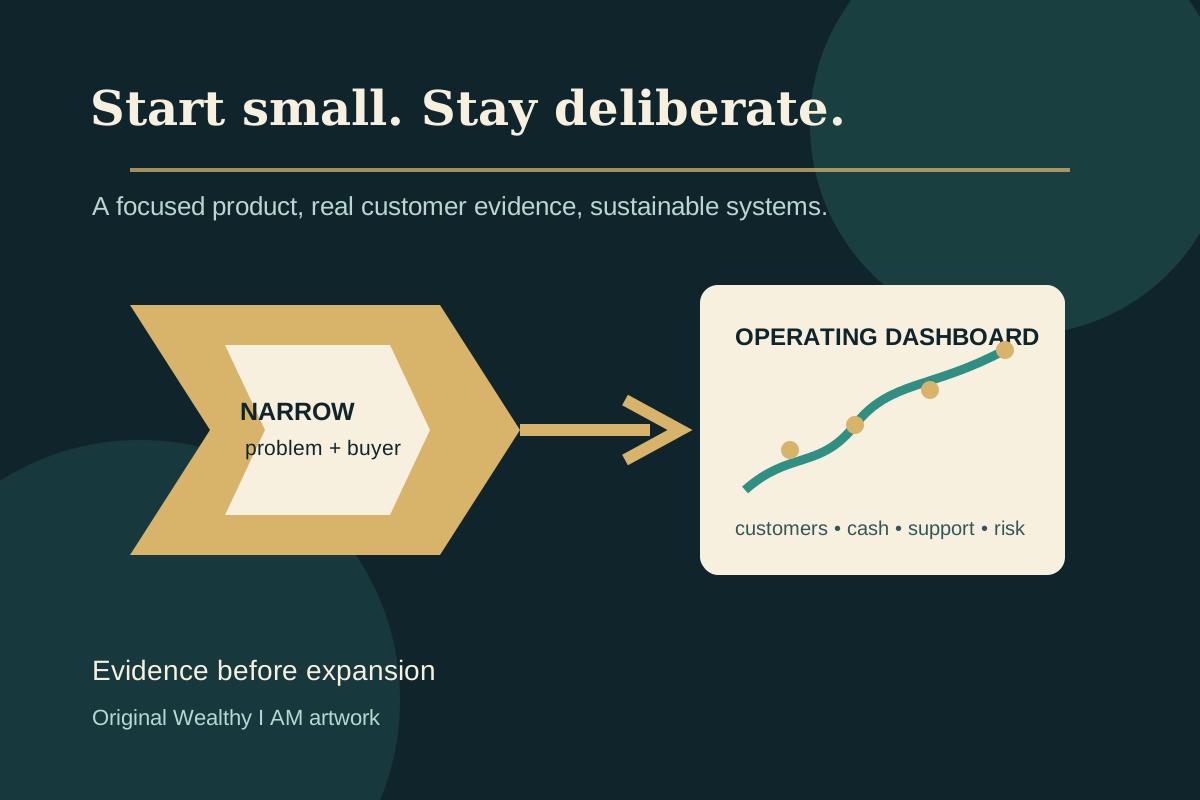
The short answer: start with a narrow problem and a business you can support
A small software business becomes more testable when its customer, problem, promise, pricing, and support burden are specific. Before building, write down one user group, one recurring pain, and the smallest useful outcome you could charge for. Then speak with potential users and look for evidence of a problem—not just enthusiasm for an idea.
The book idea and the Wealthy I AM application are related but distinct: Walling and Taber provide the source frame; the checklist below is an editorial synthesis for cautious use.
What this book is about—and who may benefit
The inventory describes the book as a practical guide to focused products, customer acquisition, pricing, and disciplined operations. That makes it most relevant to developers considering a bootstrapped product, an independent software business, or a modest side venture.
It may be less suitable as a complete guide to venture-backed companies, regulated software, employment law, tax planning, or product safety. Those areas require current, specialized sources. A software product also creates obligations around privacy, security, accessibility, contracts, and consumer protection that a short business framework cannot settle.
Seven practical lessons for building a smaller, more durable business
1. Choose independence as a design constraint
Book idea: The title’s “stay small” orientation challenges the assumption that success must mean maximum headcount, funding, or market share.
Application: Define what you actually want the business to provide: income, flexibility, learning, ownership, or a path to a larger company. Those goals affect pricing, support hours, hiring, and reinvestment.
Try this: Write three non-negotiables and three things you are willing to trade away. If you need predictable evenings, a support-heavy product may be a poor fit even if demand exists.
2. Solve a narrow, expensive-enough problem
A broad audience can sound attractive but makes product decisions and marketing vague. A narrow customer segment lets you learn the language of the problem and test a clear promise.
Wealthy I AM framework: describe the customer, the recurring task, the current workaround, and the cost of leaving it unsolved. “Cost” may be money, time, errors, or lost opportunities; do not assume a pain is commercially important until customers confirm it.
Example: A hypothetical tool that prepares a specific compliance report for a defined type of small firm is easier to test than “software for every small business.” This is an illustration, not a claim about the book or a forecast of demand.
3. Validate willingness to pay before polishing
Interest is not the same as a sale. A prospective user may like an idea yet have no budget, authority, urgency, or trust to adopt it.
Start with conversations about the current workflow. Ask what happens now, how often the problem occurs, who owns it, and what a switch would require. Where appropriate, test a paid pilot, pre-order, or manual version before building a broad feature set. Use lawful, transparent terms and do not misrepresent an unfinished product.
Measure: record the number of relevant conversations, qualified trials, paid commitments, cancellations, and support requests. These are operating signals, not proof of future success.
4. Build the smallest product that delivers the promised outcome
A minimum viable product is not permission to ship unsafe or unusable software. It is a deliberately limited first version that tests a central value proposition while meeting material security, privacy, reliability, and legal obligations.
Separate “must work for the promise” from “would be nice later.” A smaller scope reduces build cost and learning time, but it may also leave gaps. For sensitive data, payments, health information, or regulated workflows, obtain appropriate professional guidance before launch.
5. Treat distribution as part of the product
A useful product still needs a repeatable way to reach people who need it. Customer acquisition can come from direct outreach, partnerships, content, communities, marketplaces, or referrals; each channel has different costs and trust requirements.
Choose one plausible channel and run a bounded experiment. Define the audience, message, action, time period, and stopping rule. Do not equate impressions or sign-ups with durable customers. Compare acquisition effort with retention, service work, and contribution margin—the money left after the direct costs of serving a customer.
6. Price for the work of serving customers
Pricing is not only a revenue decision. It affects customer fit, support expectations, cash runway, and whether the owner can maintain the product.
List hosting, payment processing, contractors, support time, refunds, taxes, compliance work, and maintenance. Then test a simple pricing hypothesis with real prospects. Avoid presenting a price as universally correct: willingness to pay varies by market, alternatives, risk, and perceived value.
Recurring revenue can improve planning, but it is not automatically passive income. Customers can cancel, infrastructure can fail, and support obligations continue.
7. Use systems to protect the owner and the customer
A business dependent on one person’s memory is fragile. Document onboarding, releases, backups, incident response, billing, support, and decisions. Automate only after the process is understood; automation can amplify a bad process.
Review a small operating dashboard regularly: active customers, retention or cancellations, cash collected, direct service costs, unresolved support work, and the next product risk. Keep enough cash for obligations and contingencies. Do not borrow, hire, or purchase tools solely because a growth story makes expansion sound inevitable.
A cautious 30-day validation plan
- Days 1–5: define the problem. Pick one customer group and document the current workaround. List what evidence would disprove your assumption.
- Days 6–12: interview. Speak with relevant potential users. Ask about behavior and constraints, not only opinions. Do not claim that a small sample represents a market.
- Days 13–18: offer a narrow test. Present a clear outcome, price hypothesis, scope, and cancellation terms. A manual service can test demand before software is complete.
- Days 19–25: deliver carefully. Track time, errors, support requests, and customer outcomes. Protect sensitive information and use appropriate agreements.
- Days 26–30: decide. Continue, change the customer/problem, pause, or stop. Base the decision on evidence and economics, not sunk costs or embarrassment.
Mistakes to avoid
- Building a large feature set before confirming a painful problem.
- Treating compliments, followers, or free trials as proof of willingness to pay.
- Calling recurring revenue passive while ignoring support, security, refunds, and churn.
- Choosing a channel because it is fashionable rather than because the customer is there.
- Confusing a small business with a risk-free business.
- Using business advice as a substitute for current tax, legal, privacy, security, or regulatory advice.
- Scaling fixed costs before the product and customer economics are understood.
Frequently asked questions
Is Start Small, Stay Small only for software developers?
Its title and inventory description center on developers and software startups. Other founders may adapt the ideas, but the fit depends on the business model, customer problem, and technical obligations.
Does staying small mean avoiding growth?
No. It means treating scale as a choice rather than an automatic measure of success. A company can grow revenue, capability, or resilience while keeping a deliberate operating model.
How much money should I invest before testing?
There is no universal safe amount. Start with the smallest spend that can produce meaningful evidence while protecting household obligations and business commitments. Do not risk essential funds on an unvalidated idea.
Is this financial advice?
No. This is general education about a business-building framework. Business structure, taxes, contracts, privacy, employment, lending, and investment decisions require current advice suited to your circumstances.
A better definition of “wealthy” for a small business owner
A smaller software business can be valuable even when it is not designed to dominate a market. The useful test is whether it creates a customer outcome, pays its direct and operating costs, respects its obligations, and fits the life and risk capacity of its owner.
Your next step is simple: write one customer problem, one promised outcome, one evidence test, and one spending limit. Run that test before you build a business larger than the evidence supports.
Sources / Further reading
- Open Library: Start Small, Stay Small bibliographic work record — source for title, attribution, and catalogued work identity. The seven lessons and validation plan above are Wealthy I AM synthesis and application, not a claimed verbatim reconstruction.
- Open Library Covers API image endpoint — cover provenance; reuse rights should be checked before publication.