If your wealth plan depends on one paycheck, one client, or one exciting idea, the problem may be missing structure. Without a defined customer problem, cost boundary, and review process, a promising idea can become an expensive distraction.
Quick answer: Loral Langemeier’s The Millionaire Maker’s Guide to Creating a Cash Machine for Life presents business-building and recurring-income ideas. The most useful Wealthy I AM application is cautious: define a real problem, design one clear offer, test demand with limited resources, track cash honestly, and improve only what evidence supports. A “cash machine” is a metaphor for a repeatable income process—not a promise of passive income or wealth.
This is general education, not financial, tax, legal, or business advice. The lessons below are a Wealthy I AM synthesis of the book’s broad premise and practical application, not a verified reconstruction of its exact chapter list. Readers should adapt them to their country, resources, skills, and risk capacity.
What problem does the book address?
Many people begin with an income vehicle—an online course, property, service, product, or affiliate idea—before defining who will pay and why. A repeatable revenue process starts with value delivered to a specific customer, then accounts for fulfilment, acquisition, overhead, refunds, taxes, and the owner’s time. Repeatability is not certainty: demand changes, costs rise, and a business can create revenue while losing money.
Seven practical lessons for building income more carefully
1. Start with a customer problem
Write: “I help [specific customer] solve [specific problem] by [clear deliverable].” If the sentence could describe almost any business, narrow it. Observe or interview potential customers without pitching first. Record what they already do, what it costs, and what they have tried. Interest is useful evidence; payment or a credible commitment is stronger evidence.
2. Treat recurring revenue as a responsibility
Recurring billing can make revenue more predictable, but it creates an ongoing delivery obligation. A subscription, retainer, maintenance plan, or repeat purchase must remain useful. Define the renewal-worthy outcome, delivery schedule, cancellation terms, support burden, and direct cost. Do not describe recurring revenue as effortless.
3. Test the smallest version before committing capital
A small test is not proof that a full business will work. It is a lower-cost way to learn. A service can be tested manually before software is built, and a workshop can be piloted with a limited group. Set a fixed time, cash limit, and learning question—for example, whether three people will pay for a narrowly defined pilot within 30 days.
4. Separate revenue, profit, and cash
Revenue is what a business earns from customers. Profit is what remains after relevant expenses. Cash flow is the timing of money entering and leaving. A growing order book can still create a cash squeeze if inventory, contractors, software, or receivables must be funded first.
Track sales, direct delivery costs, fixed overhead, taxes set aside, refunds, owner withdrawals, and cash on hand separately. Use current local accounting and tax guidance rather than relying on a general article or a book published in 2007.
5. Build around reliable delivery
A compelling promise is not enough. The business must repeatedly produce the promised result. Document the handoff, quality check, customer communication, and exception process. Write a one-page delivery checklist for the next five customers and improve the step causing the most delay before adding another offer.
6. Use leverage carefully
Leverage means using tools, systems, capital, distribution, or other people’s time to extend output. It can improve capacity, but it can also magnify mistakes and fixed obligations. Before adding leverage, answer three questions: What constraint will it remove? What recurring cost will it add? What is the exit plan if demand is lower than expected? Do not take on debt or legal obligations you do not understand.
7. Reduce concentration risk
One large client, platform, supplier, or traffic source can make a business look stable while leaving it fragile. List the top sources of customers, revenue, fulfilment, and cash. Choose one resilience improvement, such as documenting a process, building a permitted direct customer contact list, or finding a backup supplier.
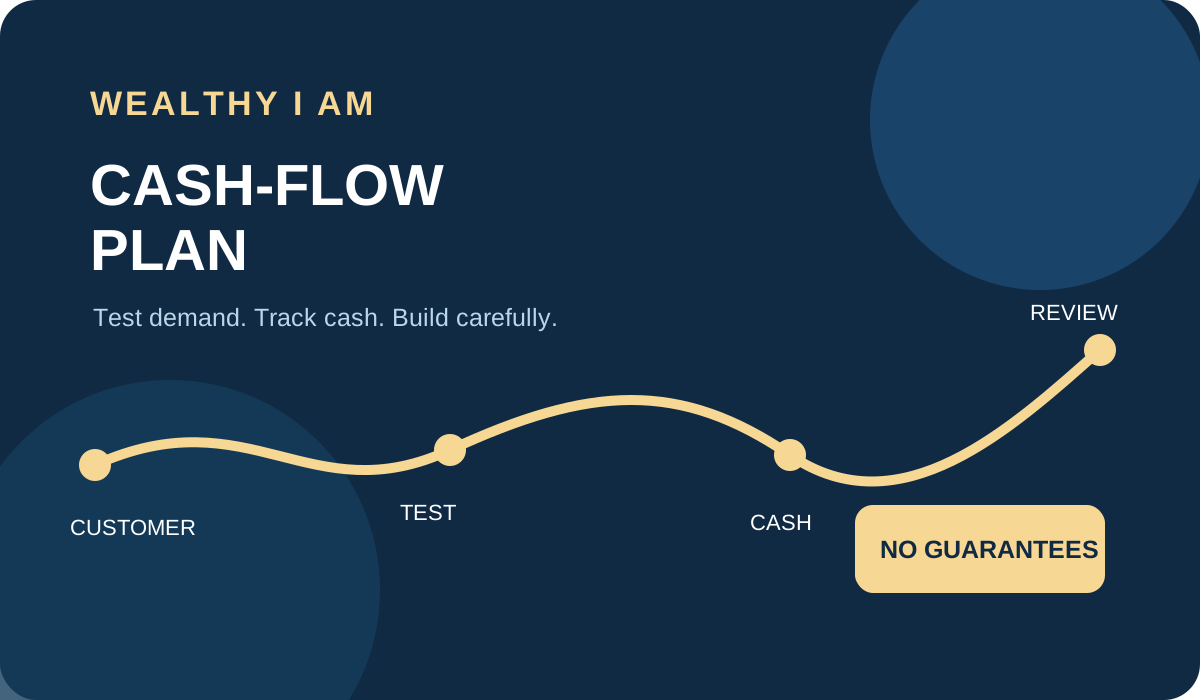
A cautious 30-day cash-flow experiment
Days 1–5: Choose one customer group, problem, deliverable, and pricing method. State what is excluded.
Days 6–12: Have honest conversations and review alternatives. Do not count compliments as sales.
Days 13–20: Present a limited pilot with clear scope, payment, cancellation, privacy, and delivery terms.
Days 21–30: Record leads, commitments, delivery hours, direct costs, cash received, refunds, and feedback. Continue, change one assumption, or stop. The aim is learning—not guaranteed income.
Mistakes to avoid
- Calling an idea passive before measuring the work required to acquire and serve customers.
- Confusing gross sales with take-home income.
- Scaling advertising, staff, or debt before repeatable demand is visible.
- Offering too many products before one delivery process works.
- Treating anecdotes or motivational claims as evidence.
- Ignoring taxes, contracts, privacy, licensing, refunds, insurance, or safety obligations.
How this differs from Wealthy I AM advice
The book supplies a broad income-creation lens. Wealthy I AM’s application is a decision discipline: customer evidence before expansion, cash accounting before celebration, bounded experiments before leverage, and resilience before concentration. These recommendations are not guarantees. They are a way to make the downside and the learning process more visible.
Frequently asked questions
Is a cash machine the same as passive income?
No. It is better understood as a metaphor for repeatable income. Even a mature system may require sales, support, maintenance, compliance, and judgment.
Can this approach replace investing?
No. A business and an investment portfolio have different risks, liquidity, tax treatment, and time demands. Assess them separately and seek qualified advice for personal decisions.
How much money should I put into a new idea?
There is no universal amount. Use a limit you can afford to lose without harming essential obligations, and clarify the learning goal before spending.
What is the first step?
Write the one-sentence customer problem and a 30-day test with a cash limit. If you cannot state what you will learn, you are preparing to spend rather than test.
Sources and further reading
- Open Library work record for The Millionaire Maker’s Guide to Creating a Cash Machine for Life.
- Open Library edition record, which lists the McGraw-Hill 2007 edition and Loral Langemeier attribution.
- Open Library Covers API image source; provenance is recorded, but applicable reuse rights should be confirmed.
A practical next step
Before buying software, borrowing money, or announcing a venture, write the customer, problem, deliverable, cost limit, and learning question on one page. Run the smallest honest test you can manage and review the numbers without turning a result into a guarantee.
Conclusion
The practical value of the book is its invitation to think in systems rather than isolated paychecks. The safe translation is not “find a shortcut to wealth.” It is “create useful value, test demand, understand cash, deliver reliably, and add leverage only when the evidence and downside are clear.”