Why market stories can make risk look easier than it is
A market win can make a weak decision look brilliant. A trader explains a position, the price moves in the expected direction, and the story feels proven. Yet one outcome cannot show whether the decision was sound, whether luck helped, or whether the risk was larger than it appeared.
Stock Market Wizards: Interviews with America’s Top Stock Traders by Jack D. Schwager uses interviews rather than offering one universal formula. This summary uses that format as a starting point for a practical question: how can a reader make decisions under uncertainty without confusing a good result with a good process?
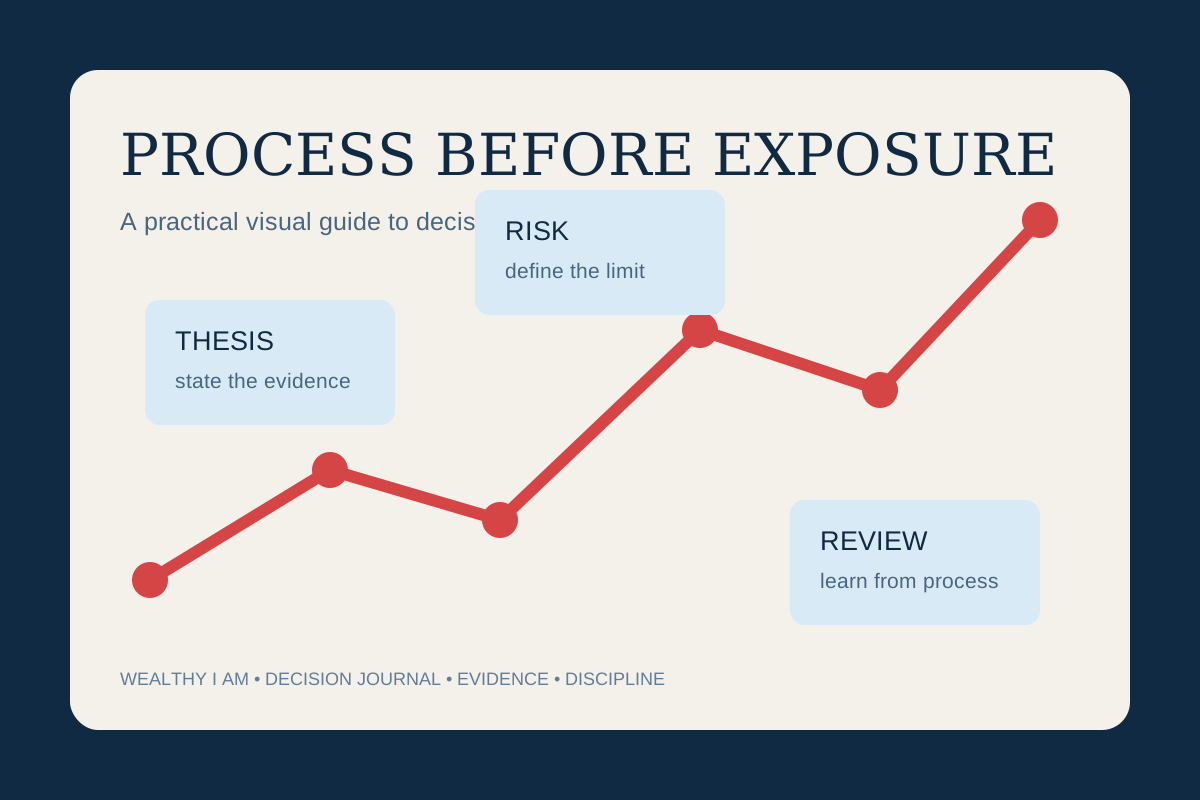
The short answer is to build a repeatable process before increasing exposure. The seven lessons below are a Wealthy I AM editorial synthesis. They are not presented as Schwager’s official numbered framework, and they should not be treated as a trading system.
Who this summary is for
This article is for readers seeking a plain-language introduction to process and risk in trading decisions. It is not a stock tip, a complete account of every interview in the book, or individualized financial advice. Trading methods can become outdated, losses can be substantial, and a method that fits one person may not fit another.
The practical goal is modest: state an idea, identify what would weaken it, limit exposure, and examine the process separately from the result. The important question is not only where to enter. It is what you will do when the evidence changes.
Seven lessons for making better decisions under uncertainty
1. Use a method you can explain
A collection of interviews can expose readers to different time horizons, instruments, and analytical styles. That variety should discourage blind imitation. The useful question is not “Which trader should I copy?” but “What is my method designed to notice?”
Write down the conditions that make a hypothetical idea interesting, the evidence that would weaken it, the expected holding period, and the risks you understand least. If the explanation depends mainly on a feeling or a popular story, it may not be a testable process.
Try this: Describe a hypothetical position in five sentences: thesis, supporting condition, time horizon, failure signal, and maximum acceptable loss.
2. Separate decision quality from outcome
A profitable trade can follow a careless decision. A careful decision can lose money. Markets contain uncertainty, so reviewing only the result encourages overconfidence after wins and discouragement after losses.
Keep a decision journal. Record the information available at the time, the assumptions you made, whether you followed your rules, and whether new evidence appeared. Evaluate the process before studying the final result. This does not make losses harmless; it makes the review more informative.
3. Treat risk management as part of the idea
Position sizing means deciding how much exposure to take. It affects how strongly one mistake can affect a portfolio or household plan. A small position does not make a weak thesis good, and a stop order does not eliminate liquidity risk, execution risk, or price gaps.
Before any live decision, write down the maximum loss you can absorb, what could make exiting difficult, and whether that loss would impair essential goals. If it would, the exposure may be too large or unsuitable. Risk control is not an accessory added after choosing a trade; it changes whether the trade belongs in the plan at all.
4. Design rules before emotion arrives
Fear and excitement are normal responses to uncertainty. The practical challenge is to make key decisions while calm, before an impulse takes control. Possible precommitments include a cooling-off period after a sharp move, a requirement to reread the original thesis, or a rule against adding exposure without a written reason.
Identify your common impulse: chasing, averaging down, selling too soon, or changing rules mid-trade. Then write one pause question: What new evidence specifically justifies this action?
A pause rule cannot guarantee a good result, but it can make an unplanned decision easier to detect.
5. Respect expertise without worshipping it
An interview can reveal habits and useful questions. It cannot prove that a method suits you or that reported success will persist. Public success stories also create survivorship bias: visible winners are not the full set of people who tried.
When studying an expert, ask what conditions the method needs, what it does poorly, and how the results were measured. Look for omitted costs, drawdowns, leverage, taxes, time demands, and skill requirements. Admiration is not due diligence.
6. Adapt from evidence, not panic
A process should be stable enough to evaluate and flexible enough to respond when conditions change. Switching systems after every loss prevents learning. Refusing to update after facts change turns discipline into stubbornness.
Create a change log with four fields: old rule, observed problem, proposed change, and review date. Explain why the change should improve the process, then decide how it will be evaluated. Do not judge a new rule from one dramatic outcome.
7. Protect the base that makes learning possible
Trading is only one possible financial activity. Emergency reserves, insurance, debt obligations, taxes, diversified long-term investing, and income stability may matter more to a household plan than a speculative idea.
Separate money by purpose: near-term needs, long-term goals, and optional experimentation. If those categories are unclear, improve the base plan before adding complexity. The ability to survive mistakes is part of the learning process.
A decision map for a hypothetical idea
Use this worksheet for learning, not as a recommendation:
- Thesis: What do I believe, and what evidence supports it?
- Time horizon: How long might the idea take to develop?
- Failure condition: What observable fact would weaken it?
- Exposure: What loss can I absorb without harming essential goals?
- Execution risk: Could fees, leverage, liquidity, or a price gap change the plan?
- Review date: When will I evaluate the process rather than react to headlines?
- Learning record: What will I document so the result can improve my judgment?
For a beginner, the first output should be written assumptions, not a trade. Learn how the instrument works—including costs and risks—before committing money. A regulated financial professional may be appropriate when a decision depends on personal circumstances.
Mistakes to avoid
- Copying a winner’s entry without understanding the method.
- Treating confidence or a vivid story as proof.
- Ignoring sample size and survivorship bias.
- Using leverage to manufacture conviction.
- Changing rules after every outcome.
- Calling a loss a lesson without recording the assumptions.
- Putting essential money at risk while experimenting.
Frequently asked questions
Is Stock Market Wizards suitable for beginners?
It can introduce readers to different market participants and ways of thinking, but it is not a complete personal-finance curriculum. Beginners may gain the most by using the interview format to form better questions about process, evidence, and risk rather than trying to reproduce a particular trade.
Does the book provide a stock-picking formula?
The verified catalog record identifies the book as interviews with stock traders and lists subjects including securities, financial futures, brokers, and options. The sources reviewed for this article do not establish one universal formula. Any specific strategy should be checked against the book itself and current authoritative information before it is described or used.
Is trading the same as building wealth?
No. Trading is one possible activity and may involve high complexity, uncertainty, costs, and risk of loss. Building wealth can also involve saving, diversified investing, developing skills, owning a business, managing debt, and protecting against setbacks.
What is a safer first step?
Complete one hypothetical decision-journal entry. Include the failure condition and maximum tolerable loss. Do not use essential funds for an experiment.
Sources and evidence boundary
- Open Library work and edition record for *Stock Market Wizards* supports the exact title, author, interview format, 2001 edition context, and broad financial subjects. The record does not contain a book description and does not establish the seven lessons as Schwager’s framework.
- Google Books title-and-author search provides an additional bibliographic lookup. Its API was quota-limited during editorial review, so it was not used to substantiate detailed content claims.
- Open Library Covers API image is the source used for cover identity and provenance.
Conclusion: make the next decision inspectable
The practical value of reading interviews with successful traders is not permission to imitate someone else’s risk. It is the chance to notice how many questions sit behind a visible outcome: What was known? What could go wrong? How much was at risk? Was the rule followed? What changed?
Your next low-risk step is to complete one hypothetical journal entry that includes a failure condition and a maximum loss. If you cannot state those clearly, no market story should rush you.
> Educational note: This article provides general education, not individualized financial, tax, legal, or investment advice. Markets can fall, losses can exceed expectations, and past performance or reported success does not guarantee future results.