A business can have a useful product and still struggle to grow because every sale depends on the founder’s memory, energy, or improvisation. Leads are handled differently, follow-up happens when someone remembers, and the team cannot explain why one opportunity moves forward while another stalls.
Chet Holmes’s The Ultimate Sales Machine: Turbocharge Your Business with Relentless Focus on 12 Key Strategies addresses that broader problem. Its central appeal is discipline: instead of chasing every new tactic, choose a few important capabilities and improve them through repeated practice.
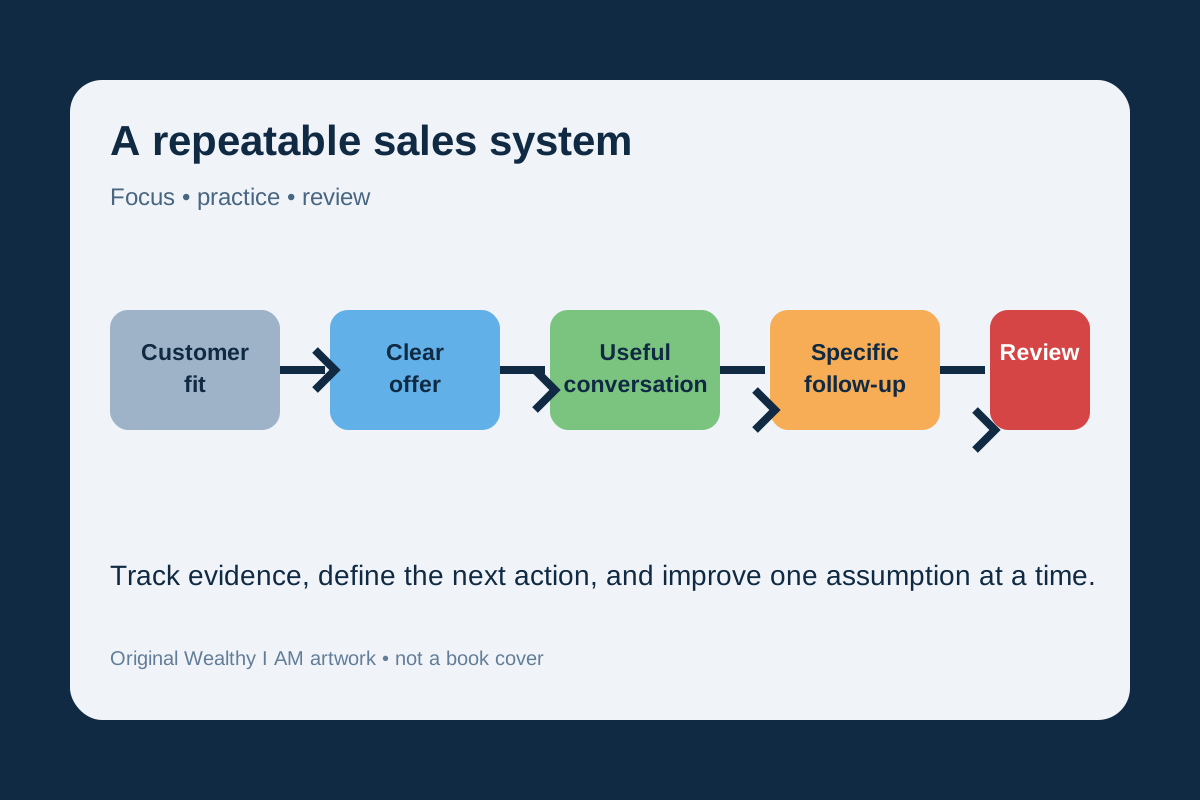
The practical takeaway is not that a sales system guarantees revenue. It is that a clear process makes customer fit, team behavior, follow-up, and results easier to examine and improve.
Scope note: Open Library records verify the title, author, 2007 first publication, subtitle, and the book’s focus on 12 key strategies. The seven lessons below are a Wealthy I AM synthesis of the book’s documented themes, not Holmes’s exact chapter order or a substitute for the full book.
Who this book is for
This perspective is useful for founders, consultants, sales managers, and small teams whose sales activity feels inconsistent. It is especially relevant when a company has some demand but lacks a shared way to identify suitable customers, explain value, manage opportunities, train conversations, and learn from results.
It is less useful as a promise of quick growth. A better process cannot repair an unwanted product, remove economic constraints, or guarantee that prospects will buy. It can reveal those problems sooner and help a team respond with evidence rather than guesswork.
The central idea: improve a few capabilities repeatedly
Many businesses respond to a weak month by adding more software, more scripts, or another campaign. Holmes’s documented emphasis points in the opposite direction: focus on a limited number of high-impact areas and practice them consistently.
That principle matters because sales problems are often connected. Poor targeting produces weak conversations. Weak conversations produce vague follow-up. Vague follow-up fills the pipeline with opportunities that are not real. A repeatable system helps a team see where the chain breaks.
7 practical sales-system lessons
1. Define the customer before designing the pitch
A sales process should begin with a problem the business can solve well, not with a list of everyone who might possibly buy. A useful customer profile describes the person’s situation, the cost or friction of the problem, the desired outcome, and the conditions that make the offer a poor fit.
Try this: Choose one customer segment for a two-week research sprint. Review recent questions, interview several prospects or customers, and record the language they use. Do not treat a few conversations as proof of demand; use them to sharpen the next test.
2. Turn features into a clear, testable offer
A feature describes what a product does. An offer explains whom it helps, which problem it addresses, what outcome it aims to support, and what the customer must do next. Clear offers avoid empty superlatives and make reasonable limits visible.
Draft one sentence: “For [specific customer] dealing with [specific problem], our [product or service] helps with [credible outcome] by [relevant mechanism].” Then show it to customers and ask what feels accurate, unclear, or exaggerated. Their answers are evidence for revision, not permission to promise more than the product can deliver.
3. Give every pipeline stage an exit rule
A sales pipeline is a view of prospects and their current steps. It is not a forecast by itself. Labels such as “interested” or “hot lead” are too vague to guide action unless the team agrees on what they mean.
Use three to five stages with observable exit criteria. A simple sequence might be: suitable prospect, problem confirmed, solution reviewed, and decision made. For every active opportunity, record the evidence that justified its stage and the agreed next action. Remove or pause poor-fit prospects instead of preserving an inflated pipeline.
4. Train judgment, not only scripts
Scripts can improve consistency, but rigid delivery can make a conversation feel mechanical and prevent real listening. Effective training covers product knowledge, discovery questions, customer constraints, ethical boundaries, and how to respond when the offer is not suitable.
Role-play the three situations the team encounters most often. After each practice round, review whether the seller understood the customer’s goal, current obstacle, decision process, and timetable. The aim is not a perfect performance. It is a conversation that produces enough shared understanding for an honest next step.
5. Make follow-up useful and specific
“Just checking in” rarely adds much value. Strong follow-up connects to something the customer actually said: a question, a promised document, a decision date, or a concern that needs clarification.
After a meeting, send a short recap of what you heard, what the offer can and cannot do, and the next action both sides accepted. If there is no agreed action, ask rather than inventing urgency. A disciplined process should reduce pressure, not automate annoyance.
6. Treat retention as part of the sales system
The first purchase is not the end of the customer relationship. Retention depends on whether the company delivers what it promised, responds to friction, and learns from the gap between the sales conversation and the customer’s experience.
Once a month, review one recurring customer question: Where did expectations and delivery diverge? What remained useful? What almost caused the customer to leave? If the answer reveals a product or process failure, repair it before buying more traffic to the same experience.
7. Use data to revise one assumption at a time
Tracking can reveal where the process loses momentum: too few suitable prospects, an unclear offer, inconsistent follow-up, or a weak handoff after purchase. It cannot prove that one change will create profit, and a small sample can be misleading.
Review the pipeline weekly with three questions: Where did suitable prospects stop? Which objection or confusion repeated? What evidence supports the team’s explanation? Change one meaningful element, define what you expect to observe, and allow enough time to learn before changing everything again.
A 21-day sales-system test
Use this short experiment to turn the ideas into a working routine:
- Choose one segment: Write the customer’s situation, problem, desired outcome, and clear disqualifiers.
- Map the current path: Document what happens from first contact to decision, including every handoff and delay.
- Rewrite one offer: Use customer language and remove claims the business cannot support.
- Create a five-question discovery guide: Ask about the current problem, its effect, previous attempts, constraints, and decision process.
- Set one follow-up rule: Tie each message to an agreed action, useful answer, or decision date.
- Track a small scorecard: Record suitable conversations, completed next steps, repeated objections, and reasons opportunities stopped.
- Review on day 21: Keep what improved clarity, revise the largest source of confusion, and document the next test.
This is a test of process quality, not a promise that revenue will rise within 21 days. If the business operates in a regulated or high-stakes field, sales copy, recordkeeping, claims, and follow-up may require legal or compliance review.
Mistakes to avoid
- Treating activity as progress: More calls or leads do not help if the prospects are unsuitable or the conversations produce no clear next step.
- Using software to avoid defining the process: A customer relationship management tool can store stages, but it cannot decide what qualifies an opportunity.
- Confusing a pipeline with a forecast: Pipeline value depends on evidence, fit, timing, and conversion assumptions; it is not booked revenue.
- Using scripts to suppress customer concerns: Consistency should improve clarity, not pressure buyers into decisions that do not fit.
- Changing several variables at once: If the segment, offer, channel, and script all change together, the team may not know what caused the result.
- Ignoring delivery and retention: Acquiring more customers can magnify an experience that is already disappointing.
Frequently asked questions
Does The Ultimate Sales Machine apply only to commission sales teams?
No. Founders, consultants, account managers, and small business owners can use the same discipline to define customer fit, improve conversations, document next steps, and review results.
Do I need sales software to build a pipeline?
No. A spreadsheet can be enough at first. The important elements are clear stages, observable exit rules, an owner, and a dated next action. Software becomes useful when it supports a process the team already understands.
How many metrics should a small team track?
Start with a few measures tied to decisions: suitable conversations, agreed next steps completed, repeated objections, and reasons opportunities ended. Add a metric only when someone knows what action it should inform.
Is higher sales volume always better?
Not necessarily. More volume can increase cost and customer frustration if targeting is weak or delivery cannot keep up. A smaller number of well-matched conversations may provide better evidence and healthier relationships.
Conclusion: build a process the team can learn from
The Ultimate Sales Machine offers a useful reminder: sales capability is built through focus and repeated practice, not a constant search for shortcuts. Begin with one customer segment, one credible offer, clear opportunity stages, and a review date. Then learn from actual conversations and improve the weakest part of the system.
The Wealthy I AM lesson is not “sell at any cost.” It is to create genuine value, explain it accurately, and build a process that customers and team members can understand.
This article provides general business education, not individualized financial, legal, tax, or compliance advice.
Sources and further reading
<small> <ul> <li><a href="https://openlibrary.org/works/OL9176664W">Open Library work record: <em>The Ultimate Sales Machine</em></a></li> <li><a href="https://openlibrary.org/books/OL9375258M">Open Library 2007 hardcover edition record</a></li> <li><a href="https://openlibrary.org/authors/OL3247343A">Open Library author record: Chet Holmes</a></li> </ul> </small>