When every stock story sounds convincing
A polished investment pitch can leave the most important questions unanswered: What does the business actually do? Which assumptions support its value? What could permanently impair capital? When reading an anthology of value-investing perspectives, the challenge is not collecting opinions. It is learning how to compare the reasoning behind them.
The Art of Value Investing, edited by John Heins and Whitney Tilson, is best used as a collection of perspectives on research, valuation, temperament, and risk—not as one formula or a promise of market-beating results. Its practical value is helping readers build a repeatable question set and make uncertainty visible.
The seven lessons below are an original Wealthy I AM synthesis, not a numbered framework claimed by the editors. The available bibliographic sources establish the book’s identity and broad subject, but not every essay’s full argument. Specific positions are therefore attributed to the book’s themes rather than to named contributors without checking the edition itself.
What readers can reasonably expect
The book’s usefulness depends on how you read it. An anthology can broaden your mental models, but it can also encourage cherry-picking: finding the view that supports a position you already want to take. Treat each essay as a chance to compare assumptions, evidence, and failure modes.
It may suit readers who want a tour of value-investing perspectives. It is not a stock list, an individualized plan, or a substitute for understanding your goals, time horizon, liquidity needs, taxes, and ability to tolerate losses.
Seven practical lessons
1. Study the process, not only the outcome
A profitable investment does not prove that the reasoning was sound. Luck, timing, and a favorable environment can produce a good result from a weak process; a sound decision can also have a poor short-term result.
Ask what was knowable at the decision date, which assumptions were explicit, and what would have invalidated the thesis. This keeps hindsight from turning an outcome into a rule.
Action: Keep a decision log before buying a security. Record the thesis, evidence, uncertainty, and reason not to proceed. Review the reasoning separately from the result.
2. Treat value as a range, not a magic number
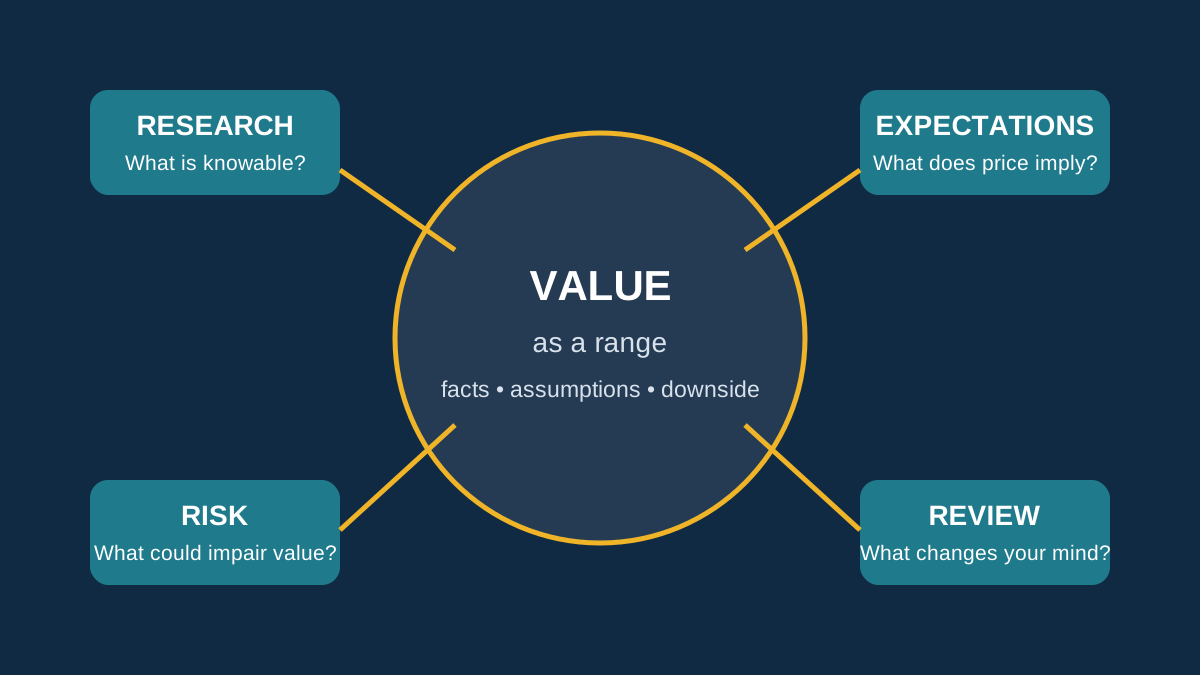
Intrinsic value means an estimate of what an asset or business may be worth based on future economic performance. It is not a price printed by nature. Changes in growth, margins, competition, interest rates, or the duration of an advantage can change the estimate.
A range is usually more honest than false precision. If one exact assumption determines the answer, the model may be disguising uncertainty rather than managing it.
Action: Write a base case and a downside case. Name the two or three assumptions that move the range most. Do not present the midpoint as a forecast.
3. Ask what the price already assumes
A price reflects expectations about future cash flows, growth, competition, and risk. The useful question is often: What must happen for this price to make sense?
Start with the market price and reason backward. If it requires years of unusually strong performance, the burden of proof is higher. If it requires little improvement, investigate why the market may disagree.
Action: Complete this sentence: At today’s price, the market seems to be assuming… Then list evidence for and against that interpretation. This is an inference, not a verified fact.
4. Separate business quality from purchase price
A durable company can still be a poor investment at an excessive price. A troubled company can remain a poor investment even when its valuation looks low. Quality and price answer different questions: How good might the economics be, and what are you paying for them?
This distinction helps resist the halo effect created by an admired brand or manager. Good characteristics do not remove the need to assess competition, capital needs, governance, and valuation.
Action: Use two columns: business facts and price-dependent conclusions. Put customer concentration and capital requirements in the first; put expected return and cheapness in the second.
5. Make temperament part of risk control
Risk is more than a visible price decline. It can include permanent impairment, excessive leverage, dependence on one uncertain event, or a mismatch between an investment and your ability to hold it. Fear, excitement, and social pressure can turn uncertainty into a bad decision.
Patience is not blind inactivity. It is the ability to wait when evidence is incomplete while remaining open to facts that disconfirm your view.
Action: Define change-my-mind conditions before acting. Include business conditions and personal conditions, such as needing liquidity sooner than expected.
6. Compare different views without flattening them into one rule
An edited collection can be valuable because different investors emphasize different approaches: business quality, valuation, special situations, or risk. Those approaches may fit different contexts and carry different failure modes.
Do not settle every disagreement by averaging opinions. Ask what each method assumes about information, time, incentives, and the market. A method designed for concentrated research may not suit someone who needs broad diversification or has limited time.
Action: Build a table with the edge claimed, evidence required, main risk, and situations where the method may fail. Turn disagreement into a learning tool.
7. Make humility operational
Humility is not merely saying that you could be wrong. It means designing decisions so that being wrong is survivable and detectable. Possible safeguards include diversification, a household cash reserve, a review process, and position sizing appropriate to your circumstances. None prevents losses, and no safeguard is universal.
Action: Before acting, answer: What do I know? What am I inferring? What would I do if the inference proved wrong?
A 30-minute Wealthy I AM worksheet
Use this original application for one company or investment idea:
- Business in plain language: What does it sell, to whom, and why might customers continue buying?
- Three to five value drivers: Which factors influence earnings, cash flow, competition, or capital needs?
- Assumption audit: Which items are verified facts, estimates, or merely a story?
- Price-implied expectations: What performance appears necessary at the current price? Label this interpretation.
- Downside conditions: What could permanently reduce value, versus create temporary volatility?
- View-changing fact: What single fact would make you revise or abandon the thesis?
The output is not a buy or sell signal. It is a clearer record of reasoning and weak points.
Mistakes to avoid
- Copying an investor’s method without copying its context, resources, time horizon, or incentives.
- Confusing a low price-to-earnings ratio with low risk.
- Using spreadsheet precision to create confidence in uncertain inputs.
- Treating historical examples as current evidence without checking context.
- Ignoring opportunity cost: capital and research time cannot serve every idea.
- Treating money needed for near-term obligations as long-term risk capital.
Who should read it?
Read it if you want a broad tour of value-investing perspectives and questions for comparing research habits. Pair it with primary company filings, dated market data, and foundational education on diversification, fees, and risk. If you prefer a low-maintenance approach, the anthology may be more useful for education than implementation.
General information is not individualized financial advice. Investing involves risk, including loss of principal. Consider your circumstances and consult a qualified professional for advice about your situation.
Frequently asked questions
Is this a step-by-step investing system?
No single system should be assumed from an edited collection. Its use is comparative: examine how investors frame research, worth, risk, and temperament, then test whether a method fits your constraints.
Does value investing mean buying a low-multiple stock?
No. A ratio is one measurement, not a complete valuation. A low multiple may reflect weak economics, high risk, or declining prospects.
Can beginners use the book?
Yes, as an introduction to questions, but beginners may need foundations on financial statements, diversification, and risk first. Start with the worksheet and independently check any example before acting.
When should an investment thesis be reviewed?
Review when material business facts or personal circumstances change, or at a consistent interval that does not encourage reacting to every price movement. The right cadence depends on the investment and your goals.
A calmer next step
Choose one company you own or are considering. Spend 30 minutes separating facts, assumptions, price-implied expectations, and change-my-mind conditions. If you cannot explain the business or downside plainly, the next step may be more research—or no action.
The durable lesson from an investing anthology is not a clever formula. It is a process that makes uncertainty visible, compares methods honestly, and leaves room for being wrong.
Sources and further reading
- Open Library bibliographic record for The Art of Value Investing — work identity, publication context, investment subjects, and cover record.
- Google Books bibliographic search for The Art of Value Investing — title and edition cross-check.