The short answer: build a shared process before chasing a perfect plan
If money conversations with a partner become tense, vague, or endlessly postponed, the immediate problem may not be motivation. It may be the absence of a shared process. Smart Couples Finish Rich by David Bach is cataloged around couples, personal finance, financial security, and investing, and its subtitle promises nine steps for creating a richer future together.
The nine-part reset below is a Wealthy I AM editorial synthesis inspired by those documented themes. It is not presented as Bach’s exact chapter sequence. The available catalog record confirms the book’s identity, subtitle, author, publication record, and broad subjects, but it does not provide enough evidence for a chapter-by-chapter summary.
This article offers general education, not individualized financial, tax, legal, insurance, or investment advice. No process can guarantee wealth. A couple’s plan must fit its income, obligations, location, health, values, and ability to bear risk.
Why couples can struggle with money even when both care
Partners may agree that they want security yet disagree about what security means. One person may prioritize a cash reserve; another may value a home, education, travel, family support, or flexibility at work. Add irregular income, debt, different financial histories, or fear of judgment, and a routine money meeting can feel like a verdict.
A more useful question than “Who is right?” is “What system will help both people make visible, repeatable decisions?” The practical steps below are prompts for building that system, not promises of a particular financial result.
A nine-step shared-money framework
1. Define the future you are trying to fund
Before debating categories, describe the life the money is meant to support. Ask what would make the next one, five, or ten years feel more secure. Which goals are essential, meaningful, or simply attractive?
Write each person’s answers separately, then compare them without immediately ranking them. Turn broad hopes into descriptions you can revisit, such as “more choice about work” or “a buffer for a family emergency.” This keeps a budget from becoming a contest over whose preferences win.
Try this: schedule 20 minutes with no account statements open. Each partner names three priorities and one worry. Look for overlap before discussing trade-offs.
2. Build one shared picture of the money
A household cannot coordinate around numbers that only one person can see. Make a plain inventory of income, recurring bills, debts, savings, investments, insurance, and obligations to others. Use current statements where possible and label estimates clearly.
This is not an invitation to monitor every purchase. It is a map. The map may reveal that the real problem is timing, expensive debt, irregular income, or a goal that has never been funded—not a moral failure.
Try this: create a one-page dashboard with each account’s name, purpose, owner, approximate balance, interest rate where relevant, and next review date. Keep credentials and personal information secure.
3. Give each dollar a job without pretending the plan is perfect
A spending plan is a set of choices made before the month gets noisy. Start with necessities, minimum debt obligations, an appropriate cash buffer, and agreed goals. Leave room for ordinary enjoyment. A plan that forbids every flexible expense may encourage secrecy or abandonment.
Use ranges when income or costs vary. A household might choose a savings range rather than a fixed amount during a variable-income month. That is a hypothetical illustration, not a recommendation or forecast.
Try this: review three categories first—one essential, one goal-related, and one flexible. Change only one behavior this week so you can learn what is sustainable.
4. Automate priorities you have already agreed on
Automation can reduce the number of moments when a good intention must compete with fatigue or urgency. It might mean a scheduled transfer to a reserve account or a recurring contribution to an existing workplace or investment arrangement, subject to the account’s rules and your circumstances.
Automation is not a substitute for judgment. Check fees, liquidity, tax treatment, contribution limits, employer-plan rules, and affordability. A transfer that causes overdrafts or forces expensive borrowing is not a successful system.
Try this: automate one priority only after both partners can explain its purpose, amount, destination, and review or cancellation process.
5. Separate safety money from long-term money
Cash needed soon has a different job from money intended for a distant goal. Liquidity means how readily an asset can be accessed without a substantial delay or loss. Investments can fluctuate, while a reserve is intended to support near-term resilience. The right balance depends on the household.
Avoid treating one rule as universal. Consider income stability, dependents, insurance, debt costs, upcoming obligations, and access to other resources. Personalized choices may require a qualified financial or tax professional.
Try this: label accounts by purpose—such as near-term reserve, planned expense, or long-term investing—and write what would justify moving money between them.
6. Make debt a shared decision, not a private source of shame
List balances, rates, minimums, and due dates. Choose which debts need attention first using a method both people understand. High-interest debt, variable rates, and secured obligations can have different consequences, so an internet shortcut may not fit every household.
One person may manage the spreadsheet, but both partners should understand the priorities and limits. If debt is overwhelming, nonprofit credit counseling or another appropriately qualified service may be worth considering.
Try this: write one sentence describing the next debt action, its amount, its date, and the spending boundary that makes it possible.
7. Protect the plan from predictable shocks
A plan should address what happens if someone loses work, becomes ill, needs care, or faces a major repair. Review relevant insurance, beneficiaries, legal documents, emergency contacts, and account access according to your jurisdiction and situation. These topics may require licensed legal, insurance, or financial guidance.
Protection is not pessimism. It is an attempt to prevent one event from forcing every long-term goal to be abandoned. Do not buy a product merely because a book or salesperson presents it as universally necessary.
Try this: complete a 15-minute “if we could not work for a while” checklist. Record gaps to investigate; do not treat the checklist as a complete risk assessment.
8. Use a regular meeting with rules that keep it humane
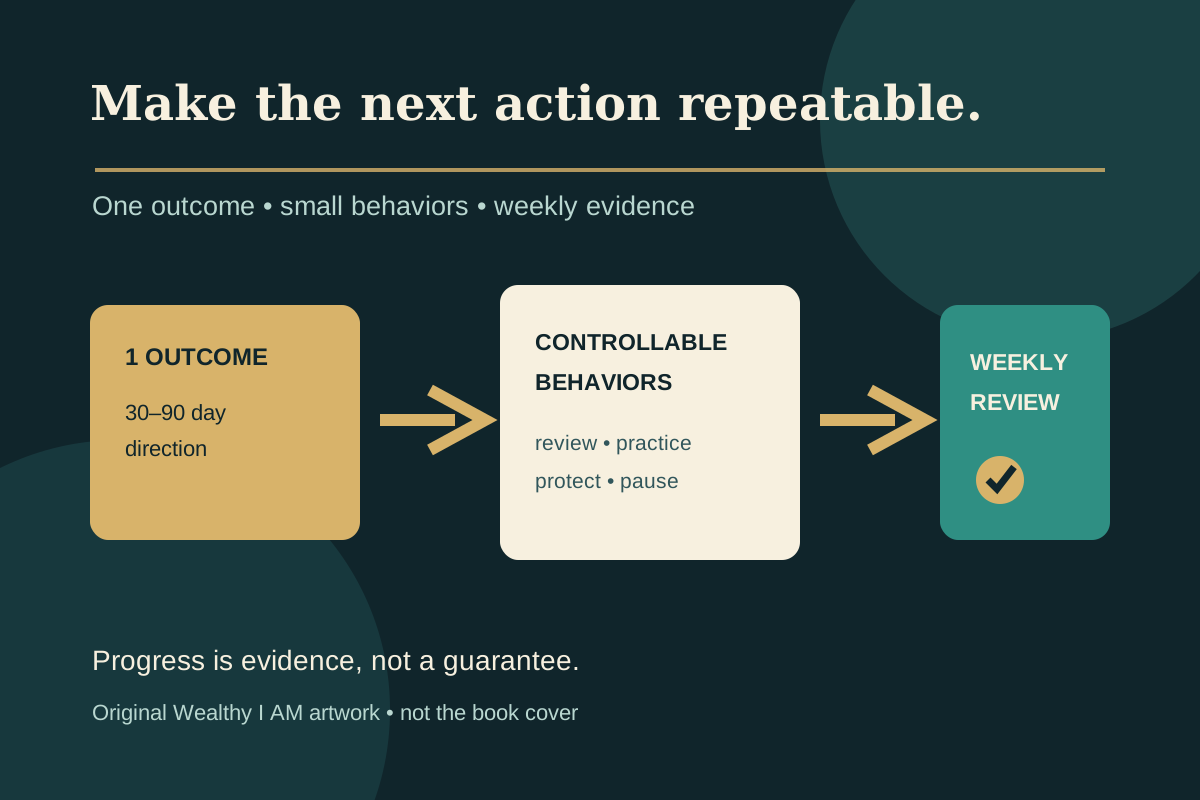
Money meetings work better when they are predictable and bounded. Choose a cadence that fits your life—perhaps monthly for household operations and less often for long-term goals. Begin with one fact that went well, review the dashboard, make one decision, and end by naming the next action.
Agree on ground rules: no surprise ambushes, insults, hidden accounts, or concealed purchases, and take a pause when either person is overwhelmed. If money conflict is severe, coercive, or unsafe, prioritize personal safety and appropriate support rather than forcing a joint meeting.
Try this: make the first meeting 25 minutes. Stop while there is still goodwill.
9. Review the system instead of judging the people
Income, health, family responsibilities, markets, and goals change. A missed target is information about the system, not proof that either partner is a failure. Ask what changed, which assumption was wrong, and what small adjustment is reversible.
For investments, review the plan against time horizon, diversification, costs, and risk capacity rather than reacting to one headline or recent result. Diversification spreads exposure across holdings; it does not prevent loss or guarantee a positive outcome.
Try this: keep a short review log with the date, decision, reason, and next review date. Record the process, not only the outcome.
A 30-minute Smart Couples money reset
Use this sequence as a starting point, not as a complete financial plan:
- Five minutes: each partner writes one priority and one money worry.
- Five minutes: list the three numbers you most need to see, such as monthly take-home income, essential outgoings, and available cash.
- Ten minutes: choose one action that is specific, affordable, and reversible where possible.
- Five minutes: name one uncertainty or risk that needs research or professional advice.
- Five minutes: schedule the next review and decide what evidence will show whether the action helped.
The result is intentionally small: one shared priority, one visible fact, one next action, and one open question. That is enough to begin without pretending that half an hour can solve every financial issue.
Mistakes to avoid
- Turning the meeting into surveillance: visibility should support shared decisions, not humiliation.
- Copying a rule without checking fit: a savings percentage, account type, or investment approach may not suit your situation.
- Confusing automation with a plan: automatic transfers still need review for affordability, fees, access, and changing goals.
- Using past performance as a promise: historical outcomes do not establish future returns.
- Ignoring unequal knowledge: explain terms plainly and give both partners time to ask questions.
- Forcing agreement on every value: aim for explicit trade-offs and a fair process, not identical preferences.
- Treating conflict as a spreadsheet problem: recurring fear, coercion, or unsafe control requires a different kind of support.
Who may benefit—and what this framework leaves out
The book may appeal to couples who want a shared vocabulary for discussing goals, spending, saving, investing, and protection. Readers looking for a practical starting point may also find the relationship-centered framing useful.
A household-coordination framework cannot settle every question about current tax rules, products, investment suitability, law, insurance, or access to professional advice. The available catalog information verifies the book’s identity and broad subjects, not every chapter-level claim. Treat the nine lessons here as an editorial application, and consult current primary or professional sources before making a regulated or high-stakes decision.
Frequently asked questions
Is Smart Couples Finish Rich only for married couples?
The process can be adapted by partners who share obligations or goals. Legal ownership, taxes, benefits, and estate matters vary by relationship and jurisdiction, so those questions may require individualized advice.
Should couples combine all their accounts?
There is no universal answer. Some households combine certain expenses while keeping other accounts separate. Decide based on transparency, access, legal context, protection, and the system you can operate fairly—not on a slogan.
What if one partner avoids money conversations?
Start with one bounded, non-accusatory question about a shared priority. Offer a short meeting and a clear stopping point. If avoidance is connected to coercion, deception, or serious conflict, seek appropriate professional or safety support rather than escalating pressure.
Does this framework say what to invest in?
No. It describes a process for discussing goals and decisions. Asset selection, account choice, tax treatment, and risk level require current information and may require individualized advice.
Sources and image provenance
- Open Library work record: Smart Couples Finish Rich — bibliographic identity, author link, subjects, first-publication record, and cover ID.
- Open Library author record: David Bach — author identity.
- Open Library Covers API image — exact-book cover used for identity and provenance. The publisher must confirm acceptable use and verify featured-media upload and attachment before publication.
A final next step
Do not try to redesign your entire financial life tonight. Ask your partner: “What is one money decision that would make our shared future feel a little clearer this month?” Write down the answer, schedule a 25-minute meeting, and bring one current number.
A durable plan is built through honest visibility, manageable actions, and repeated review—not through a perfect first conversation.