If your skills, offer, or business model works today but feels vulnerable to tomorrow’s changes, The Road to Reinvention offers a useful lens: do not wait for a crisis before questioning what has made you successful.
The available catalog record identifies Josh Linkner’s book with subjects including innovation diffusion, organizational change, new products, strategic planning, and business success. Its cover frames the promise as driving disruption and accelerating transformation. The seven lessons below are a Wealthy I AM synthesis of that documented theme—not a claim that they reproduce Linkner’s chapters or an exact numbered framework.
The practical takeaway is straightforward: preserve what is still valuable, challenge one assumption at a time, and run a small, reversible experiment before making a large career or business bet. Reinvention can create learning and options, but it cannot guarantee income, growth, or career security.
Why reinvention is a wealth issue
Your earning power depends partly on the value you can create and communicate in a particular context. That context changes. Customer needs shift, tools become cheaper, roles are redesigned, and processes that once created an advantage can become routine.
That does not mean you should abandon everything that works. Reinvention can be much smaller: combining an established strength with a new customer problem, updating how you deliver a service, or learning an adjacent skill. This approach is usually more useful than treating change as an all-or-nothing identity crisis.
Seven practical lessons from The Road to Reinvention
1. Question the assumption behind the old success
A strategy can work for years and still become less suitable when its original conditions change. The danger is not only failure. It is becoming more efficient at a model whose central assumption is no longer true.
Try this: complete one sentence: “Customers choose us because…,” “My employer rewards…,” or “This skill is valuable because….” Then write down the evidence that would support or challenge that belief. The goal is not to declare the assumption wrong; it is to make it testable.
2. Look for change before it becomes an emergency
A crisis narrows your choices. A calm review gives you room to investigate while your current income, customer relationships, and professional network are still available.
Early observation is not prediction. It is preparation for more than one possible future.
Try this: once a month, record three changes you have noticed in customer questions, tools, competitors, regulation, or workflow. Keep observations separate from interpretations. “Three clients asked for shorter projects” is an observation; “long projects are dead” is a conclusion that still needs evidence.
3. Preserve the useful core while changing the delivery
Reinvention is often described as starting over, but that can waste hard-earned advantages. A better question is: which capability, relationship, process, insight, or reputation can move into a new format?
A teacher might adapt an established lesson for a different audience. A service business might package a reliable process differently. These are hypothetical examples, but they illustrate the principle: change the delivery without discarding the value underneath it.
Try this: divide a page into “what already works” and “what may need to change.” Keep the first list as a constraint. Change only one element from the second list so that the result of the test is easier to interpret.
4. Run small experiments instead of defending large plans
A useful experiment has a question, a limit, an observation method, and a decision date. It is not a large commitment disguised as a test.
Small experiments can reduce the cost of being wrong, although they cannot remove uncertainty. Their purpose is to buy information before you commit more resources.
Try this: choose a test that does not endanger essential bills, safety, confidentiality, customer promises, or legal obligations. Record:
- the question you are testing;
- the maximum time and money at risk;
- the evidence you will collect;
- the date you will review the result; and
- the condition that would make you stop, revise, or continue.
Decide from the evidence, not from enthusiasm alone.
5. Treat creativity as a practical business input
Creativity in business does not have to mean artistic talent. It can be a clearer explanation, a simpler offer, a better process, or a combination of capabilities that were previously kept separate.
The first plausible idea is rarely the only option. Generating alternatives makes it easier to compare usefulness and downside rather than becoming attached to one solution.
Try this: write ten possible responses to one customer or work problem before choosing. Score each option for usefulness, feasibility, learning value, and downside. The score is a discussion tool, not an objective truth.
6. Build skills that can travel
A narrow tool can be valuable, but transferable capabilities may remain useful when a specific platform or role changes. Clear communication, customer discovery, analysis, project execution, and relationship management can support many kinds of work.
That does not mean everyone needs the same “future-proof” skill. The right combination depends on your field, goals, access, and current strengths.
Try this: choose one adjacent skill that strengthens something you already do well. Spend two weeks producing a small work sample, getting specific feedback, and recording what you still do not understand. A course, certificate, or project can demonstrate learning, but it does not guarantee a job or income result.
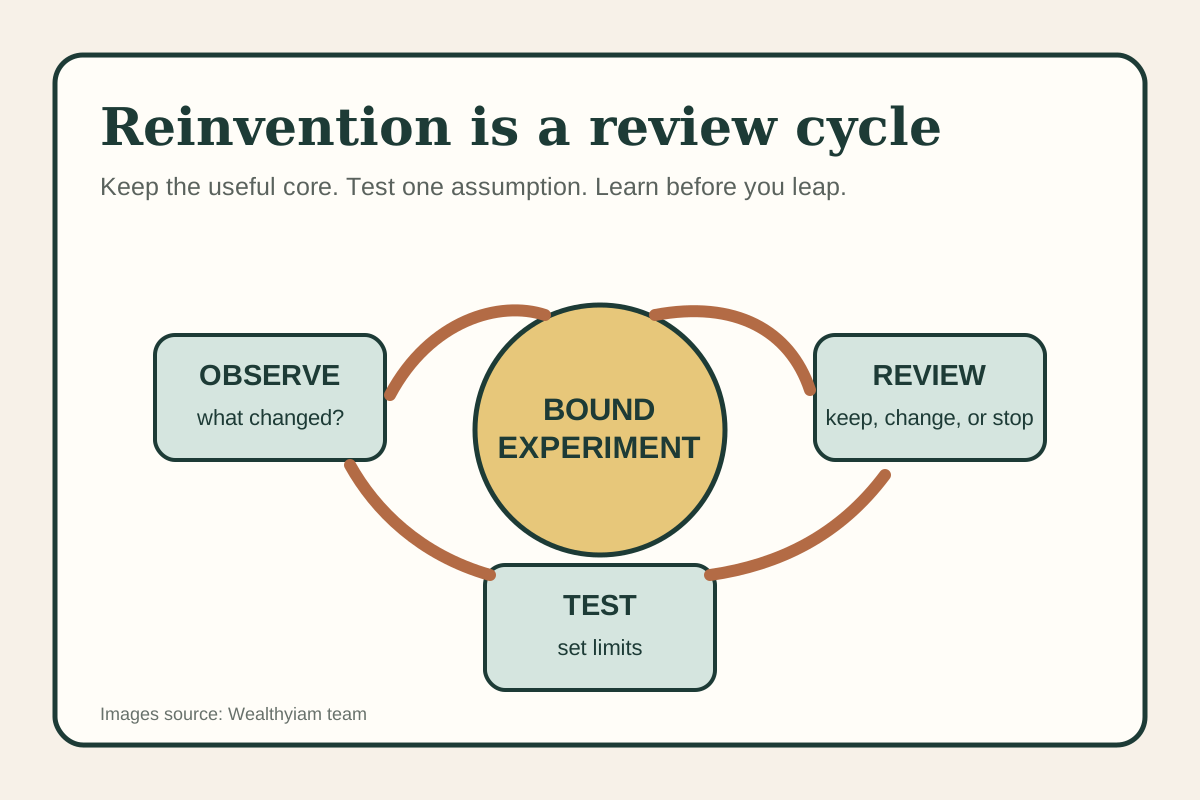
7. Make reinvention a review cycle
A one-time reinvention can harden into another fixed identity. A review cycle is more durable:
- observe what is changing;
- identify an assumption;
- choose a bounded test;
- collect evidence;
- decide what to keep, change, or stop; and
- schedule the next review.
Try this: keep a one-page reinvention log with the date, assumption, experiment, resources at risk, evidence, result, and next decision. Review it monthly. Preserve what works, and retire tests that consume resources without producing useful learning.
A 30-minute reinvention screen
Use this short process for one career, business, or earning-power question.
- Five minutes — name the pressure. What has changed, or what might change? Write observations separately from worries.
- Five minutes — identify the asset. Which skill, relationship, customer insight, process, or reputation could carry forward?
- Ten minutes — design a test. Choose one reversible experiment and set limits on time, money, and attention.
- Five minutes — define the learning. What will you measure or ask? What result would change your view?
- Five minutes — protect the downside. Confirm that the test does not compromise essential obligations, confidentiality, safety, or applicable rules.
The result should be modest: one assumption, one experiment, one evidence plan, and one review date. That is more actionable than a vague promise to “be more innovative.”
Mistakes to avoid
- Confusing novelty with value. A new idea still has to solve a real problem or improve a meaningful process.
- Risking essential resources. Do not bet housing, food, debt obligations, emergency needs, or core business commitments on an untested concept.
- Changing too many variables. If everything changes at once, you may not learn what helped or hurt.
- Treating anecdotes as evidence. One compelling success story does not establish typical odds or future results.
- Discarding the existing advantage. Starting over may waste trust, knowledge, and relationships that could support a better experiment.
- Calling a prediction a plan. A useful plan states assumptions, limits, evidence, and a review date.
- Failing to stop. Every bounded experiment needs a stopping rule so curiosity does not become uncontrolled spending.
Where this approach is useful—and where it is not
This reinvention lens may help professionals, founders, and teams who want a practical way to adapt before an old approach becomes untenable. It is strongest when paired with disciplined testing and honest review.
It is not a personalized investment strategy, labor-market forecast, or guaranteed business formula. A broad innovation theme cannot prove that a side business will work, that a skill will command a particular salary, or that adaptation will prevent financial hardship. High-stakes employment, contractual, tax, legal, or regulated decisions require current authoritative information and, where appropriate, qualified professional advice.
FAQs
What is The Road to Reinvention about?
The available catalog evidence places the book in the fields of innovation, organizational change, new products, strategic planning, and business success. Its cover emphasizes driving disruption and accelerating transformation. This article applies that broad theme without claiming to reproduce the book’s chapters or exact framework.
Does reinvention mean changing careers?
Not necessarily. It might involve a new delivery method, customer segment, workflow, product, or adjacent skill. Whether a career change is appropriate depends on your obligations, finances, health, local conditions, and tolerance for risk.
How can I test a business idea more cautiously?
Start with a narrow question and a bounded experiment. Set a maximum resource commitment, protect existing obligations, collect direct evidence, and choose a review date. Do not make a large irreversible commitment because of encouraging early signals alone.
Can reinvention guarantee more income?
No. It may create learning or options, but income also depends on demand, competition, execution, timing, and circumstances outside your control.
What is the best first step for a busy professional?
Write down one assumption behind an important part of your work. Then identify the smallest responsible experiment that could test it, and put the review date on your calendar.
Conclusion
The durable lesson in The Road to Reinvention is not that everyone must constantly become someone new. It is that relevance can be managed more deliberately when you question old assumptions, preserve useful strengths, and experiment within clear limits.
Start with one 30-minute screen. Protect the resources you cannot afford to lose. Then return to the evidence on the date you chose.